


The freedoms outlined in the First Amendment to the U.S. Constitution – speech, press, religion, assembly, and petition – are interconnected and foundational to democratic society, personal dignity, and social progress. They enable us to think, express, pray, and live according to our conscience and traditional values without government interference.
Indeed, freedom of religion protects individual conscience, which includes both the right to practice one’s faith or have no faith at all. The First Amendment prevents religious discrimination, protects the right of all people, regardless of their faith, by ensuring that the government cannot establish a religion or force citizens to conform to a particular set of beliefs. It also fosters a diverse and pluralistic society by allowing people to live, speak, and act according to their beliefs peacefully and publicly.
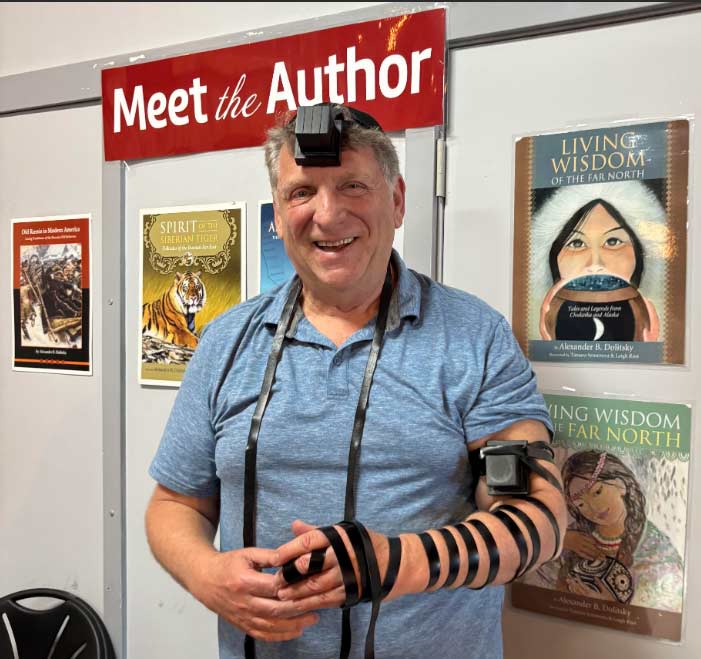
This summer, I have been signing my books at the Hearthside Books in the Merchant Wharf Mall in downtown Juneau – an engaging way to meet diverse tourists from all corners of the world. On one occasion, a relatively young orthodox-looking Jewish tourists from New York approached my table, purchased one title of my books, and after recognizing that I am a Russian-born Jew, offered to perform a blessing for me.
Certainly, one would not refuse such a sincere offer. Very quickly two young men displayed necessary items for blessing ceremony, secured two leather boxes (tefillins), one on my forehead – just above the hairline – and centered between the eyes (tefillah shel rosh), and the other box on the bicep of my non-dominant left arm (tefillah shel yad). The box on my arm was angled toward the heart, and the strap is wrapped nine times down the arm and around the hand. These Jewish prayers are called tefillin. The practice is meant to fulfill the Torah’s commandment to bind the words of God “upon your hand” and “between your eyes.”
Inside each box are scrolls of parchment inscribed by a scribe with four specific passages from the Torah, which express the core tenets of the Jewish faith. The placement of the tefillin on the arm and head symbolizes the devotion of a person’s intellect, emotions, and actions to serving God.
This practice is considered a mitzvah (commandment) for Jewish men starting at their Bar Mitzvah – a Jewish rite of passage for a boy at age 13. It marks his transition to religious adulthood, where he is held accountable for observing Jewish laws (mitzvot) and gains new responsibilities within the community.
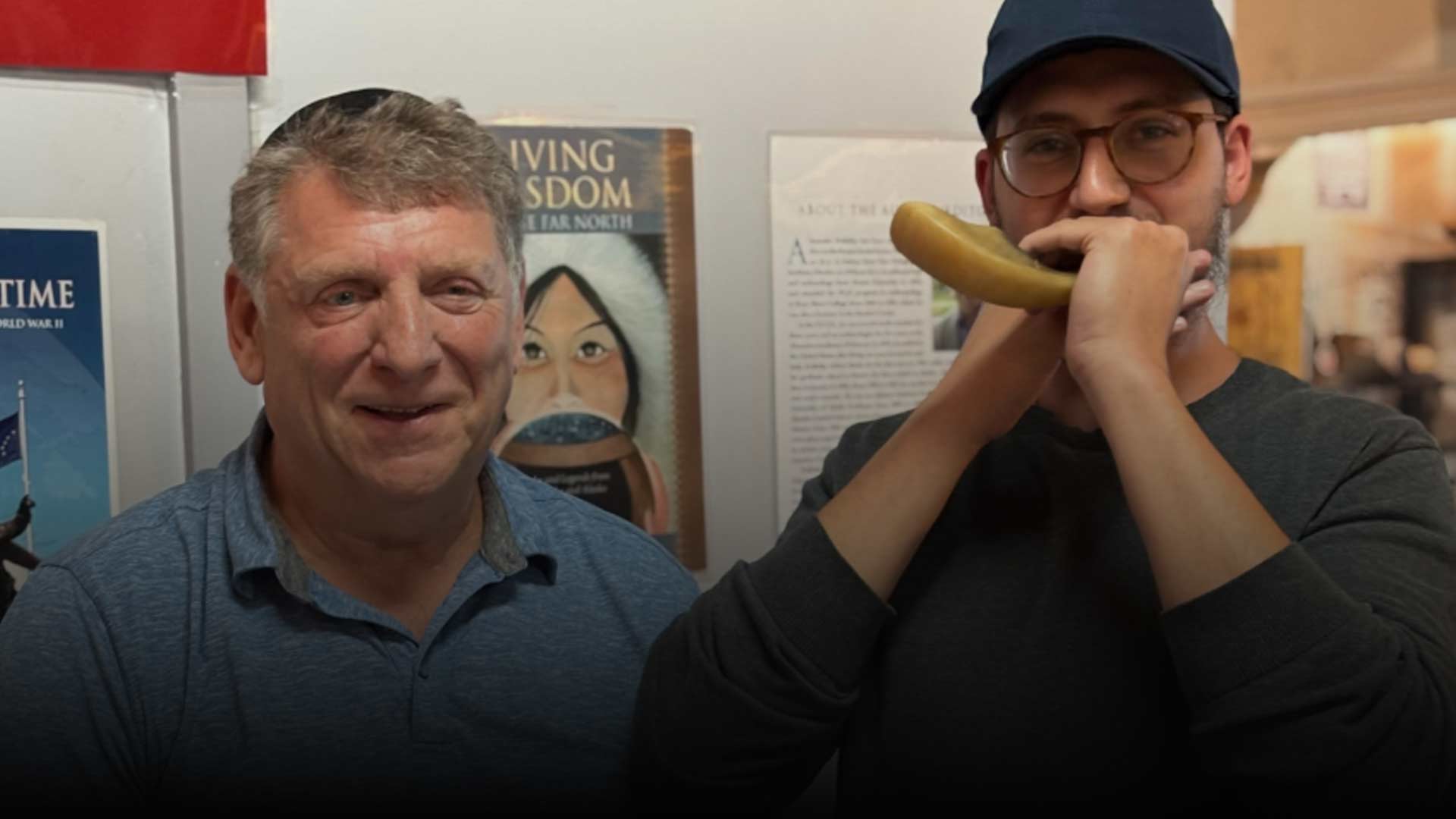
After I was wrapped in tefillin, a young man pulled from his pocket a small-size Torah, instructed me to repeat after him and recited the prayers from the Torah. After completion of the prayers, he blew shofar – a Jewish horn used in ceremonies – that echoed around the Merchants Wharf Mall.
In America, we do not whisper our prayers, and we do not hide our faith.
The shofar is an ancient, sacred instrument, typically made from a ram’s horn. Its sounds are considered a spiritual alarm clock, calling people to reflect, repent, and reawaken their connection to God and Jewish tradition. Throughout history, the shofar was used to announce significant events and signal the start of a jubilee year.
At the end of the ceremony, the young man asked me if I ever had this experience. I replied that in Juneau I organized a Bat Mitzvah for my daughter in the local synagogue when she was 12 years old, but I never was blessed until now. “Well, this was your Bar Mitzvah,” he acknowledged with a friendly smile.
This spontaneous public ceremony in Juneau, performed for my benefit by absolute strangers from New York, led me to remember Kiev, of the former Soviet Union. Being a Jew in the Soviet Union meant navigating systemic discrimination, state-sponsored anti-religious campaigns, and political persecution, particularly under the Stalin regime until the mid-1980s. Jews were labeled “outsiders” and faced quotas in education and various professions. While some assimilated Jews lived “normal” lives, religious observance and cultural expression were suppressed and often forbidden by the government.
The Soviet state exercised anti-religious policies, promoted atheism, leading to the closure of synagogues and banning of religious teachings. State-controlled media often engaged in anti-Semitic propaganda.
ALASKA WATCHMAN DIRECT TO YOUR INBOX
Upon my 13th birthday, unexpectedly, my dear aunt Lilya invited me to the restaurant to celebrate. In fact, it was my first visit to the restaurant.
In the Soviet Union, privileged individuals dined at a small number of high-end state-run restaurants. These restaurants, favored by the government officials and cultural celebrities, offered a level of cuisine and service unavailable or unaffordable to the public.
Then she gifted me a soccer ball for my birthday, leaned toward me and whispered: “Sasha, son, in a Jewish tradition, today on your 13th birthday, you become an adult.” Her voice was trembling, and tears appeared in the corner of her eyes. “Today is your Bar Mitzvah, a Jewish transition to religious adulthood. Remember this day,” she continued.
As I reminded my daughter during her Bat Mitzvah held in Juneau in 2004, “Elena, in America, we do not whisper our prayers, and we do not hide our faith. If we glow together as a nation, and believe in the wisdom of Judeo-Christian values and traditions, our nation will survive and prosper.”
The views expressed here are those of the author.






4 Comments
I’m with you, professor, one hundred percent!
There are many in this world who continually pray for the things they don’t want and it is called “worrying”.
More silly superstitions, dogma and ceremonies. I’ll stick with science and the Palestinians.
Ah… such a lovely Hebrew practice.