



One of the things the government shutdown has shown us is just how badly the government spends our tax dollars. Examples of SNAP and EBT fraud have been in the news, but as bad as these problems are, a less-understood issue is much more important.
The government distorts the marketplace when it tries to help people, thereby making goods and services more expensive for every American. College tuition assistance is a great example and will be used to demonstrate how this works, but you can apply the same lessons to every aspect of government assistance.
Many young people desire to attend college but are unable to do so using their own resources. Fortunately for them, there are government loan and grant programs. Proponents say taxpayer-funded loans are needed to educate the next generation of professionals the country will need. Is this really true?
College kids can attend college using these programs, but education costs in inflation-adjusted dollars are actually more expensive now than before student loan programs were introduced. Here is a chart to illustrate that point.
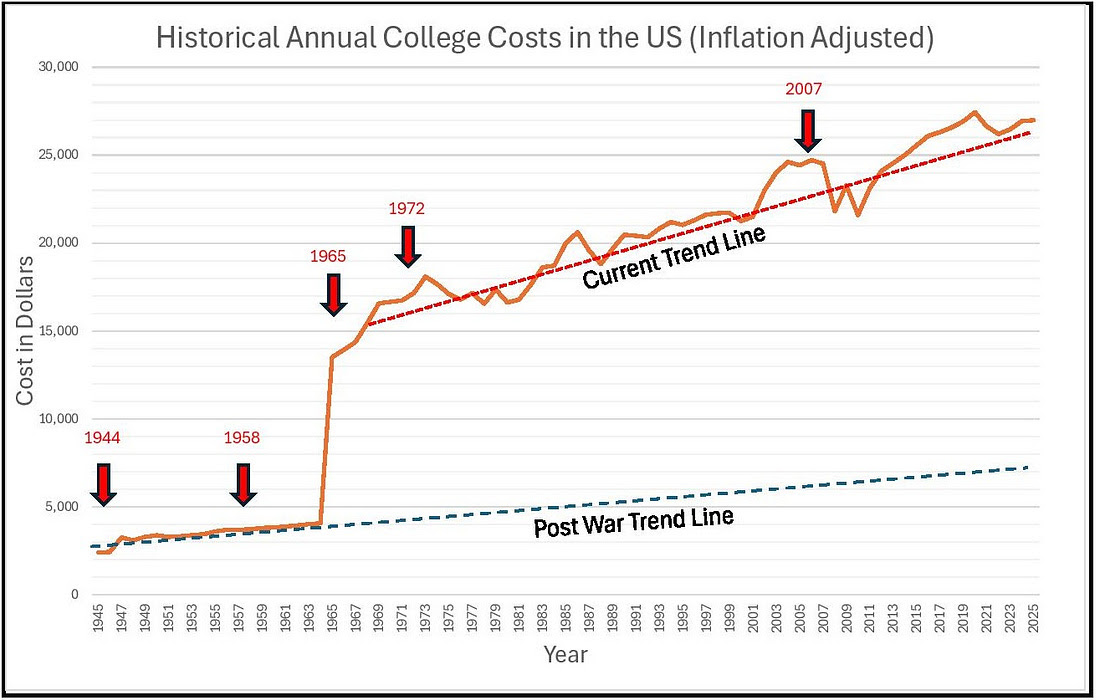
The above chart shows the annual cost of college for each year since 1945. The dollar amounts have been adjusted for inflation to 2025 dollars. The red arrows show the introduction of college assistance programs. You can see that before 1965, college costs were low and growing slowly. After 1965, there was a dramatic increase in both the cost of college and the rate at which it was growing. Those government programs are summarized as follows.
— 1944 – GI Bill of Rights: A grant program introduced to provide four years of college or vocational education, providing tuition, fees, books, and a stipend to GI’s returning from the war.
— 1958 – National Defense Student Loan Program: A loan program introduced during the Cold War to ensure a skilled workforce for national defense needs. Students had to pursue a degree in math, science, engineering, foreign languages, or education and the loan had to be repaid.
— 1965 – Federal Guaranteed Student Loan Program: A loan program that expanded the 1958 NDSLP, making it available for every degree and every student.
— 1972 – Pell Grants: Grants provided to low-income students that do not need to be paid back. The current amount in 2025 is $7,395 per year.
— 2007 – Teacher Education Assistance for College and Higher Education: Grants for college students who promise to work as teachers in low-income schools after graduation.
You can see from the chart that the big shift in college costs came in 1965 when student loans were made available to everybody. Instead of making college more affordable, the cost to attend college grew dramatically. In 1987, then Education Secretary William Bennet even coined a term for this effect. He said that increases in federal financial aid enabled colleges to raise tuition because the federal loan subsidies would cushion the increase. This was such an accurate prediction that it is now known in the education industry as the “Bennet Hypothesis.”
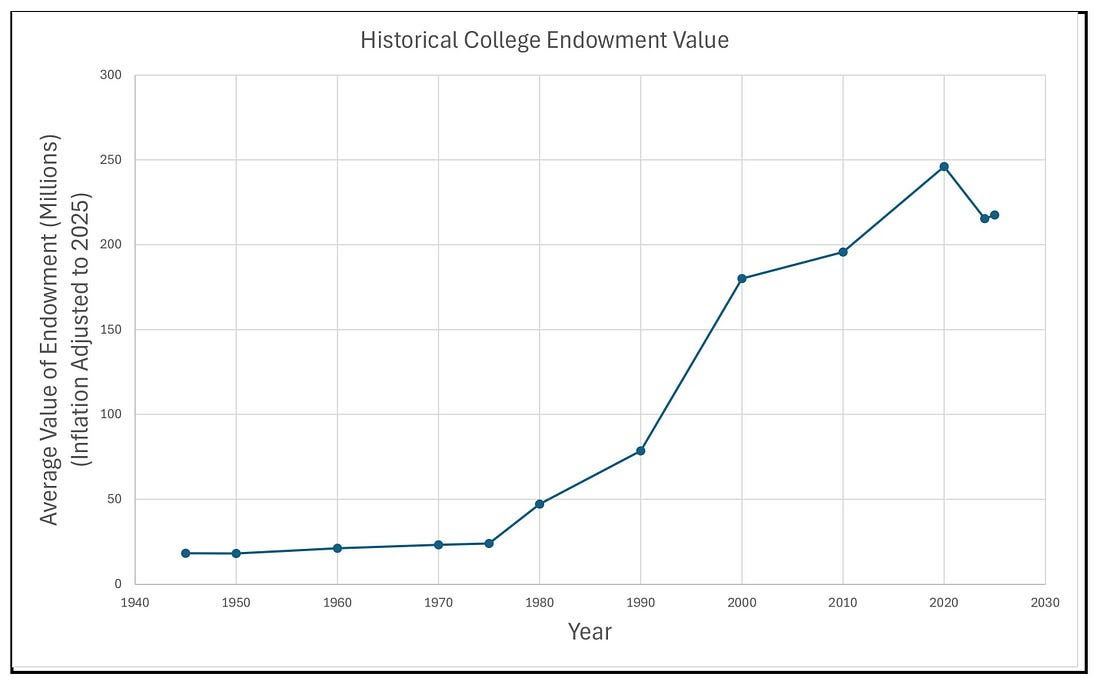
So, if it isn’t college kids who benefit from the federal student loan programs, who does benefit? Colleges do. Chart 2 shows the average value of college endowments, which are like investment portfolios owned by colleges containing stocks and bonds. You can see how the size of endowments has tracked the increasing costs of college enabled by the different student loan programs. It is no coincidence that just after the 1965 Federal Guaranteed Student Loan program was created, college endowments grew dramatically. Federal loans haven’t made college more affordable for college kids; they have just enriched the teaching institutions.
Does this mean we should no longer help people go to college? Of course not, but the government should provide assistance more wisely. The 1958 National Defense Student Loan program was open to everyone, but it didn’t distort the marketplace because loans were directed to important fields of study that were needed by our country, and where people were able to readily find jobs. Perhaps the government is doing kids a disservice when it funds a four-year gender studies degree for someone who will leave college with $200,000 in student loan debt and be destined to work as a barista. Maybe we need to get back to something similar to what was done in 1958 and only provide targeted assistance to degrees in fields really needed.
The lesson from this example is that when the government gets involved in paying for things, it distorts the marketplace, driving up the costs for everyone and hurting the very people it intended to help. These same conclusions can be drawn for any government assistance program, including SNAP, Medicaid, and the healthcare subsidies that have been discussed in the most recent government shutdown.
Our government should stop trying to “help” us so much. Maybe they should let us keep more of our own money and spend it how we see fit. That might work out better for everyone.
The views expressed here are those of Greg Sarber. Read more Sarber posts at his Seward’s Folly substack.





1 Comment
Do you see this being the same case for government funded homeschooling such as ESA’s or correspondence? Since You can homeschool in Alaska without these programs what is the benefit long term in the marketplace?