



Alaska’s Education Funding Task Force hasn’t even finished its coffee, and the outcome is already written. When every seat at the table is filled by state legislators bankrolled by the same education unions whose interests they’re supposed to scrutinize, “task force” becomes another word for pre-approved spending. You don’t need a political science degree to see where this train is heading – just follow the money.
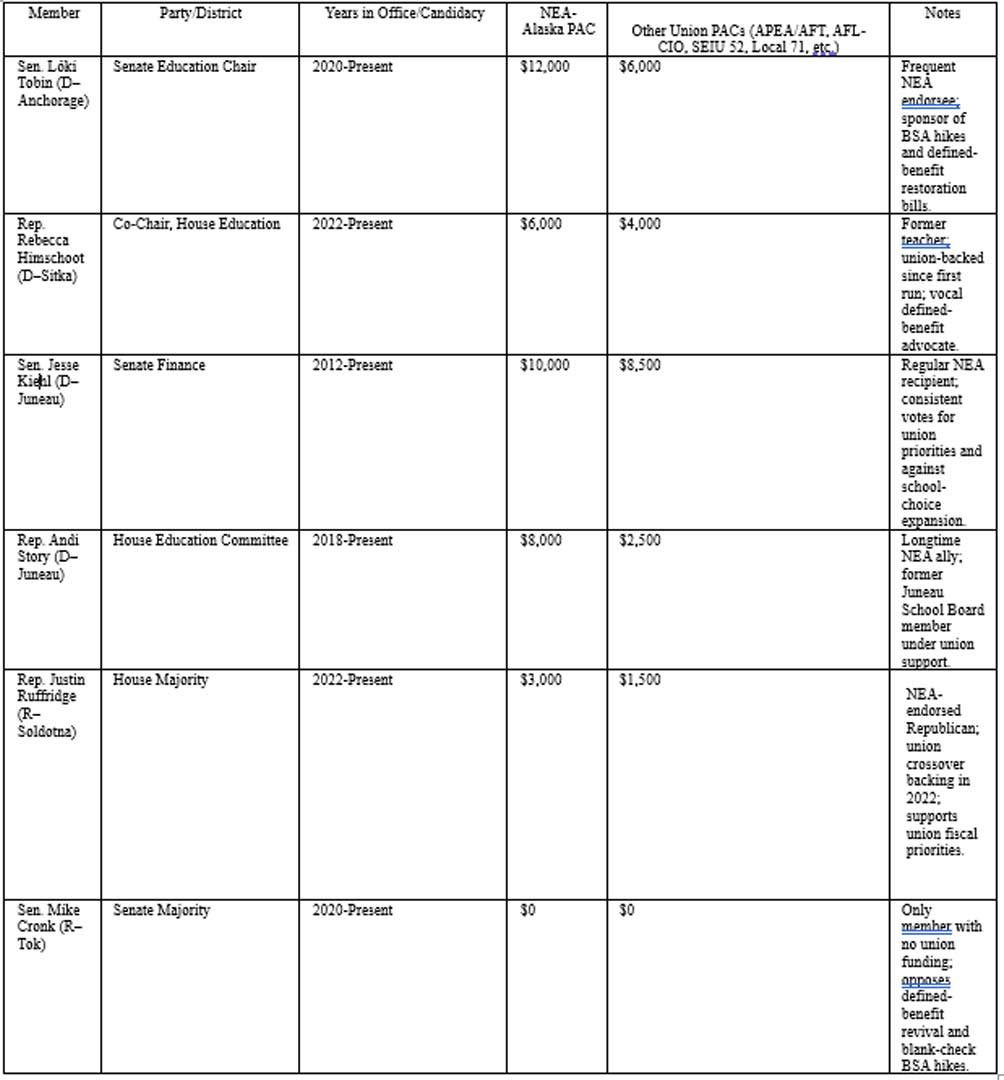
Five of the six voting members share the same benefactor: the National Education Association (NEA) and its Alaska affiliate. Sen. Löki Tobin, Rep. Rebecca Himschoot, Sen. Jesse Kiehl, and Rep. Andi Story have all been endorsed or financially supported by those unions. Even “moderate” Republican Rep. Justin Ruffridge – the bipartisan face of the group – accepted NEA-Alaska PAC support in his 2022 campaign.
That leaves Sen. Mike Cronk as the lone member not tied to education-union funding. He now sits surrounded by colleagues whose political fortunes depend on keeping those organizations happy. The people who profit from increased education spending are designing the system that determines how much spending there will be. Every incentive in the room points toward one conclusion.
Alaska’s students need adults who will demand outcomes. Instead, they’ve been handed a panel designed to preserve the status quo.
The NEA’s goals are not a mystery. It wants Alaska to restore a defined-benefit pension system – precisely the structure many states curtailed after it pushed them toward insolvency. It also wants a large, permanent Base Student Allocation (BSA) increase without performance conditions. The same politicians who received the campaign help are the ones championing both ideas under the halo of “evidence-based.” The alignment isn’t accidental; it’s baked in.
No one should expect this task force to seriously interrogate outcomes or efficiency. Members will talk about accountability, but they won’t vote against the funding structure that keeps their campaigns viable. People rarely challenge the hand that signs their checks. In this case, the union doesn’t have to buy votes – it already owns the assumptions.
The Legislature had alternatives. It could have seated classroom teachers, parents, or outcome-driven policy voices who don’t owe their careers to union endorsements. Instead, it stacked the panel with politicians whose donor lists mirror the lobby roster. That composition guarantees recommendations that track the familiar priorities: larger BSA, revived pensions, and continued insulation from performance scrutiny.
The choreography is predictable. Hearings feature “experts” already aligned with union interests. A report will declare a funding emergency. Lawmakers will cite the report to justify BSA hikes and long-term pension liabilities. Behind the scenes, union officials will celebrate. Nothing in that sequence depends on better reading, math, writing, or history outcomes for Alaska’s kids. It depends on narrative control.
ALASKA WATCHMAN DIRECT TO YOUR INBOX
Campaign finance records tell the story plainly. NEA-Alaska and allied labor PACs have steered support into targeted legislative races for years, concentrating on members poised to influence education policy. None of this is illegal. All of it is disqualifying when the same recipients are then presented as neutral arbiters of the unions’ wish list. That is a textbook conflict of interest even if state law declines to say the quiet part out loud.
The result will match the membership. Expect recommendations for a steep BSA increase, a push for defined-benefit restoration, and amplified “weights” for programs that will not be audited for hard gains. Expect the press release to call it “bipartisan consensus” and “student-centered.” What you’re reading is not consensus; it’s confirmation.
Trust is earned by independence. If Alaska wants credibility, it needs task forces that are not pre-aligned with the beneficiaries of their own recommendations. Put parents at the table who are focused on mastery of reading, writing, math, and history. Put reformers and economists at the table who can separate wants from needs and insist on proof per dollar. Publish every member’s major donors as a standing footer on all task-force materials. And require at least one seat for a member with genuine classroom experience who is not financially entangled with the education bureaucracy.
Alaska’s students need adults who will demand outcomes. Instead, they’ve been handed a panel designed to preserve the status quo. Meetings are being held, statements drafted, and a report will be issued. But the punchline landed the day invitations went out. Alaska’s kids need reformers. They got fundraisers.
References
— Alaska Public Offices Commission. (2012–2024). Campaign finance disclosures & political contribution data.
— NEA-Alaska. (2016–2024). Educators’ Choice endorsements & public statements.
— TFEF. (2025). APA Consulting Presentation on Alaska School Funding.
— TFEF. (2023). Alaska Economic Trends Education Report.
The views expressed here are those of the author.






5 Comments
Mr. Cooper, you get an A+ on this excellent framing of the Education Funding Task Force and its members. Thanks for your dedication and research in connecting the dots from these task force members to their teacher union funding. KUDOS!
Thank you Mr. Boyle, it is greatly appreciated.
Justin Ruffridge turned out to be one major disappointment for the peninsula. Amazing how a wolf in lamb clothing can fool you once.
Steve
I want to change that fact as a candidate for House District 7 in the upcoming election, thanks for your comment!
Please, Please take your kids out of these public schools. Your kids will thank you later.