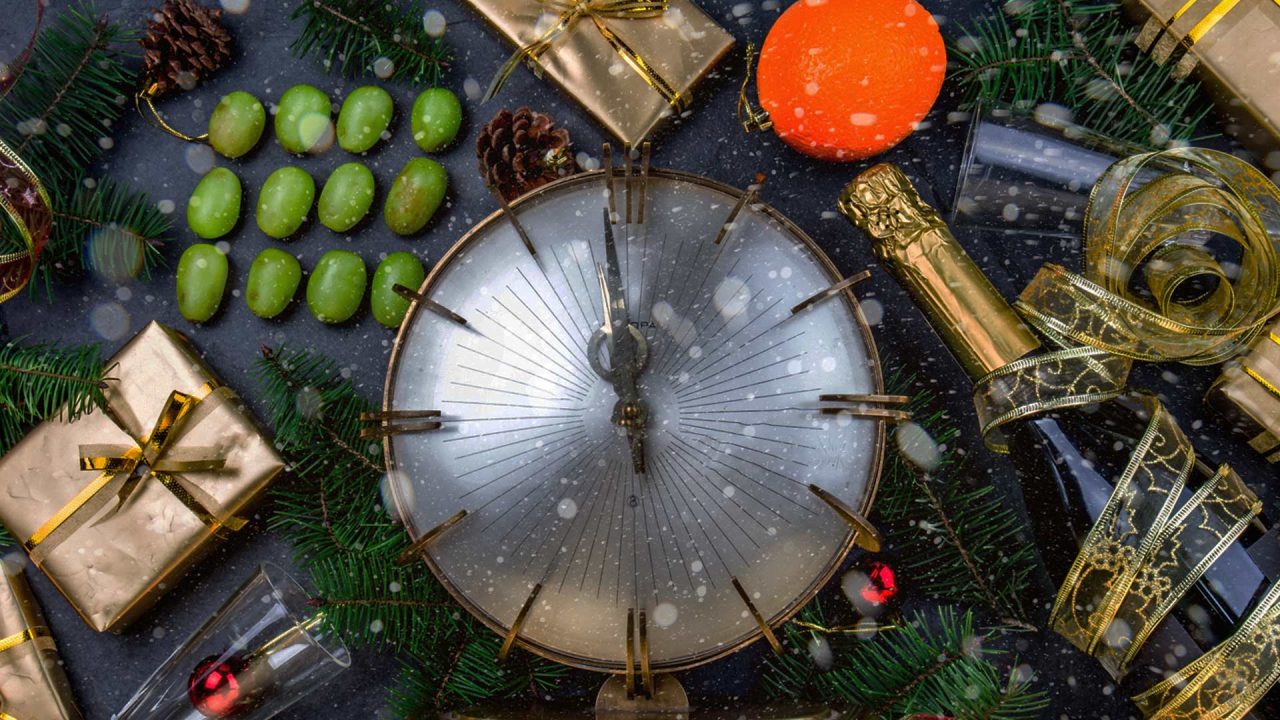


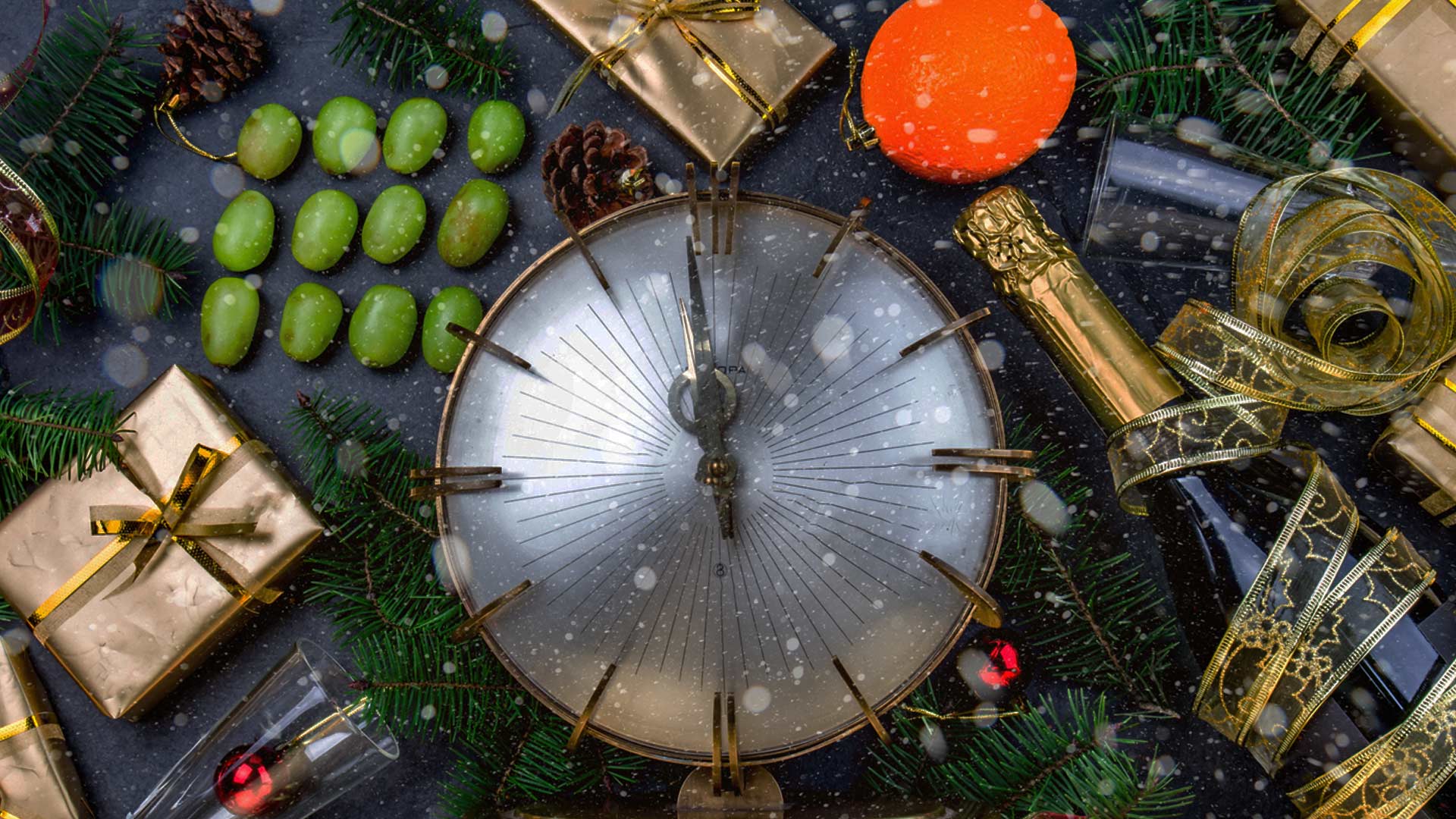
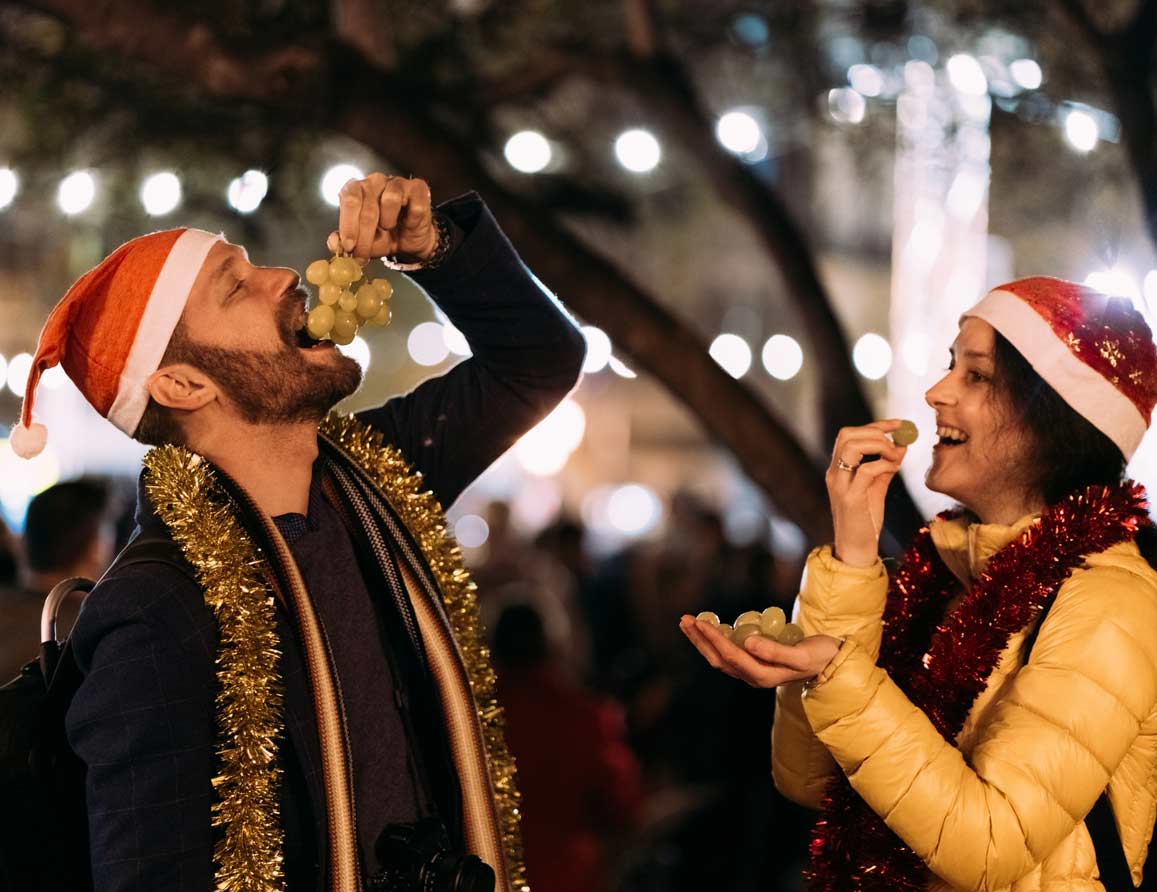
Worldwide, New Year’s Eve traditions often focus on luck, prosperity, fortune and new beginnings – featuring lucky foods like Spain’s Las Doce Uvas de la Suerte (The Twelve Grapes of Luck tradition consists of eating a grape with each of the 12 strikes of the clock bell at midnight on Dec. 31 to welcome the New Year. Each grape and clock strike represents each of the coming 12 months); the Southern U.S. tradition of eating black-eyed peas; noisemaking to scare spirits (Ireland’s pots, Ecuador’s effigies); symbolic actions like Scotland’s “first footing”; Brazil’s wave jumping, wearing specific colors (red underwear in Italy, white in Brazil); and cultural rituals like Japan’s 108 temple bells for purification. Indeed, these traditions are deeply rooted in bringing fortune and a fresh start in the coming year.
Historically, across Slavic countries, New Year’s celebrations are characterized by lively festivities, large family and friends’ gatherings, elaborate and delicious feasts, fireworks, and shared superstitions focused on ensuring good fortune for the coming year. While specific folk traditions vary by region, several core similarities exist.
Slavic countries are nations in Eastern, Central, and Southeastern Europe with Slavic majorities. Linguistically and demographically, Slavic countries are grouped into East (Russia, Ukraine, Belarus), West (Poland, Czechia, Slovakia), and South (Slovenia, Croatia, Serbia, Bosnia & Herzegovina, Montenegro, North Macedonia, Bulgaria). These nations share common linguistic roots and cultural heritage, though they vary in history, cultural values, religion (Orthodox in the East/South and Catholic in the West), and political development.
Key Similarities in Slavic New Year Celebrations
A widely shared belief is that the way one spends New Year’s Eve will set the tone for the entire year. This leads to common practices briefly described below.
House Cleaning and Settling Debts: Many people clean their homes, resolve disputes and pay off debts before Dec. 31 to start the year fresh and avoid bad luck or financial instability.
Festive Gatherings and Feasting: The New Year is primarily a social and family-oriented holiday, often considered more important than Christmas in some Slavic countries, like Russia and Ukraine, due to historical Soviet-era secularization.
Abundant Food: A rich, abundant table is a mandatory attribute, believed to ensure prosperity. Traditional dishes, while different across Slavic countries, are prepared in large quantities. For example, Olivier salad (mayonnaise-based salad with diced boiled potatoes, carrots, eggs, pickles, and peas, ham or bologna) in Russia and Ukraine; boiled pork head in Czechia and Slovakia; and faworki pastries in Poland (also known as angel wings—light, crispy, deep-fried, and dusted with powdered sugar).
Champagne and Toasts: Toasts with champagne or local sparkling wine are a universal tradition at midnight.
Fireworks: Setting off fireworks is popular in both public squares and private homes across Poland, Russia, and Czechia.
Making Wishes: A common ritual involves writing a wish on a piece of paper, burning it, and drinking the ashes in a glass of champagne before the clock finishes chiming for the wish to come true.
Symbolic Decor and Figures: The New Year tree is a central decoration across many Slavic homes, decorated with lights and ornaments, symbolizing the season’s cheer.
Folk Traditions: In some South and East Slavic countries (Bulgaria, Serbia, Ukraine), pre-Orthodox folk traditions like costumed caroling, dancing, and house-to-house performances persist, aimed at bringing luck and playfully teasing neighbors.
“Old New Year” Celebration: Countries with a strong Orthodox Christian influence often celebrate the New Year twice: once on January 1 (Gregorian calendar: the standard civil calendar used worldwide today, replacing the inaccurate Julian calendar by adjusting leap years) and again on January 14 (Julian calendar), providing an extended festive season or a reason to celebrate pre-Orthodox tradition.
New Year Celebration in Russia
In Russia, New Year is the most notable winter holiday—surpassing even Christmas in significance due to Soviet-era (1917 to 1991) suppression of religion – becoming a secular, family-focused event filled with feasting, gifts from Ded Moroz (Grandfather Frost), and festive traditions, symbolizing hope, renewal, and uniting generations with joyous celebrations and toasts for the year ahead.
This holiday was promoted by the Soviet Union as a secular holiday that would supplant Christmas, which (along with other religious holidays) had been abolished due to the Communist Party’s policy of state atheism. In the former Soviet Union, religion was tolerated but not encouraged.
Gifts from Ded Moroz and Snegurochka
Children receive gifts from Ded Moroz (Father Frost) and his granddaughter Snegurochka (the Snow Maiden) on New Year’s Eve. These two figures are central to New Year’s celebrations, just like Santa Claus and his Elf for children in the West.
ALASKA WATCHMAN DIRECT TO YOUR INBOX
Dressing up
Children often dress up in costumes, such as hares, foxes, bears or Little Red Riding Hoods (the classic European fairy tale). Some children also make up their own costumes of a favorite literary character.
New Year Tree of Wishes
In recent years, Russian political leaders, including President Vladimir Putin, have participated in the New Year Tree of Wishes campaign, granting the wishes of children. The New Year Tree of Wishes (Yolka Zhelaniy) is a Russian charitable campaign where adults fulfill New Year’s dreams of children by picking their written wishes from a special tree.
Schools and preschools hold New Year’s celebrations for children starting from around the age of three. Traditionally, children receive sweets and toys from Ded Moroz (Father Frost) and his granddaughter Snegurochka (The Snow Maiden).
Fifteen minutes before midnight, all TV channels show the President’s speech. You must watch it if you do not want to miss the chimes, whether you like it or not. When the chimes of the Kremlin’s Spasskaya Tower signal the start of the New Year, Russians make a toast to the good year to come and drink champaign bottoms up. Families and friends exchange gifts, a tradition like Western Christmas.
Preparations for New Year’s Eve
On December 31st, Russian homes resemble the homes in America on December 24th. People decorate their condos (most people in Russia live in condos/apartments) in red, white, gold and green. Central to the celebration is the New Year tree (Novogodnaya Yolka), which looks exactly like the Christmas tree. However, there are no stockings in Russia; all the presents need to be put under the New Year tree.
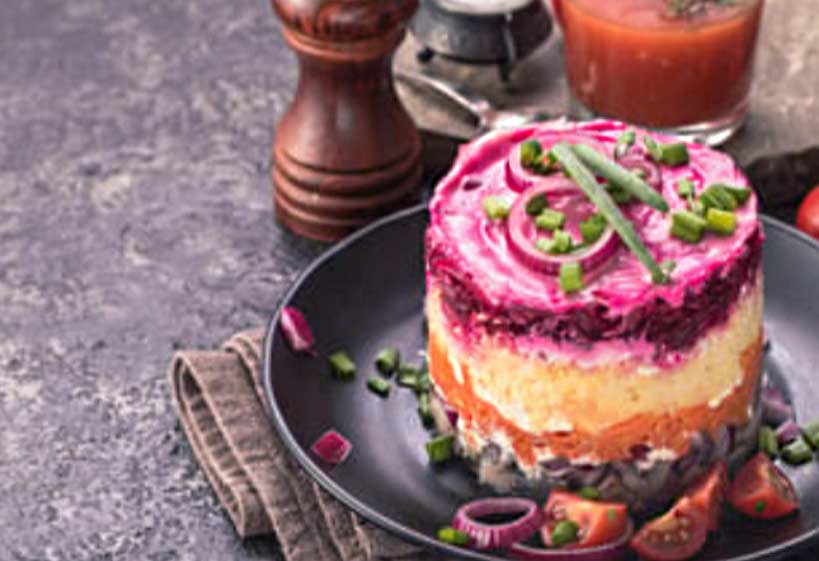
What’s on the Table: The Russian Salad (Olivier salad) & Beyond
The New Year’s meal plays a crucial role in the festivities, highlighted by iconic dishes of Olivier salad, Selyodka pod shuboy and ikra (caviar).
The Olivier salad, also known globally as the Russian salad, is a combination of diced potatoes, carrots, peas, eggs, mayonnaise, and usually ham, chicken, or beef, making it a central dish.
Selyodka pod shuboy (herring under a fur coat) includes layers of herring, potatoes, beets, and carrots, topped with mayonnaise.
Ikra (caviar, salt-cured fish eggs) served on buttered bread. Although caviar is a rare and expensive delicacy on the Russian table, people make sure to have it on New Year’s Eve, as it represents the hope for a year filled with prosperity and good fortune.
Happy, prosperous and peaceful New 2026 Year to all.
The views expressed here are those of the author.