

Alaskans are not afraid of technology. We use it every day, but we are rightly cautious when government power is quietly delegated to artificial intelligence.
That’s why a procurement issued last fall by the State of Alaska deserves public attention – not because it mentions artificial intelligence, but because of what it authorizes AI to do.
WHAT IS ALASKA PROPOSING?
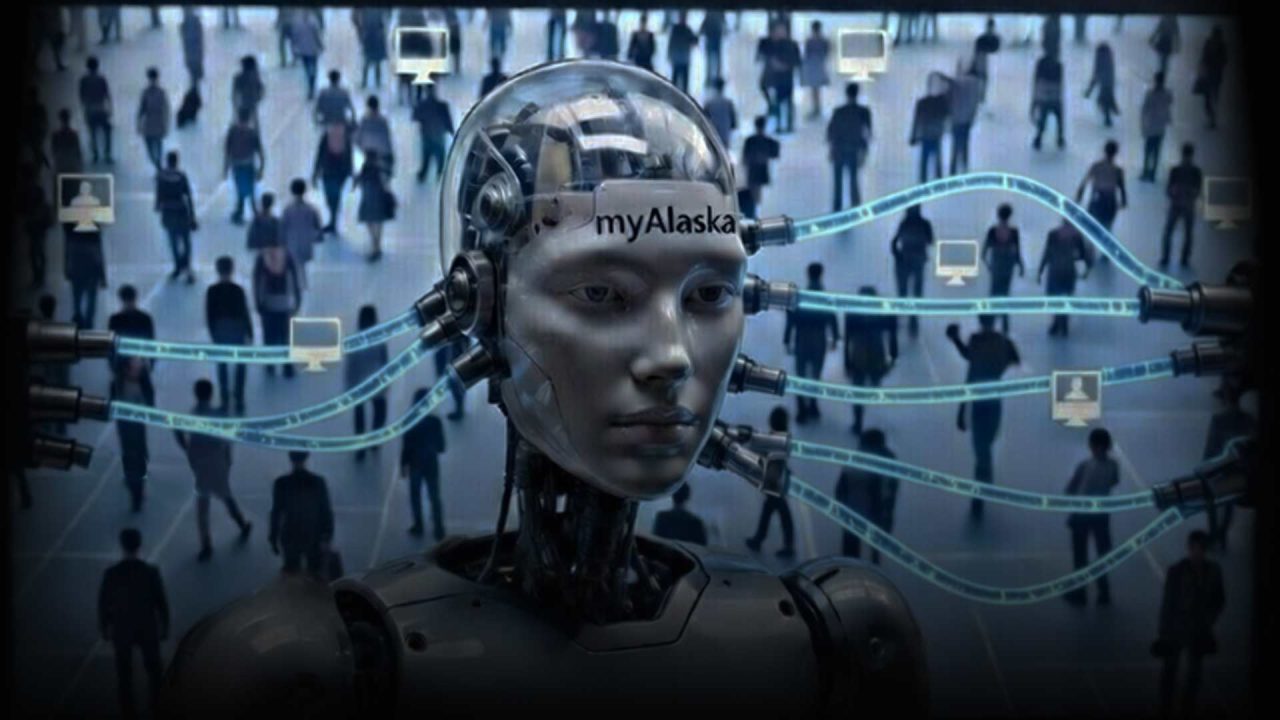
The state wants to embed “agentic artificial intelligence” into the myAlaska app – not just to answer questions, but to act on behalf of users.
To be clear, the myAlaska app is the official mobile companion to the State of Alaska’s myAlaska platform, which serves as a secure single sign-on and electronic signature system for citizens. It allows Alaskans to access and manage a variety of state government services through one unified account, using a single username and password. Launched in 2025, the app lets users access myriad state services such as PFD applications, DMV records, retirement benefits, public assistance, vaccine records, job applications, various state permits and much more. It essentially serves as a one-stop digital portal for government interactions with the public.
Rather than have humans deal with Alaskans’ questions and problems, the state wants a company to create a system that can:
— Autonomously complete multi-step government transactions
— Interact directly with legacy state systems
— Conduct eligibility checks
— Retrieve and exchange documents across agencies
— Learn from user behavior
— Proactively recommend services
— Use voice and biometric inputs
— Store digital credentials
In plain English, the AI would be acting on behalf of the state, not just serving the public. That is a fundamental shift in how government power is exercised.
EFFICIENCY IS NOT AUTHORITY
No Alaskan voted to replace human judgment with automated judgment, and no statute authorizes an algorithm to:
— Decide eligibility for benefits or services
— Trigger downstream legal or financial consequences
— Function as a government agent
A computer cannot swear an oath, be cross-examined or weigh fairness or context. And it cannot be held personally accountable, yet this system is being designed to act proactively on behalf of state government.
DUE PROCESS DOESN’T DISAPPEAR IN AN APP
Under both the U.S. Constitution and the Alaska Constitution, citizens are guaranteed:
— Notice
— A human decision-maker
— An opportunity to be heard
If an AI system flags an application, denies eligibility, or delays access, who made that decision – and how does an Alaskan appeal it?
Consent buried in a phone screen is not due process. Automation does not override constitutional protections.
ALASKA’S PRIVACY RIGHTS ARE STRONGER – AND EASIER TO VIOLATE
Alaska’s Constitution explicitly protects the right to privacy. That matters when a single government app aggregates data across multiple agencies, learns from personal behavior, uses voice and biometric inputs and makes proactive recommendations.
Even well-intended systems can become digital general warrants if they are not strictly limited by law. Once built, such systems are difficult to control.
It’s also reasonable to ask about how this proposal impacts due process guarantees, mandatory human review, clear appeal rights, legislative authorization, limits on automated discretion, transparency and public oversight.
COMMON SENSE BOTTOM LINE
Alaskans want government services to work and we welcome modernization. But efficiency does not excuse the constitution. Before Alaska automates government action, the state must answer one simple question: Who holds the power – and how do Alaskans hold them accountable?
Once government authority is automated, getting it back will be much harder than clicking “I agree.”
The views expressed here are those of the author.





8 Comments
Thank you Mr. Martin for this information. We are NOT interested in this trend to using AI in ANY area. We do not need this technology. This iaa waste of state taxpayer money. We are completely opposed to this move in technology!!!!
absurd
There was a syfy movie out years ago about this sort of thing.. Terminator come to mind..?
Also, the Matrix and Will Smith’s I, Robot!
Good article and one of serious meanings for the destructive work of AI. Do not want it in personal, medical, private or government records at any time. I checked on it and also had it downloaded to my computer without my consent from the internet and went to google to ask how to take the junk off my computer. The best and right thing to do is file a class action lawsuit against the use of that sick program. Bog Tech is not your friend or mine. Have the information AI puts out is missing and convoluted. NO to the scheming to put it in every faze of our lives. Makes me scared to see the wrong thinking resorting to use it in defense and programs needed on airplanes, and ships. Scary!!
Never mind Alaska.gov control, don’t give AI control over the Alaska National Guard, Alaska Defense Force and heaven forbid – the War Department. Too late, they got autonomous drones for use by the military.
The Army has been clear on the need for autonomous, payload-agnostic platforms that are ready now,” said Pat Williams, Chief Programs Officer at Oshkosh Defense. “The Oshkosh Family of Multi-Mission Autonomous Vehicles are engineered on proven tactical vehicles, with scalable autonomy and payload versatility to deliver what the Army needs today with the flexibility to adapt as the battlefield evolves.”
Next step – Skynet, anyone? It could never happen….. right?
Too late, Lockheed Martin has now unveiled its robotic Lamprey Multi-Mission Autonomous Undersea Vehicle (MMAUV), which can hitch a ride on friendly ships and submarines, charge its batteries like a parasite, and arrive at the theatre ready for operations. The highly modular design of the MMAUV allows it to attach itself to the hulls of ships or submarines without requiring a design change to the host vehicle, charge its batteries using its built-in hydrogenerators, and arrive at its destination fully charged.
The uncrewed undersea drone can also be configured to launch aerial drones, torpedoes, and decoys, and conduct surveillance, reconnaissance, intelligence, patrolling, and offensive missions. The drone can also loiter stealthily on the seafloor, waiting patiently for its target.
Other companies are already using Artificial Intelligence: VRBO, Priceline, Experian etc. the problem with AI is that it can only answer general questions. If you have a situation like you gave a wrong email address (AI can’t fix it), or if you want to make an annual payment, not a monthly payment (AI can’t fix it), if you can’t get into your VRBO rental because there’s NO keys and you want a refund because you can’t access the VRBO you paid for (AI can’t fix it)! Artificial intelligence for state services is bad news!! There will be a lot of people not receiving their PFDs because if there’s an issue AI won’t be able to fix it.
Please research Bio-digital convergence.