



Alaska’s path to lean, sustainable governance is not only about cutting costs – it’s about reimagining the role of public personnel in an economy grounded in resource development and private enterprises. With thousands of state jobs tied to duplicative bureaucracy, inefficiencies, and dependency on federal dollars, the state faces a crucial challenge: how to transition this workforce without layoffs, lost income, or disruption to Alaskan families.
This section presents a strategic, fully federally funded framework for transitioning public sector employees into private-sector roles – particularly in natural resource development, infrastructure, environmental compliance, and logistics – all while shrinking government, preserving earnings, and accelerating economic independence.
STRATEGIC OBJECTIVES
— Reduce the size and cost of government by phasing out redundant administrative roles.
— Protect state employees through transitional compensation, training, and placement support.
— Grow Alaska’s private economy by redirecting talent into mining, energy, infrastructure, and tribal co-management roles.
— Use federal funds exclusively to cover all costs of transition without state financial exposure.
— Enable long-term self-sufficiency by replacing public jobs with sustainable, productive private-sector careers.
FEDERAL FUNDING & LEGAL FOUNDATION

Legal Compliance
— All funding streams are aligned with federal eligibility rules.
— Transition programs qualify as retraining due to administrative reorganization and redeployment to critical industries.
— No state general funds are required for implementation.
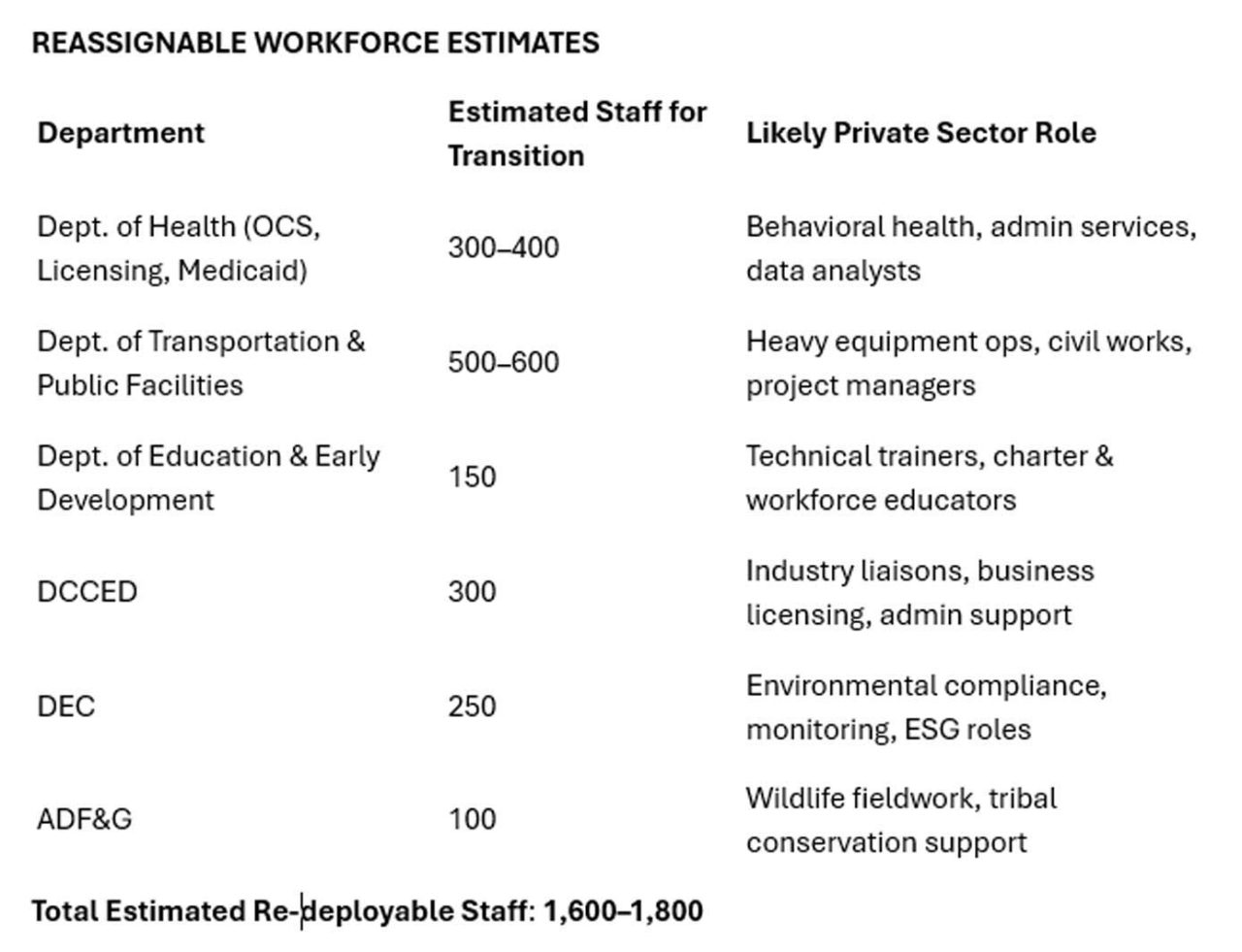
TRANSITION PROGRAM COMPONENTS
Voluntary Separation and Early Retirement
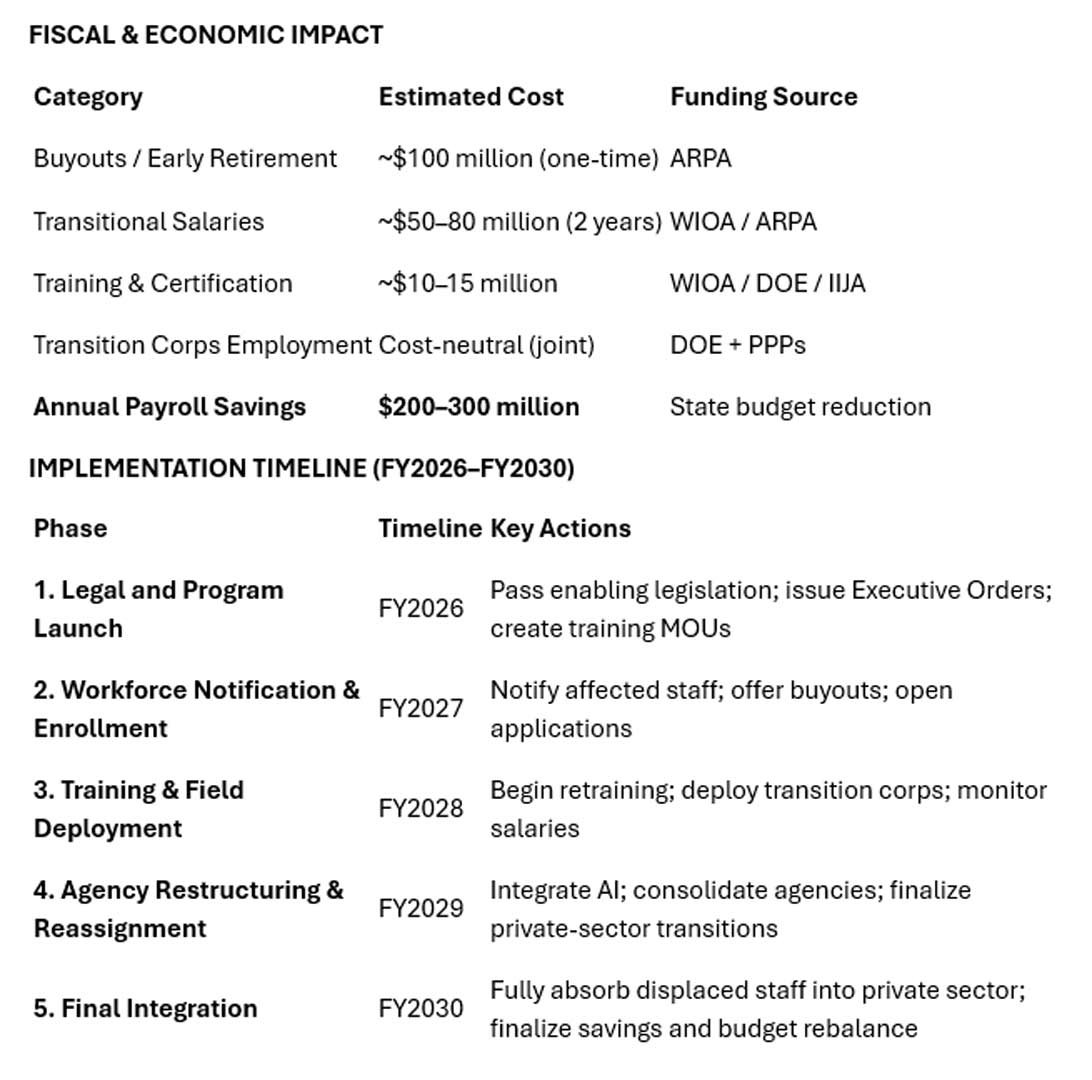
— Offer 1-year salary buyouts or 2–3 years PERS/TRS service credit.
— Focus on retirement-eligible or high-cost administrative positions.
Transitional Salary Protection
— 6–12 months of income continuation for employees who accept reassignment.
— Phased decline, federally funded through ARPA or WIOA.
Statewide Reskilling and Certification Pipeline
Fast-track training in: Energy systems, Mineral development, Regulatory compliance, Logistics and infrastructure.
Delivered through:
— University of Alaska system
— Trade schools and labor unions
— Industry training partnerships
Alaska Resource Transition Corps
18-month employment contracts jointly funded by: Federal workforce grants and Private developers (mining, energy, construction)
Workers fill roles in:
— Roads, ports, and energy projects
— Compliance auditing and permitting
— ESG and tribal monitoring
Tribal & Nonprofit Employment Partnerships
Reassign caseworkers, enforcement agents, and support staff to: Tribal health systems, Wildlife co-management entities, Community nonprofit partners
PERFORMANCE OVERSIGHT & RISK MITIGATION
Personnel Transition Oversight Board
— Track worker outcomes, wage changes, placement rates
— Conduct exit surveys and feedback sessions
Savings Tracker
— Maintain a public dashboard of payroll savings and staffing trends
— Tie future agency funding to successful redeployment rates
Grant Compliance Office
— Ensure all federal expenditures meet eligibility and audit standards
SUMMARY
— Alaska can reduce its administrative payroll by over $200 million per year, without layoffs or service collapse.
— Up to 1,800 public employees can be smoothly redeployed into resource development and infrastructure roles.
— All transition costs can be covered with federal funds.
— The result: a leaner government, a stronger private economy, and a path to lasting fiscal sovereignty.
The views expressed here are those of the author.





6 Comments
Ask JBER how well that worked with their public works privatization. For the most part, the exponential increase in costs resulted in the reduction of work and the increase in active duty personnel dealing with the increasing rate of decay on the facilities. It did work out profitably for the defense contracting industries for a while, however……….run by retired military flag officers.
Another shining example is the wonderful way NGOs have solved our homeless crisis under contract.
This is not new! This is going on right now with the downsizing of federal workers and re-appropriation of funds to other needed streams of work. What is mixed here by the author is the fact that operations for re-employment is mixed. Human resources ensures that the MOU’s and training is done as a program before the reorganization begins. Once the reorganization teams have set the pattern to be used, notification to employees begins.
Well written. Truths spoken in a world inundated by lies and deceit. Mt. 7:14 reminds us though that narrow is the way that leads to life. Thus the demonic world we live in. Thanks again for the well written article.
https;Www.join.work43.com
Up to 1,800 public employees can be smoothly redeployed? The bump in the road is the existing contracts with all the unions are being ignored in this analysis. You want to privatize the state troopers? Good luck with that. Private entities are likely to prioritize profits over service quality or lack adequate training and accountability compared to traditional state troopers. Private police forces might not face the same constitutional restraints and legal oversight as state troopers, raising questions about potential abuses of power or unequal service delivery. Not saying it can’t be done, but should it be done?
Existing contracts: https://law.alaska.gov/department/civil/LSA/CBA.html
Alaska Correctional Officers Association Correctional Officers Unit July 1, 2021 – June 30, 2024
Alaska Public Employees Association / Supervisory Unit July 1, 2024 – June 30, 2027
Alaska State Employees Association / General Government Unit July 1, 2025 – June 30, 2028
Alaska Vocational Technical Center Teacher’s Unit July 1, 2025 – June 30, 2028
Confidential Employees Association July 1, 2025 – June 30, 2028
Inlandboatmen’s Union representing the Unlicensed Marine Unit July 1, 2022 – June 30, 2025
International Organization of Masters, Mates, and Pilots July 1, 2025 – June 30, 2028
Labor, Trades and Crafts Unit July 1, 2024 – June 30, 2027
Marine Engineer’s Beneficial Association July 1, 2025 – June 30, 2028
Public Safety Employees Association (DPS) July 1, 2023 – June 30, 2026
Public Safety Employees Association (DOT&PF) July 1, 2023 – June 30, 2026
Teachers’ Education Association of Mt. Edgecumbe July 1, 2025 – June 30, 2028
The simplest way to summarize this nonsense is to say, ” Let’s just fire everyone who works for the state, hand the keys to the North Slope oil and gas fields to the lowest bidder, allow foreign corporations to iwn and exploit our mineral resources with no oversight or pollution control . ” While we’re at it, let’s log the Tongass National Forest and give China and Japan even MORE CONTROL over are fisheries and aquatic farms. I say this because that’s exactly what will happen when you terminate state public employees .
Restraunt inspectors from Monsanto corporation.