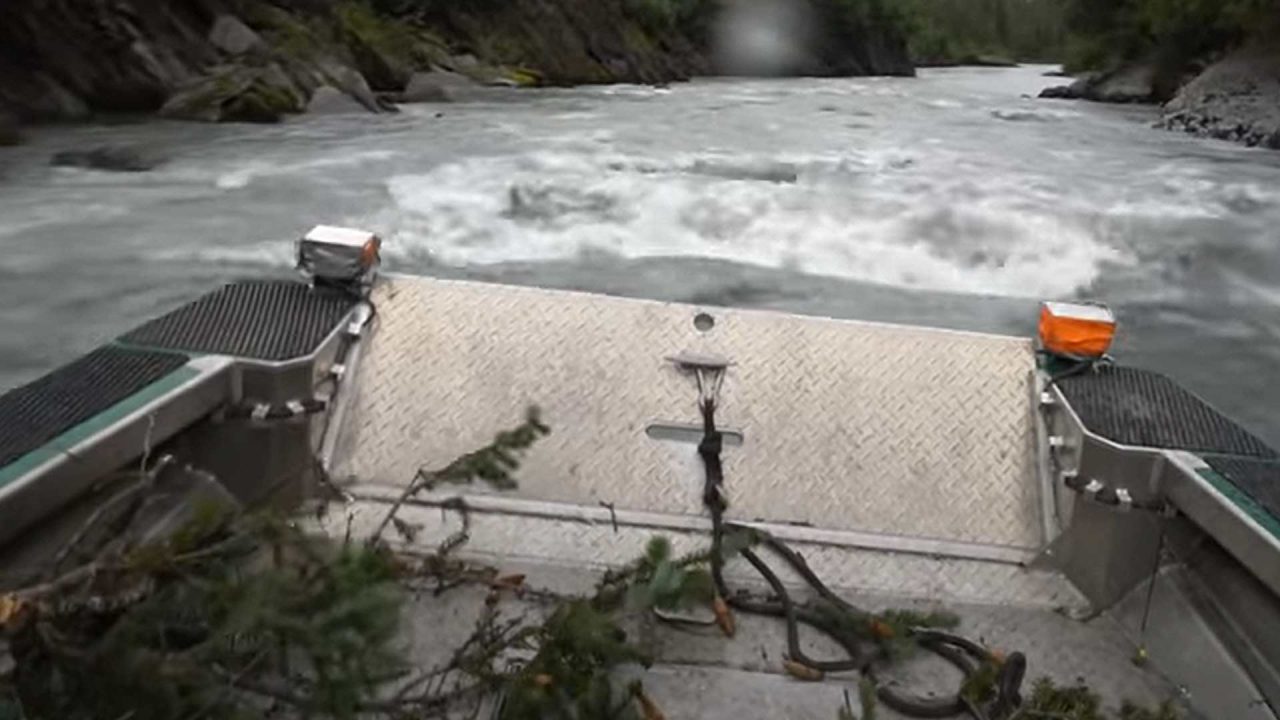


The State of Alaska is asking the U.S. Supreme Court to decide whether the federal government can regulate navigable waters within Alaska that are not “public lands” under federal law.
According to a petition filed on Sept. 15, the issue affects Alaska’s ability to manage its lands and resources comprehensively, ensuring the well-being and sustainability of its communities.
“When Congress enacted ANILCA, it preserved State control over navigable waterways,” Gov. Mike Dunleavy said in a Sept. 15 statement. “That promise wasn’t symbolic – it was foundational as it protected not only the State’s ability to manage how people travel over the water, but also the resources within the water that sustain our communities, our culture, and our future. It’s time the Courts honored Congress’s commitment.”
The dispute culminated over two fishing seasons. In 2021, after Alaska limited salmon fishing to subsistence users under state law, the federal government stepped in and further restricted fishing to only “rural” residents. Then, in 2022, after Alaska imposed stricter fishing restrictions due to low salmon numbers, the federal government opened fishing to “rural” residents. The federal government later sued the state.
“ANILCA says what it says. Congress used the term ‘public lands’ more than 200 times, and it gave that term a single, clear meaning,” Alaska Attorney Gen. Stephen Cox noted. “Courts don’t get to rewrite statutes by giving words different meanings in different sections. Alaska is asking the Supreme Court to hold fast to the text, because fidelity to the law as written is the foundation of the rule of law.”
ANILCA, or the Alaska National Interest Lands Conservation Act, is a landmark federal law enacted in 1980 that designated more than 100 million acres of federal land in Alaska for conservation purposes. In ANILCA, Congress limited the government’s authority to “public lands.”
The Supreme Court has already addressed issues similar to this twice before, in Sturgeon v. Frost (2016 and 2019). In the 2019 decision, the high court ruled that the National Park Service could not enforce federal regulations – such as a ban on hovercrafts – on Alaska’s navigable waters within federal conservation units. In doing so, it held that these waters are not “public lands” under ANILCA, and thus not subject to federal control.
ALASKA WATCHMAN DIRECT TO YOUR INBOX
However, the Ninth Circuit has a separate line of cases known as the Katie John Trilogy that hold the federal government continues to have some control over these same waters under the federal reserved water rights doctrine. Despite the Supreme Court’s clear ruling in Sturgeon, under this theory the federal government continues to impose subsistence fishing rules on navigable rivers like the Kuskokwim River. In a recent decision the Ninth Circuit upheld federal fishing regulations on the Kuskokwim River, reasoning that the term “public lands” could mean one thing in Title I of ANILCA and something else in Title VIII. The State of Alaska argues that this interpretation conflicts with both the plain text of ANILCA and clear Supreme Court precedent.
The Kuskokwim River runs more than 700 miles to the Bering Sea in Southwest Alaska. As the State’s petition explains, the conflict over the Kuskokwim River epitomizes problems over piecemeal management. Only part of the Kuskokwim (about one-fourth) lies within a federal refuge, which is in the lower portion of the river near the Bering Sea but it is critical that salmon escape the federal preserve and travel upstream. Almost all salmon spawning (laying and fertilizing of eggs) occurs above the refuge, and many rural communities live upriver from the refuge depend on subsistence fishing. Thus, when the salmon population in the Kuskokwim is low, the State seeks to protect salmon and fishing opportunities in the entire river But the federal government focuses only on providing subsistence opportunities for a small slice of the Kuskokwim that falls within the refuge. This regulatory narrowness has led to overfishing within federal areas and corresponding harms to those living upstream.






1 Comment
Dumb Dunleavy is at it again! Stupid!