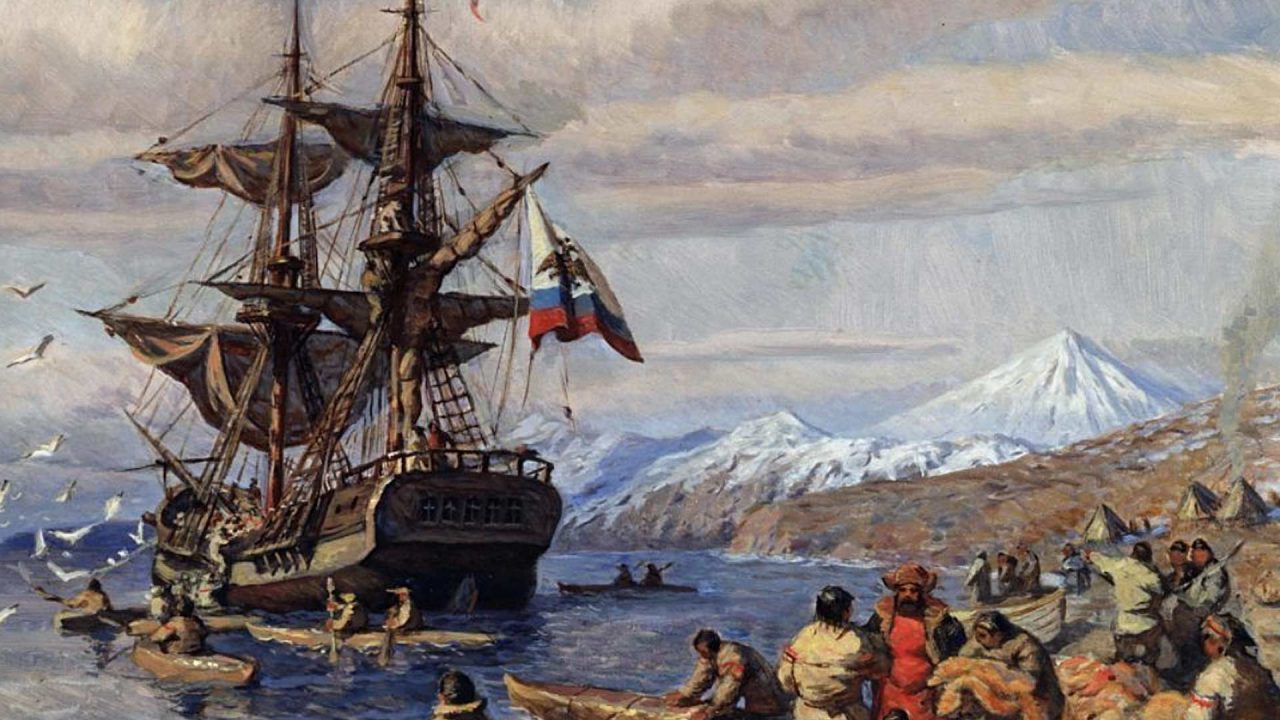


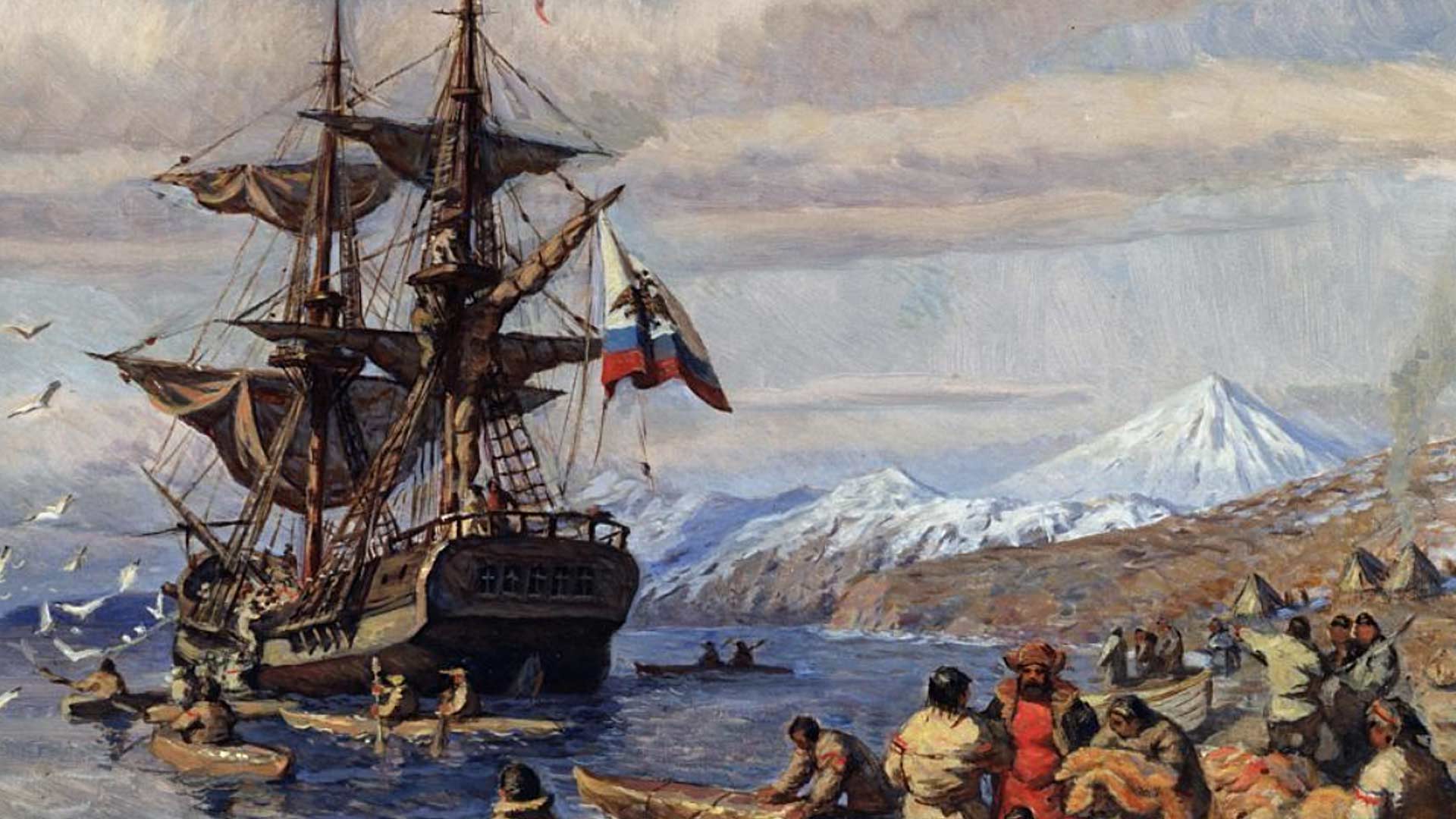
The most important aspect of the ethnohistory of the people of the high north was the process of exploration and colonization of Siberia and Alaska by the Russian empire officials. Exploration of the northern territories in the 17th century caused a significant transformation of population, strengthened conflicts between local ethnic groups and changed modes of production and material culture of the aboriginal population, among other effects.
Russian officials did not wish to exterminate the aboriginal northern population, but rather, in cooperation with local Native leaders, to reform them into good and meticulous suppliers of valuable furs.
From the point of view of Russian officialdom, the process of exploring the North American territories presumably had the same rationale as in Siberia; the Russians viewed North America as a geographical continuation of their politics. The Russians used a socioeconomic and political strategy in North America like that used in Siberia, imposing the local head tax (yasak) and strengthening their influence.
The process of colonization of the eastern territories was quite elaborate. One of the peculiarities of the aboriginal populations of Siberia, the Far East, and northwestern North America was the absence of any State organization. Lacking an institutional defense against the sophisticated social organization and military superiority of Russians, the Native population had to accept Russian dominion and consequently agreed to pay them yasak. Another peculiarity in the Russian population of the eastern territories was the absence of serfdom. Oppressed Russian peasants who had escaped from their landlords in the European part of Russia often fled to Siberia, the Far East, or North America to attain freedom. The Russian authorities, surprisingly, instead of having them prosecuted, had promoted them into government jobs.
Often Russian explorers were ruthless toward an aboriginal population, but overall, this movement was much more humane than colonization of Australia or colonization of North American territories in the Lower 48.
Thus, when the government had established its control over the northeastern territories, the commercial people (promyshlenniki and kuptsy) began organizing commercial companies (artels) and markets (yarmarkas and bazaars), and the Russian Orthodox Church began sending missionaries to the East. Thus, in contrast to peasant movements, which had a spontaneous character, the organized government expeditions to the East already had in place a colonial system, i.e., the imposition of regular yasak and the extension of State territories.
After discovery of the Aleutian Islands and southern Alaska, a series of commercial expeditions to North America from Siberian and Far Eastern Pacific ports (Okhotsk and Nizhne-Kamchatsk) took place. Between 1743 and 1786 the Russian Government Treasury received commercial products from North America – primarily fur and sea mammals worth 193,798 rubbles. In addition, they collected products worth 42,394 rubles in yasak.
One effect of these enterprises was a significant increase in the Russian population in North America. In 1794, the Russian population in Alaska was over 800, compared to 500 in 1788 (Alekseev 1982: 38-39). In 1799, the population in Russian America controlled by Russians was about 8,000, which included only 225 Russians.
ALASKA WATCHMAN DIRECT TO YOUR INBOX
Russians in North America hunted sea mammals, fished, built ships, and attempted to cultivate some crops. Several Russian settlements were established in the Aleutian Islands, on Kodiak Island, on the Kenai Peninsula, and southeastern Alaska. By the end of 18th century, the Russian-American Company was founded in Alaska. The company monopolized all commercial enterprises in Russian North America and held almost all political power in the region. Until the U.S. government purchased Alaska in 1867, Siberian-North American contact was very close. The Russians’ management of Alaska always represented the interests of the tsarist government and was conducted in cooperation with their Siberian partners and supporters.
It is also important to stress that many historic material and textbooks published prior to the 1990s describe the Russian period of Alaska’s history as a bloody and ruthless colonization of northern territories. Russia’s Eastward expansion into Siberia, the Far East, and Alaska was motivated by exploration of new hunting territories (James R. Gibson, Feeding the Russian Fur Trade. Madison: The University of Wisconsin Press, 1969). Often Russian explorers were ruthless toward an aboriginal population, but overall, this movement was much more humane than colonization of Australia or colonization of North American territories in the Lower 48. The aboriginal population in Siberia and Alaska had not been placed on reservations or dislocated from their homeland as they were in the Lower-48.
The views expressed here are those of the author.






8 Comments
Love this professor’s research and writing. Bring on more of this history of Alaska. Its fun to read.
So…..government shows up and immediately institutes a “head tax”. Nothing has changed much since then. We are just worker bees supporting the socialist hive.
Ahh good ole colonialism. Many people had suffered the implementation, but many more benefit from its outcomes.
Sorry about the growing pains. Hope a wealthy, healthy and prosperous life is what you get to enjoy now.
Don’t worry though, if you wanna go back to the stone age, just give Democrats the power over your lives and you too can be like your ancestors. Cold and without cell phone reception. Woo hoo!
Great article. I hope that the writer will do more of these type of historical articles to correct some of the errors of politicized history to bring more light on Alaskan history.
The current Pribilof islanders are the descendants of the original people from the Aleutian chain, forcibly relocated by the ruthless Russians to gather seal and sea otter furs, so, there actually was dislocation from their homeland as the Pribilof’s were uninhabited at the time.
Andy, there is some truth in your observation. Nevertheless, I have my reservation to believe that several dozens Russian hunters could apprehend and force several hundred Aleuts to travel long and dangerous distances by baidarkas from Aleutian Islands to Pribiloff Islands. Pribiloff Islands were discovered by Russians in 1786 and in 1788 a small group of Russians accompanied by Aleuts begun an enterprise on the islands. I visited St. Paul and St George eight times in the capacity of a lecturer on the cruise ships (e.g., World Discoverer, Cruise West, etc.) in the mid-1990s and early 2000s. As you know, St. Paul is the largest Aleut community outside Aleutian chain.
In 1985, archaeologists Stan Davis, Karen Swanson and I excavated several sites in the Poison Cove, Southeast Alaska. In the early/mid 19th century, Russian promyshleniki arrived at this location with several hundred Aleuts. Aleuts peddled baidarkas long distance from the Aleutian Islands; they were unfamiliar with the seasonal cycles of Southeast Alaska and its environment. So, many Aleuts of Unalaska have died after eating toxin-laded shellfish from a local beach. As a result, this cove was named Poison.
In short, although secondary sources suggest that Russian hunters forced Aleut’s relocation, I have my doubts. There were some levels of unforced cooperation between these two groups. Thank you for your intelligent insights.
what a amaizing website ………… Workapp1.Com
“You can put lipstick on a pig…”.
I’ve noticed over the years that people of Russian origin always paint Russian Alaska in relatively rosy terms. Oleksa did this too.
In truth, history is rife with abuses and death. This is the legacy of fallen man.