

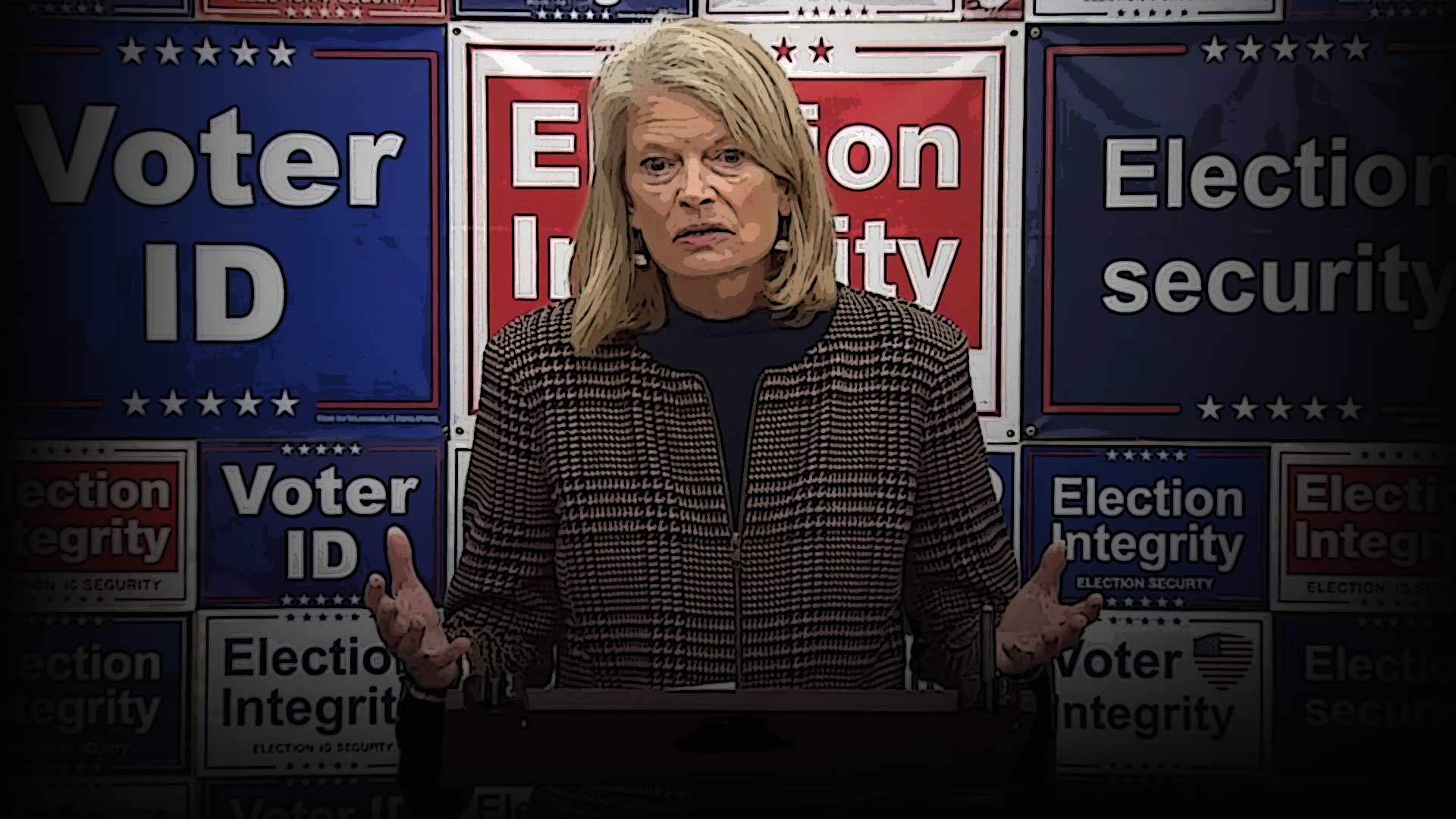
Recently, U.S. Sen. Lisa Murkowski created a letter explaining her opposition to the Safeguard American Voter Eligibility (SAVE) Act. Her letter reflects a pattern that has become common in election debates. Many politicians say they support voter ID and election integrity in principle, yet oppose reforms that would meaningfully strengthen those protections.
Free, fair, and transparent elections are foundational to our system of government. Public trust in the integrity of elections is essential to the stability of our republic. When confidence in elections erodes, the consequences extend far beyond any single political contest.
In Alaska, a voter can present something as simple as a non-photo utility bill as identification. The law goes even further. A voter who arrives without any identification can still cast a ballot. In some cases, an election official may attest to the voter’s identity, but even that is not strictly required. A voter can cast what is known as a questioned ballot, and that ballot will be counted if the name appears on the voter rolls and the individual is registered.
In other words, the system confirms that a registered name exists. It does not necessarily confirm that the individual casting the vote is that person.
What is never verified in that situation is whether the person casting the ballot is actually the person whose name appears on the voter roll.
Much of the conversation about election integrity stops at rhetoric. Saying “I support voter ID” has become politically safe language.
At the same time, voter rolls themselves are not always carefully maintained. Across the country, they frequently contain outdated registrations for people who have moved, died, or registered in multiple states. When voter rolls are not rigorously maintained, and the identification requirements at the polls are weak, the safeguards that many voters assume exist simply are not there.
Yet many politicians continue to claim that Alaska already has voter ID protections.
Technically, that statement may be defensible on paper. In practice, however, the standard is so loose that it provides little real verification. Calling something a voter ID law does not make it effective. A system that accepts a non-photo document, or even allows a ballot without identification at all, is not what most Americans think of when they hear the phrase “voter ID.”
This disconnect between rhetoric and reality erodes public trust.
Sen. Murkowski’s letter raises concerns about federal legislation such as the SAVE Act and the role of the federal government in election administration. It is true that the Constitution gives states primary responsibility for running elections. But it also clearly gives Congress authority to regulate federal elections. Establishing baseline standards for voter eligibility is not unprecedented. If states were consistently maintaining accurate voter rolls and strong verification systems, the pressure for federal involvement would likely be much lower.
Legislation like the SAVE Act is aimed at improving that situation by requiring proof of citizenship when registering to vote in federal elections and providing states with tools to verify citizenship using federal databases. It does not give federal agencies authority to purge voter rolls. States remain responsible for maintaining their voter lists.
Reasonable people can disagree about the details of any legislation. But those debates should start with an honest description of the system we currently have.
ALASKA WATCHMAN DIRECT TO YOUR INBOX
The truth is that in many places, voter ID exists mostly in name. When identification can be as minimal as a utility bill or bypassed altogether through a questioned ballot, it is difficult to argue that the system provides meaningful verification.
Most Americans routinely present identification in everyday life. We show ID to board airplanes, to access secure buildings, and to complete countless ordinary transactions. Voting, one of the most important civic acts in a democracy, should not operate under weaker verification standards than activities that are far less consequential.
A well-designed system can make it easy for eligible citizens to vote while still ensuring that each vote is cast by the person legally entitled to cast it.
Unfortunately, much of the conversation about election integrity stops at rhetoric. Saying “I support voter ID” has become politically safe language. But the reality of many state laws, including Alaska’s, tells a very different story.
Public confidence in elections is fragile. Restoring that confidence requires honesty about where our systems fall short and a willingness to strengthen the safeguards that protect them. Pretending weak standards are strong ones does not help anyone. It only delays the reforms needed to ensure that elections remain both accessible and trusted.
The views expressed here are those of the author.



27 Comments
I’m a life-long Alaskan, and I have been voting for many years. While I have a driver license, I do not have a birth certificate or a passport. Why do you want to restrict me from voting?
Good to know! Your statement means you do not have the new state driver’s license and will require you to get one if you want to fly on a plane or drive on the expiration of the license you now hold. Get your birth certificate and a passport. Then get your new drivers license. Easy!
A REAL ID does not prove citizenship.
You need a Certificate of Live Birth to get your Passport
Well if you can’t prove you’re a citizen then I guess you made the choice to forfeit your tight to vote, just the same if you didn’t have a driver’s license you forfeit your right to drive! If you don’t have a birth certificate you can apply for one, as I had to do myself about 10yrs ago. And I had to apply for a new passport last year as mine expired. So you just have to make an effort. Don’t know if you’re on Social Security, but it takes and effort for that as well, Medicare as well.
Exactly Dean…………nobody is accountable for their OWN actions. And for those that wait to the last minute? That is on them, and nobody else.
Frank. Take some responsibility for your life man. The documents aren’t that hard to obtain and you have had many years to do it. No excuses.
Are you a reason there are instructions on a shampoo bottle or what?
You need an ID to apply for the Permanent Fund Dividend. I can’t imagine anyone in Alaska who doesn’t have one.
This proposed law will require proof of citizenship, not just an ID. Everybody agrees that an ID should be required, but there are thousands of citizens without a passport or a readily-available birth certificate.
To Joanne and Frank
I had to get a copy of my birth certificate from the state where I was born (in 1956) – yes thate was a long time ago.
Please allow me to help you and those who you can help by giving you the information this old person was able to find on Grok:
To get your birth certificate, it’s pretty straightforward – just head to the vital records office in the state (or country) where you were born. In the U.S., most states let you order it online now – usually through their health department website or a service like VitalChek. You’ll need your full name, date and place of birth, parents’ names, and a credit card. Fees run about $20 to $40 bucks, plus shippings if you want it mailed. Takes a week or two, sometimes faster if you go in person. If you’re not sure where to start must Google ‘vital records’ and it’ll pop right up.
Okay – I hope that helps. Back in the day when I had to get a copy of my birth certificate there wasn’t handy dandy services like Google or Grok and we didn’t have cell phones that are really small computers to look up answers on (those cell phones are not just for social media use).
AND at the time I was on a budget so the cost was at first a problem, but I saved up so I could obtain this VERY IMPRORTANT document to put into my VERY IMPORTANT personal file that I made for myself.
If you need suggestions on how to make a VERY IMPORTANT PERSONAL INFORMATION file to store all the documents and records you need while you are on this planet that are for you, your children or your family members – I’d be happy to offer helpful suggestions with that too.
So. Please understand how simple it is to get your birth certificate copy ASAP so you can vote as an AMERICAN CITIZEN for what we in this country call our Constitutional Right.
God’s Speed
Well Joanne, they better get workin’ on it while they got the time. They been warned.
If dey too dum to git an ID, then they should NOT be votin’.
Jus sayn
Murkowski is counting on smoke and mirrors in our elections to hopefully keep her seat. Voter ID and citizenship proof would lessen her chance of staying in power. Plain and simple. All of her excuses and the long winded letter that I also received, are just ‘par for the course’ gaslighting.
Absolutely correct!
She is hardly a Republican, she rarely votes with her party. She should run as a democrat.
She’s Bought and Paid For and the definite beneficiary of Rank Choice Voting!
I am NOT a fan of Rank Choice voting and totally agree with you. I live in California but have friends that live in Alaska and follow what goes on there. She votes with the Dems about 8 times out of 10. She is not a Republican.
Thank you Joshua for making clear what is at stake. Murkowski probably understands voter fraud as she was able to beat her opponent as a write-in candidate after he had defeated her in the primary,
She spits nothing but lies. We’ve accepted mediocrity for far too long. This Senator’s vote goes to her master. Whoever that may be. It is certainly not We the People.
Notably absent from the opinion piece is that the SAVE act requires proof of citizenship in order to register to vote, requiring either a passport or birth certificate. Do you know where your birth certificate is? Did you change your name when you married? Did you change it again when you divorced? The SAVE act is a “solution” looking for a problem. Decades of looking for evidence of voter fraud by immigrants or whoever has resulted in a handful of cases. Stop wasting my tax money chasing this ghost.
Oh my.
We certainly can’t expect anyone to keep track of their personal records as they move about the planet, marrying, divorcing, buying a home, doing their taxes, paying their medical bills, balancing their checkbook, getting a Costco membership, etc., etc. It’s just too much to ask. And people are just too dumb.
Jean, talk about a red herring. Everyone has a identification that will allow them to vote, except the dead and illegals. Maybe that’s what you’re opinion is referencing? You probably don’t understand the “SAVE” act is all about SAVEing US from the dead and illegals.
Yes, I have all my documentation and I don’t have any “dead names”. Poor lefties have fragmented their identity so hard they don’t even know who they are anymore.
I know who I am and am a responsible citizen of this fine country. I will have no problem voting with any of these changes. If you are having problems with retaining your own documents, then take this time to correct that.
And if you are soooo concerned about your tax dollars being misused, perhaps you can give Ukraine a call.
Lisa Murkowski knows she can not win a free and fair election. When did she ever win an election where as she didn’t have a hand in some sort of shenanigans in order to win? She is so high and mighty that she thinks her constituents are stupid. Any politician that intentionally misleads (lies to) the voters is just plain evil, and that is what Lisa Murkowski is!
So, you may recall that Lisa Murkowski was put in her job by her father, Gov. Murkowski to fill the vacant position for senator. Her placement as Senator was a complete DISENFRANCHISEMENT of the vote of the people of the state to elect a person to fill that position under the Alaska and US Constitution. Every person who votes was cheated by the Murkowski Crime Family and Lisa Murkowski has never stopped the corruption and crimes against the voters of this state. That was only the first of events against the voters of the state.
Lisa doesn’t tell you she Literally has to insert her ID Card to Vote on these Bill’s .
She has not been elected by a majority with the exception of when she ran against Tony Knowles.
if you current qualify to fly commercial airlines, anywhere, you qualify to vote, and will continue to be under Safe act.
Murkowski is nothing more then a miserable worthless RINO and she isnt even good at that. Her daddy gave her the office which she never should have had. If not for daddy she would have to work for a living like the rest of us. She needs to be terminated from this senate and sent back to wherever she lives now as she is hardly ever in AK anymore