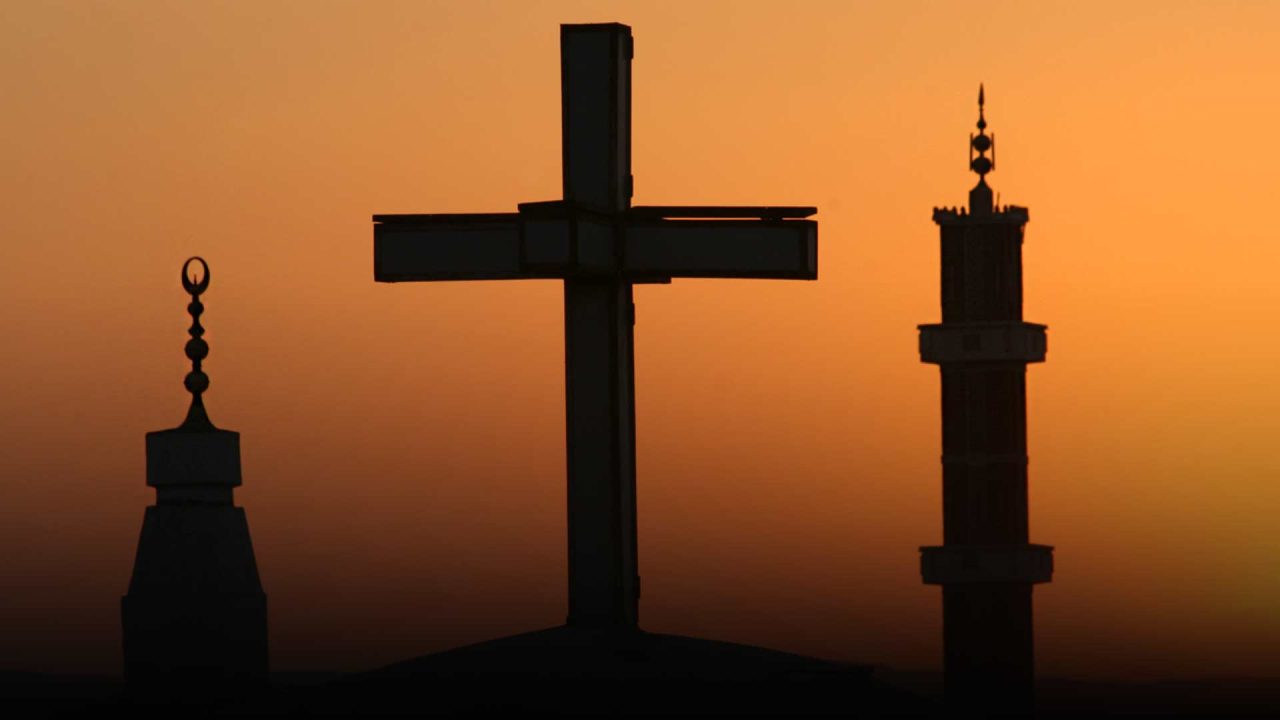



The relationship between Islam and the West is often viewed through two distinct lenses: (1) the historical absorption of indigenous populations and (2) the modern reality of global migration.
While the Russian experience was shaped by centuries of eastward expansion into established Muslim Khanates (Turkic polities across the Eurasian steppes that stretched from Mongolia to the Black Sea: Tatar, Volga Bulgaria, Tatarstan, Mari El, Chuvashia, Mordovia, Udmurtia, Bashkortostan; its capital was the city of Kazan), the Western experience in Europe and North America is primarily a result of the post-World War II demographic shifts via migration.
Both contexts, however, converge on a singular, enduring challenge: how a state rooted in one tradition can effectively integrate and manage a diverse conservative religious minority. Today, as the United States and Western Europe navigate the complexities of religious freedom, cultural values, and the rule of law, the search for a sustainable model of coexistence remains one of the most pressing socio-political questions of our time.
How to effectively manage this integration while balancing differing cultural values – such as those regarding gender roles and religious freedom – remains a complex challenge for which there is no easy consensus.
For centuries, Islam and Christianity have coexisted within the borders of Russia and, later, the Soviet Union. As the Russian Empire expanded southward and eastward – annexing the Volga-Ural region, the Crimean Peninsula, Caucasus Mountains, Kazakh steppe and vast areas of Central Asia (including today’s Kazakhstan, Turkmenistan, Kyrgyzstan, Uzbekistan and Tajikistan) – it absorbed deeply rooted, native Muslim populations.
These Muslim communities were not immigrants; they were indigenous inhabitants whose presence in these territories preceded Russian eastward expansion, often dating back to the 7th or 8th centuries AD. Consequently, the Russian state had to learn how to manage a large, diverse Muslim population, like the administrative challenges posed by managing other indigenous minorities.
This process mirrors the westward expansion of the United States and the annexation of Native American lands, though the Russian context involved incorporating complex, pre-existing Islamic state structures (such as the Khanates) rather than nomadic tribes. While this coexistence was sometimes marked by forced conversion in the 16th century, it shifted under Catherine the Great (1762 to 1796 ) toward a more pragmatic, bureaucratic management of Islam through established institutions, such as the Orenburg Muslim Spiritual Assembly. This allowed the Russian Empire to incorporate these territories while navigating the complexities of a multi-religious, multi-ethnic empire.
The presence of Muslim populations in Western Europe and North America is largely the result of the post-World War II immigration, not historical indigenous habitation. In response to the complexities of this demographic shift, several Eastern European nations (Poland, Hungary, Chechia and Slovakia) adopted restrictive border policies. Conversely, Western European nations, Canada and the United States permitted Muslim immigration, resulting in settled, established communities.
Research suggests that the Muslim immigrant community is in a transitional phase.
Given that a sizable portion of the roughly 3.45 to 4.5 million Muslims in the US are citizens, and many are multi-generational, large-scale deportation is legally and practically unfeasible. Consequently, the focus shifts to integration and management within the framework of Western laws and Judeo-Christian principles, which emphasize freedom of religion, individual dignity and the rule of law.
How to effectively manage this integration while balancing differing cultural values – such as those regarding gender roles and religious freedom – remains a complex challenge for which there is no easy consensus. However, in the United States, effective management of this integration can be approached through several nuanced, long-term strategies; although a single, simple solution does not exist.
Cultivating an Evolutionary “American Islam” Model: Research suggests that the Muslim immigrant community is in a transitional phase. Rather than enforcing strict assimilation, a more effective approach supports the organic development of a unique American Islamic identity. This is particularly evident among second-generation Muslims, who often replace the cultural expectations of their parents with a flexible interpretation that integrates traditional faith with modern Western values.
Encouraging “Structural Assimilation” Over Complete Acculturation: Instead of demanding full cultural assimilation, promoting “structural assimilation” – active participation in American economic, political and civic life – is more effective. American Muslims are often as educated as or more educated than the average American, which aids this integration.
ALASKA WATCHMAN DIRECT TO YOUR INBOX
Fostering Culturally Competent Institutions: To bridge cultural differences, schools, healthcare and workplaces should embrace – rather than fear – cultural accommodations (e.g., offering tailored care or dietary options), which builds trust and boosts participation.
Fostering Inter-Community Unity: Building relationships through shared social and secular events helps bridge gaps between the Muslim community and the public. By focusing on shared values like the Golden rule – “Do unto others as you would have them do unto you” – this approach dismantles “us vs. them” narratives and strengthens mutual understanding.
Supporting Reformist Voices within the Community: Empowering the next generation of American-born, locally educated Muslim leaders is critical for the community’s evolution. By supporting imams – (Islamic leaders) who can provide theological backing for causes such as gender-inclusive spaces and women’s leadership – we establish a faith-based framework for integrating with Western values.
Ultimately, the goal of effective management of ethnic and religious minorities is not to force a complete abandonment of religious tradition, but to encourage a synthesis where Islamic identity coexists with, and operates within, the American constitutional framework and Judeo-Christian values, allowing for a pluralistic society where religious freedom and the rule of law are maintained.
The views expressed here are those of the author.




15 Comments
Islam is not so much a religion as it is a supremacist political collective with a small religious component. Western religions cannot peacefully coexist with an organization that violently opposes it. To “reform” Islam would mean to take out the very heart of its belief, which is convert and submit or die, so it is unlikely to happen. Hilaire Belloc rightly classified Islam as a heresy of Christianity which removed all personal responsibility as well as all understanding of the dignity of the person, and replaced it with submission and violence against “unbelievers.” Equating Islam with Christianity as a religion is simply foolish, and leads to such things as 9/11.
Do you actually KNOW any Muslims? Do you count any among your friends? Maybe it’s time. In my experience American Muslims are NOTHING like their counterparts in the Middle East. They aren’t like Christian Nationalists, mixing faith with public policy. They practice their faith like Presbyterians do, observantly but not politically.
Yes, I have met Muslims. However, not one of your observant Muslims decried October 7. Not one of them was upset on 9/11. Until you understand taqiyya, you will not understand Islam.
Please explain to me how one can have faith and NOT have it inform how you believe you should live? Mixing faith with public policy is exactly what the Founding Fathers did. Perhaps you should read up on American history until you know what it is you denigrate.
Pretty ridiculous statement when you consider that just last week there were two incidents of Muslim terrorism in America perpetrated by supposedly assimilated young men. There is a long record of such occurrences. Islam is not, nor will it ever be a “religion of peace”. So-called moderate Muslims just keep quiet about Islamic terrorism because they don’t really disagree with it. The whole socio-political system is based on world domination, and unlike Jesus’ Great Commission, it is written in their Quran that violent force will be used to make people submit (Islam means “submit”) to their belief system.
Lefties love Islam because it is the enemy of their enemy, which is Christianity. They choose to ignore Islam’s horrific actions upon the very people that lefties rally around: women and gays. But then the only consistent thing about most any liberal is their inconsistency.
Tamra, while I am with you emotionally and intellectually, I recognize that emotions alone lack practical consequences. My background in the anthropology of religion—specifically my published work on Russian Old Believers in Alaska—has led me to understand that religious affiliation is the most enduring aspect of human belief.
Based on my 1973 work experience in Uzbekistan and Turkmenistan, I observed that Islam was so deeply ingrained in the local culture that it was impervious to eradication or forced change. At that time, the Soviet government was actively worried about the rapid demographic growth of the Muslim population, which typically saw families having five to ten children.
Statistically, Muslims made up nearly half of the Soviet military in the 1970s. Even after the independence of the Soviet Central Asian and Azerbaijani republics, Muslims still comprise 12-15% of Russia’s population, a demographic the state has learned to manage. Regarding my own country (USA), I am unsure of the best solution, though perhaps limiting Muslim immigration or restricting Islam in favor or in accordance with Judeo-Christian values is necessary. In my view, Europe is currently experiencing cultural chaos due to mass Muslim immigration.
With all due respect, my statements here are not emotional. Nor are they simply intellectual, although I certainly hope they are that. My comment here is strictly practical. We cannot compromise or assimilate that which refuses to do so.
We cannot coexist with a belief system where the Koran instructs them to behead or enslave the infidels.
I Believe Winston Churchill said it very well : ” How dreadful are the curses which Mohammedanism lays on its votaries! Besides the fanatical frenzy, which is as dangerous in a man as hydrophobia in a dog, there is this fearful fatalistic apathy. The effects are apparent in many countries. Improvident habits, slovenly systems of agriculture, sluggish methods of commerce, and insecurity of property exist wherever the followers of the Prophet rule or live. “
Today’s Muslims are different than the Muslims you lived around in your younger years
Seriously doubt the good nature of anyone not a real Christian. Just because one knows a few Muslins and they seem really good and nice to you. Would they really stay good and kind to you if you were the minority? If People like Paul Hart would be the only white man without any management or special skills to put him over the Muslims working around him like if he could work housekeeper with the Muslims at ANTHC, he’d see them like the clique they are.
The Muslims he knows only are nice to him because they want to impress him. He’s got something they want.
Islam is a theocratic political system seeking societal control by tyranny; including anti-feminism and total disdain/acceptance for all other religions. Coexistence cannot occur as Islam insists on total, non-negotiable dominance. There is no sustainable model of coexistence that includes sharia law, refusal to accept the United States Constitution as superior to islamic laws, imams in American mosques “preaching” for Death To America, multiple wives, female genital mutilation, honor killings, horrid physical abuse of women and children because islamic belief says it is acceptable. Islam by definition will never conform to western values. To harbor fantasies that it could is naive at best, foolhardy at worst. If Islam were to conform to western values, it would require that it no longer be Islam.
My opinion on Islam and those of that cult is their present destructive nature to expand the cult thinking. They do not assimilate…. They will relinquish nothing of their principles they were taught in their growing and study to be a good Muslim. No law of any country means anything to them and they do not assimilate. I have met Muslims and simply do not want them in my country. Their purpose is total domination. Hence, Sharia Law. That dominates each household wherever they reside. So, the cult practice needs control and the US needs to limit or completely cut out any immigration of Muslims from any part of the world. I don’t have to be fair to others or the cult of Islam
You say it is imperative that we dismantle the “us v.s them” parigdim. But I would ask, have you not read the Qu’ran? That parigdim is the bulwark upon which the whole work rests. To jettison that is to throw off everything. The scandalous particularity of Islam is just that, salvation, and the God of salvation, is theirs alone. And further, to shrug off His precepts is to forfeit immortality. Did Christ not say “For what is a man profited, if he shall gain the whole world and lose his own soul?” — but for the fruits of democratic capitalism they may be haphazardly shrugged off. How shallow a faith you seem to ascribe to the children of Mohammed and the legions whose heritage is the same as Mehmed II, and whose dominion is the whole world.
I’m quite certain that any argument from me as an atheist will not get you all to slap your foreheads and think, “Evan is right. Again”. But: Religion is the poison at the heart of Trump’s WWIII and the ancient animosities in the Middle East. Remove it and be closer to peace. All the comments here are about NOT TOLERATING difference and a religious justification for killing others. That’s poison. Atheists don’t do that. We only confront religionists when they impact us like pretty boy podcaster Pete Hegseth’s Christian no quarter war.
A fun story: A rabbi was asked by one of his students “Why did God create atheists?” After a long pause, the rabbi finally responded with a soft but sincere voice. “God created atheists” he said, “to teach us the most important lesson of them all – the lesson of true compassion. You see, when an atheist performs an act of charity, visits someone who is sick, helps someone in need, and cares for the world, he is not doing so because of some religious teaching. He does not believe that God commanded him to perform this act. In fact, he does not believe in God at all, so his actions are based on his sense of morality. Look at the kindness he bestows on others simply because he feels it to be right. When someone reaches out to you for help, you should never say ‘I’ll pray that God will help you.’ Instead, for that moment, you should become an atheist – imagine there is no God who could help, and say ‘I will help you’.”
D, while I haven’t read the Quran and accept your premise, I am questioning the practical, legal, and constitutional feasibility of dealing with 4.5 million Muslim residents in our country through mass deportation or removal, given that the U.S. Supreme Court would never uphold such actions. Since mass deportation violates US Supreme Court precedents, what is your actionable plan?
Professor Dolitsky, respectfully you would be wise to educate yourself about Islam, the Muslim Brotherhood, CAIR, and the myriad of muslim groups affiliated with them. Familiarize yourself with the works of Gaad Saad, Brigitte Gabriel, Jamie Glasov, Frank Gaffney, John Guandolo, and Daniel Greenfield to name but a few. As to the muslims already here in America? 1) No Sharia Law anywhere. 2) Abolish the word Islamophobia (created by CAIR). 3) Stop muslim refugee resettlement and legal/illegal immigration now. 4) Shut down mosques with imams calling for death to America (better yet deport those imams if possible). 5) Punish (deport, imprison) the thousands or more of muslim Somalis who have defrauded US taxpayers to the tune of billions of taxpayer dollars. 6) Do not permit muslim only colonies to be built (ie Plano, Texas). 7) Any muslim elected to office must not be allowed to use the US Constitution to implement Islamic practices that are sanctioned by islam (child marriage, female genital mutilation, multiple wives, abuse of women, sharia banking etc). 8. Protect the human rights of muslims who wish to leave or speak out against islam under the islamic penalty requiring their death.
Lastly, watch Dinesh D’Souza’s recent video “Importing Jihad” (the first 16 minutes). https://youtu.be/g9ny8rCQuyI