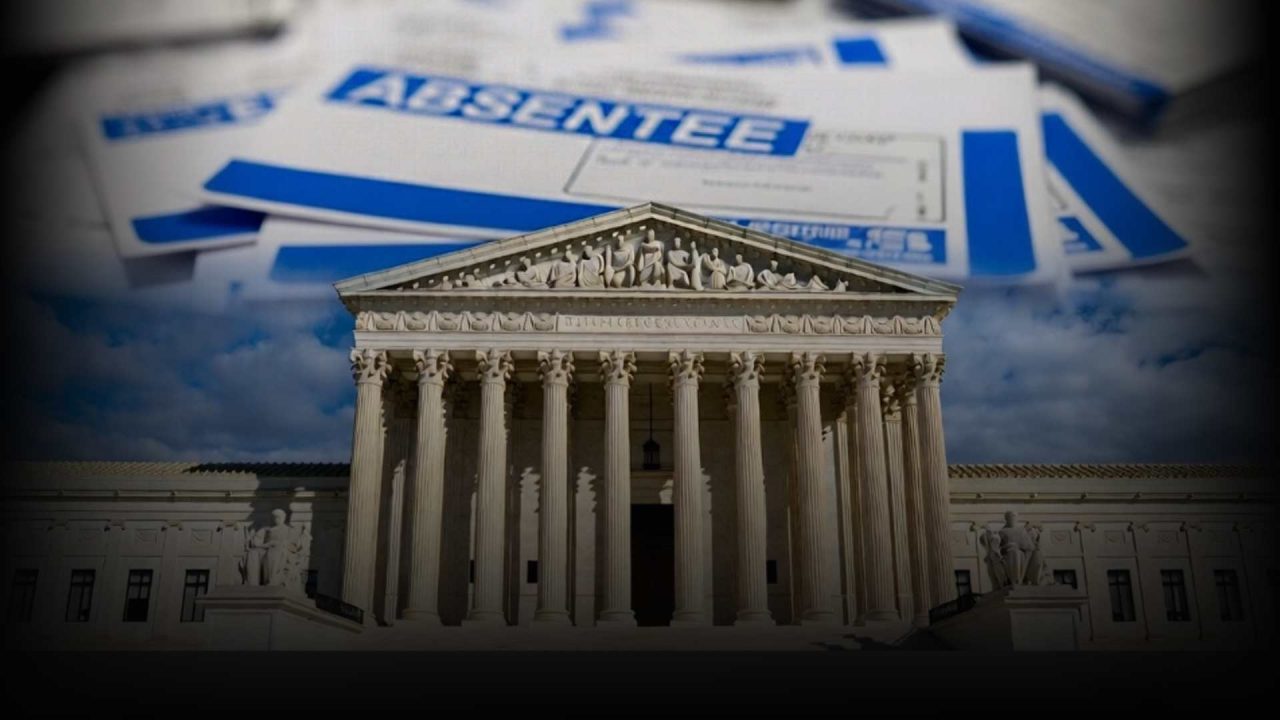


The U.S. Supreme Court is set to hear oral arguments on March 23 in Watson v. Republican National Committee, a case that could upend election rules in more than a dozen states, including in Alaska, by determining whether federal law requires ballots to be received by Election Day – not just cast or postmarked by then.
The dispute originated in Mississippi, where a 2020 law (enacted amid the COVID-19 pandemic) allowed absentee ballots postmarked by Election Day to be counted so long as they were received within five business days afterward. The Republican National Committee (RNC), Mississippi Republican Party, Libertarian Party of Mississippi, and others challenged this Covid-era change, arguing it conflicts with federal statutes designating the Tuesday after the first Monday in November as a uniform “Election Day” for congressional and presidential elections. These groups cite the 1997 Supreme Court ruling in Foster v. Love, which struck down Louisiana’s early “open primary” system as violating the single-day requirement – interpreting “election” as encompassing both voter submission and the official receipt of ballots.
A federal district judge upheld Mississippi’s 2020 law, reasoning that the extended deadline for receiving ballots did not create multiple election days. However, the 5th U.S. Circuit Court of Appeals reversed this opinion – holding that ballots must arrive by Election Day.
Mississippi is now set to defend its election policy before the Supreme Court, claiming that an “election” concludes when voters cast ballots to choose their candidate, not when officials receive or count those ballots. Supporters, including briefs from military/overseas voter groups, warn that invalidating such rules could disproportionately harm U.S. service members stationed away from home, who rely on extended deadlines.
Those challenging the Mississippi law, including nine states led by Montana, counter that federal law demands a uniform final election deadline. They argue that late-arriving ballots undermine the goal of a single election day.
In January, Alaska Attorney General Stephen Cox filed an amicus brief, which did not take either side of the issue, but sought clarity.
Alaska is one of 13 states that permit all mailed ballots (postmarked by Election Day) to count if they are received within 10 days after the election (for in-state) and 15 days (for overseas/military).
Proponents of Alaska’s policy often cite the state’s vast terrain, extreme weather, remote villages and reliance on air and boats to transport ballots.
However, Alaska does have a lengthy early voting period in place, wherein voters can request a ballot be sent to them 25 days prior to Election Day. Active military members, spouses and dependents, and U.S. citizens temporarily or permanently living overseas can have ballots sent to them 45 days prior to Election Day.
In January, Alaska Attorney General Stephen Cox filed an amicus brief, which did not take either side of the issue, but sought clarity and urged the court to take into consideration Alaska’s unique geography and transportation challenges.
“Alaska is committed to providing accurate, secure, and fair elections,” Cox wrote. “Whatever the outcome of this case, Alaska will continue to require its citizens’ ballots to be cast by election day and counted in a timely fashion. But as this Court has recognized, “‘Alaska is different’ from the rest of the country.” Sturgeon v. Frost, 587 U.S. 28, 32 (2019). With over 80 percent of Alaskan communities off the road system, and extreme weather making access by boat or plane unreliable during certain months, including November, Alaska’s Division of Elections will continue to establish processes unlike any other State to ensure that its geography does not limit its citizens’ ability to vote. Alaska asks that as this Court crafts a rule in this case, it provide clear parameters for Alaska to apply.”
ALASKA WATCHMAN DIRECT TO YOUR INBOX
In particular, Cox asked the court to clarify what would happen if votes were cast and received by some poll workers on election day, but state officials did not receive the physical ballots or vote tallies until days later. Which receipt date would apply?
He also asked the court to weigh in on situations wherein a voter casts an in-person absentee ballot in a remote area shortly before election day, and the absentee voting official must send the ballot (in its unopened absentee ballot envelope) to the regional office, which may take some time.
“Is the ballot ‘received’ the day it is turned over to the voting official? Or is it ‘received’ only once it reaches the regional office, where, for the first time, the Division evaluates eligibility before opening the envelope and counting the ballot within?” Cox asked.
If the Supreme Court upholds the 5th Circuit, Alaska and other states with similar provisions could be required to revise their election policies this year, potentially requiring stricter deadlines or shifting to in-person voting in certain regions. The case’s outcome, expected later in 2026, could influence mail voting access ahead of midterms and beyond.






13 Comments
If voting by mail and you know it takes 10 to 14 days to get to its destination, then vote 10 to 15 days earlier (if not sooner) and send it in the mail at that time. Earlier you mail, the earlier it gets to its destination. Don’t wail until it is too late to arrive by election day.
Agreed. Alaska has one of the most corrupt election systems.. During Trump’s election we watched the election tallies and there was an obvious reversal of the votes at the end of the twelfth day. Ranked Choice was on its way out at the beginning of the day. At the end of the twelfth day it made a dramatic switch and was not defeated. Lt. Governor candidate Josh Church wrote an essay for Alaska Watchman pointing out the discrepancies in the way elections are handled up here.
Dahlstrom needs to be publicly shamed to the point that her face becomes a monument of corruption!!!! Kevin Meyer as well! Dunleavys pumpkin head at the top!!!! Might as well use the pfd to fund and build it. Why not? We’re not going to get it!
This is so EASY a caveman could figure it out! NO one needs to wait until election day to mail their ballot NO MATTER where they live!!!
This is too easy??
Folks, this is Alaska and we have always found away. I strongly suspect there are those who really dont want to “find a way” to get those ballots counted and in town by deadlines. In only a few exceptions has the Iditarod been stopped due to weather. maybe we need hire Balto to carry ballots
THe Alaskan DA does not represent the view of many Alaskans, the ones who want voter integrity for this state. There are too many excuses for avoiding voter integrity laws. We are able to meet the deadline. The question is do people want to continue to cheat like Murkowski does? Pray for integrity in our government. Dahlstrom and ALaskan government workers should not be able to receive a salary for not doing their job., yet they do..
This is not Alaska’s first election rodeo.
For as long as we have been a state, Alaska has voted and counted the votes totals by the next day, without the overwhelming fear that deployed military or certain areas of the state are being treated unfairly.
And why the concern now? Which areas of Alaska are without the internet, phone service or air service?
Strange how suddenly some are overly concerned that the outlying areas will not have time to get their ballots in. This is just plain ridiculous.
Anyone else paying attention? Didn’t this concern come into the spotlight during the pandemic and then led to the most questioned national election results in current history. And rightfully so. Strange shenanigans were afoot nationwide.
And yet, here we are being encouraged to follow this ‘concern trend’ like brainless sheep being led by untrustworthy shepherds to the jaws of hungry wolves.
Just say NO.
I vote early by mail, NO problems. I voted for Murkowski the 1st time but NO more, she votes for Main not Alaska!
I’m very intrigued by this idea. I also appreciate Atty Gen Stephen Cox’s clarifying questions.
Many miss the point that the U.S. Postal Service is totally in charge of mail-in ballots and absentee ballots. Would anyone trust the Postal Service to postmark ballots, deliver timely ballots? It seems as if it has the power to determine some election outcomes.
You may wish to dial back the paranoia a notch.
Get a grip Boyle! Just by chance, are you a friend to Judy eledge? STUPID THINKING NEEDS TO END!