



Of the seven Republican RINOs who are part of the Democrat-led governing caucuses in Juneau, one stands out. That individual is Cathy Giessel, the Alaska Senate Majority Leader, and the dark queen of Ranked Choice Voting (RCV). Because of her rabid support for RCV, how she used it to sneak into office, and because she is suing the state to preserve it, Giessel deserves a Republican primary challenger in this year’s election.
All you need to know about this piece of work is that she loves RCV. I mean, really loves it. In the Lisa Murkowski do-what-you-must-to-get-elected kind of way. Which is a bit odd. If we use the best indicator of a district’s political orientation, which is how they voted for President Trump in 2024, Giessel represents a pretty evenly split Senate district. The 2024 presidential election in Senate District E was about as close as you could get, with 9,919 votes for Kamala Harris and 9,938 votes for Donald Trump. Because of this, you might expect Giessel to take a relatively neutral position on the controversial RCV issue, since it is so unpopular with Republicans, but that is not the case. Giessel is firmly committed to RCV because she benefited from it.
Giessel was first elected to the Alaska Senate in 2012 but lost the 2020 Republican primary by 30 points to challenger Roger Holland – a very surprising outcome for an incumbent. Notably, this was the last conventional, non-RCV primary election in Alaska.
What really alienated Giessel with the voters in this race was her membership in the misappropriately-named organization, the Alaskans for Better Elections Foundation. She is on the board of ABE, and it was this organization that first sponsored putting RCV on the ballot in the 2020 election. Although Giessel was defeated in 2020, RCV was narrowly approved by the voters, and Giessel was later able to take advantage of it.
Just two years later, because of redistricting, Giessel was able to run for her old seat again, but this time she had RCV on her side. You may remember the infamous Mary Peltola victory in that year’s election, which defined everything Alaskans dislike about RCV. Mostly forgotten now, Giessel also had a similar controversial RCV victory in that election.
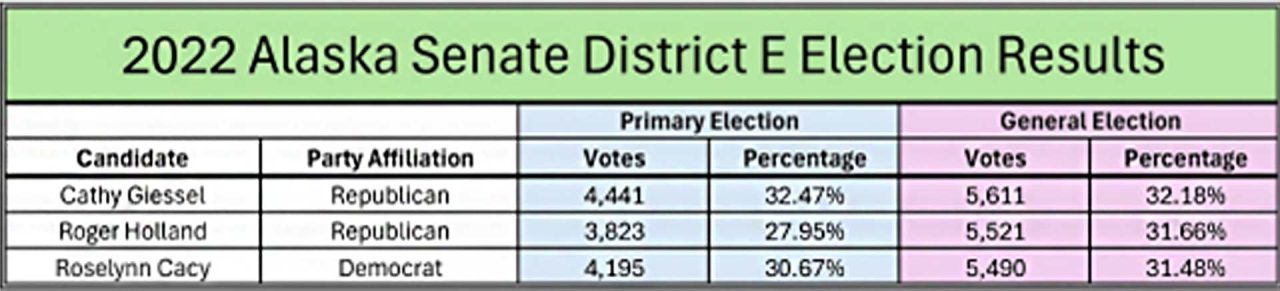
Giessel ran against the then-incumbent senator, Roger Holland. In the primary election, the vote was split very evenly between the two Republican candidates and their Democratic challenger; however, thanks to RCV, both Republicans were able to remain on the ballot for the general election. It was again a close three-way split, but thanks to the mysterious automatic RCV recount process, Giessel was eventually declared the winner. Readers should note that Giessel may have won, but a vast majority of over 11,000 voters wanted someone else to be their state senator.
Having benefited from RCV to win reelection, it is no surprise that today Giessel and her ABE organization are doing everything they can to preserve it. While voters have again raised enough signatures to put repealing RCV on the ballot this year, Giessel and ABE are suing the state to change how the initiative appears on the election ballot. Changing the wording of the initiative will likely confuse the voters and make it more difficult to repeal RCV, which is probably her intent.
Cathy Giessel is the poster child for Ranked Choice Voting in Alaska. She supported bringing it to our state, she has won elections using it, and she is doing everything she can to save it. Giessels re-election will be a referendum on it. If voters choose to repeal RCV, they should also vote Giessel out of office. Whatever else happens in this year’s election, Giessel desperately needs a primary challenger to run against her. Any volunteers?
The views expressed here are those of Greg Sarber. Read more Sarber posts at his Seward’s Folly substack.