
A new document from the Alaska Board of Education paints a sobering picture of persistent and ongoing failures of public education in teaching Alaska students basic reading, writing and arithmetic skills.
Education officials released a draft strategic plan last month, outlining three-year goals under the longstanding Alaska’s Education Challenge (AEC) framework. While the plan reaffirms five strategic priorities established nearly a decade ago, the accompanying data shows little to no gains across most grade levels.
The document emphasizes the need for accelerated improvement. Yet statewide assessments reveal that the vast majority of Alaska students are failing to attain grade-level mastery of foundational subjects, further underscoring dismal achievements despite initiatives like the Alaska Reads Act.
EARLY LITERACY FLOUNDERS
Under Strategic Priority 1, which aims to support all students reading at grade level by the end of third grade, the plan sets targets based on screenings and statewide assessments. Kindergarten through 3rd-grade students made progress during the school year. For example, the percentage of students performing at or above benchmark on literacy screeners rose from 41% at the beginning of 2023–2024 to 57% by year-end, and from 44% to 59% in 2024–2025. However, end-of-year performance remains below 60%, leaving a significant portion of young learners behind.
Grade 3 English Language Arts (ELA) proficiency on the AK STAR tells a similar story of incremental but insufficient improvement. In 2023, just 27.28% of third-graders scored proficient or above. The rest were failing.
That edged up slightly to 27.89% in 2024 and 28.68% in 2025.
The plan acknowledges that the rate of improvement must accelerate dramatically, especially for third grade, which is considered a pivotal “transition point” where students shift from learning to read to reading to learn; persistent gaps here risk compounding challenges in later grades.
Looking more broadly, in grades 3-9, only 32.69% of students were proficient in reading, with nearly seven in 10 failing.
MATH SCORES LANGUISH
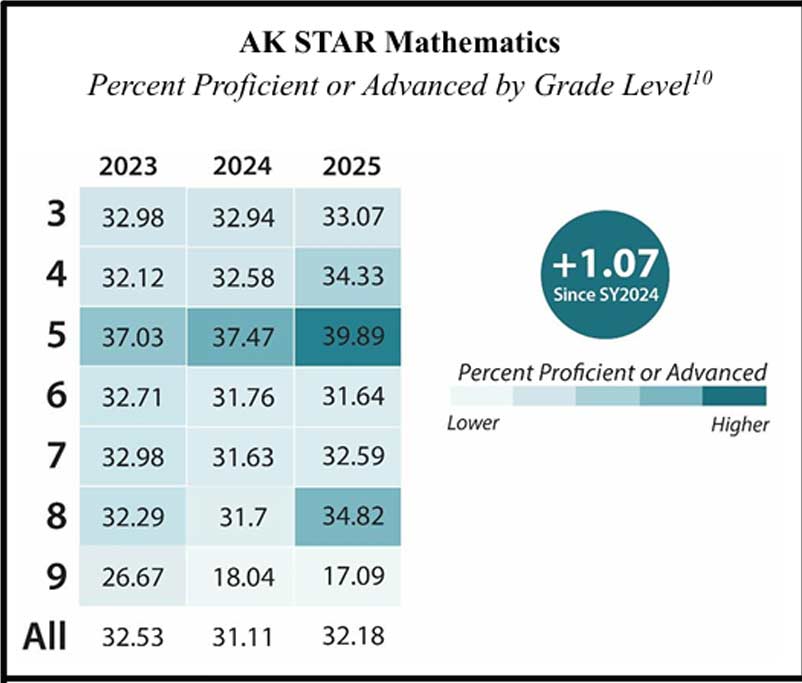
Mathematics performance mirrors the literacy challenges. In grades 3–9, only 32.18% of students could perform at grade level in 2025. The plan notes “modest improvement” in some early grades but highlights notable declines in upper grades, particularly grade 9, where a staggering 83% of students are now failing to attain the basic proficiency level. This suggests there are major gaps in the lower grade levels that are undermining student readiness for high school math.
The latest report shows that Alaska’s public school system is continuing to suffer from a chronic inability to instill basic reading, writing and math skills.
Other areas of the report focused on career-technical education (CTE), educator workforce development, and student well-being. Despite dismal academic scores, bullying incidents appear to be declining.
The continued failure of public schools to instill basic academic skills comes despite historic increases in funding, as unions and career bureaucrats continue to oppose efforts to tie education spending to outcomes, while opposing efforts to expand school choice options such as homeschool, charter schools and scholarships that follow students to whichever schools their parents choose – public or private.
The education board has opened the plan for public comment before final adoption. Comments must be sent via email to eed.stateboard@alaska.gov. The deadline is Aug. 10.






9 Comments
Could you find the numbers for each school district? That would be helpful and tell which districts are faithfullly teaching their Science of Reading curriculum. Some curriculums may be better than others.
Put your kids in homeschooling or a private Christian school.
How on earth did we all learn to read, write, do math, and understand science? Get rid of the gimmicks, teach the basics, rote learning until the basics are in place, and then teach how to think. It isn’t rocket surgery here, folks. Perfectly simple. But of course, we can’t have that, because all the “science of education” people need their phony baloney jobs.
Get your kids out of public schools. They have become sewers.
Our guvormunt makes us praise!
Praude!
1dunce + 1 dunce = a lot of taxes!
This is the result of Dunleavy standing tall
Is this strategic plan or a political surrender to existing challenges and a continuation of the status quo.
1. Strategic plan appears lack significant changes from previous approaches that have led to academic failure among students.
2. Smart goals do not provide specific details or clear direction for addressing any underlying issues -ie strategic goals 1 and 3
3. Heavy emphasis on increased testing and mandated attendance without detailed plans for providing a content rich curriculum. -no detailed scope and sequence
Will there be any further, possibly in-depth, coverage of these “smart goals” given the window for commenting is rapidly closely and the critical role public education will play in Alaska’s immediate future.