
In Alaska, public education carries extraordinary power and control. It does more than transmit mathematics, science, history and language; it helps shape how young people understand authority, citizenship, rights, government and their relationship with one another. Precisely because that influence is so great, public education must resist the temptation to transform instruction into political mobilization. The proper purpose of civic education is not to produce students who arrive at an institutionally preferred conclusion. It is to produce citizens capable of reaching conclusions for themselves.
History demonstrates why this distinction matters. Some of the greatest political catastrophes of the 20th century occurred when ideology ceased to be an idea open to examination and became a doctrine enforced through institutions. The Soviet Union under Stalin, Nazi Germany under Hitler, Maoist China, Cambodia under the Khmer Rouge, and Iran under revolutionary clerical rule demonstrate the immense and tragic human cost that can follow when totalizing ideologies are fused with centralized state power, political conformity is enforced, and the rights and dignity of the individual are subordinated to the objectives of the regime.
The resulting suppression of dissent and the subordination of the individual to an ideological objective destroys human lives, potential and true societal progress. History provides abundant warning that revolutionary socialist movements have developed into communist and Islamic systems in which political conformity displaced individual liberty and independent judgment.
A disturbing pattern emerged in Alaska in both 2024 and 2026.
The lesson is not that students should be protected from any political philosophy. The opposite is true. They should study all of them seriously. Students should read Adam Smith and Karl Marx, examining how Western liberalism, socialism, and Islamic political thought have understood property, labor, government, social order, and human flourishing. Students examine labor movements and free markets and compare the promises of political systems with their historical results.
They should be taught to distinguish ambition from outcome and propaganda from evidence, and to understand why the American constitutional system, grounded in individual liberty, representative government, free enterprise, private property, and the rule of law, has produced a more durable foundation for freedom, prosperity, and human flourishing than the totalitarian alternatives history has repeatedly tested.
That educational obligation becomes compromised when taxpayer funded institutions move from teaching political participation to manufacturing it.
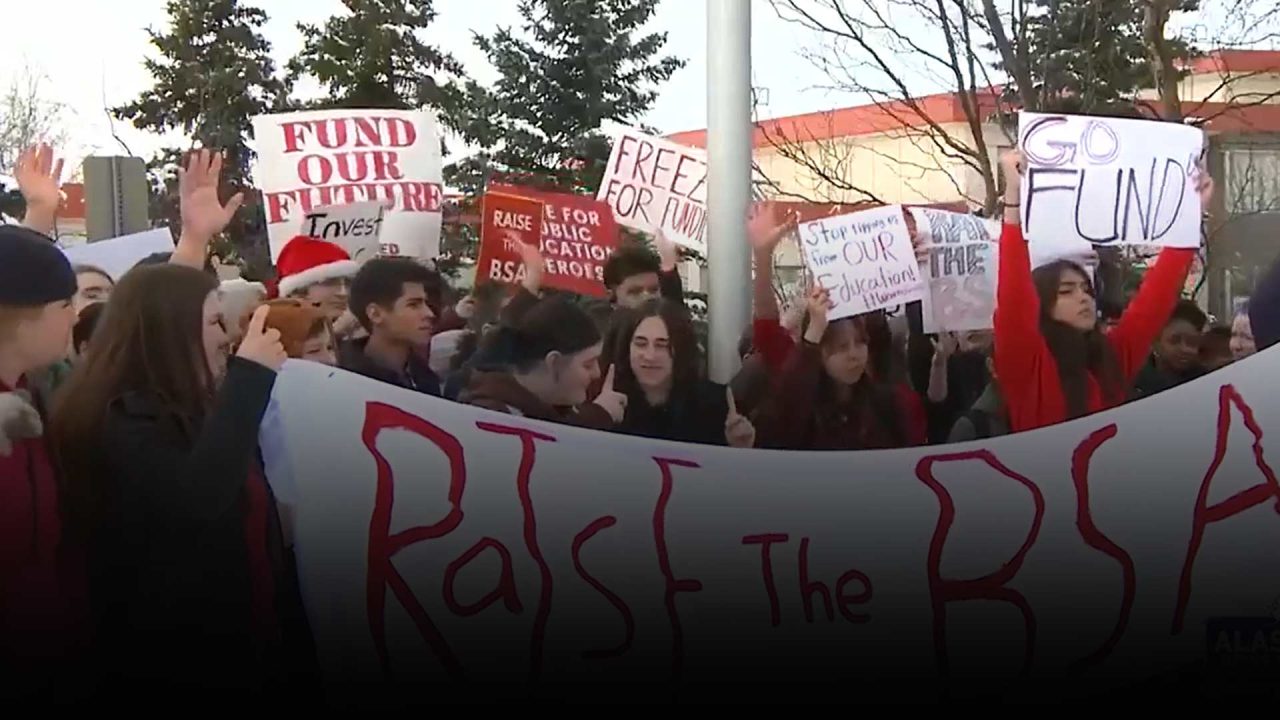
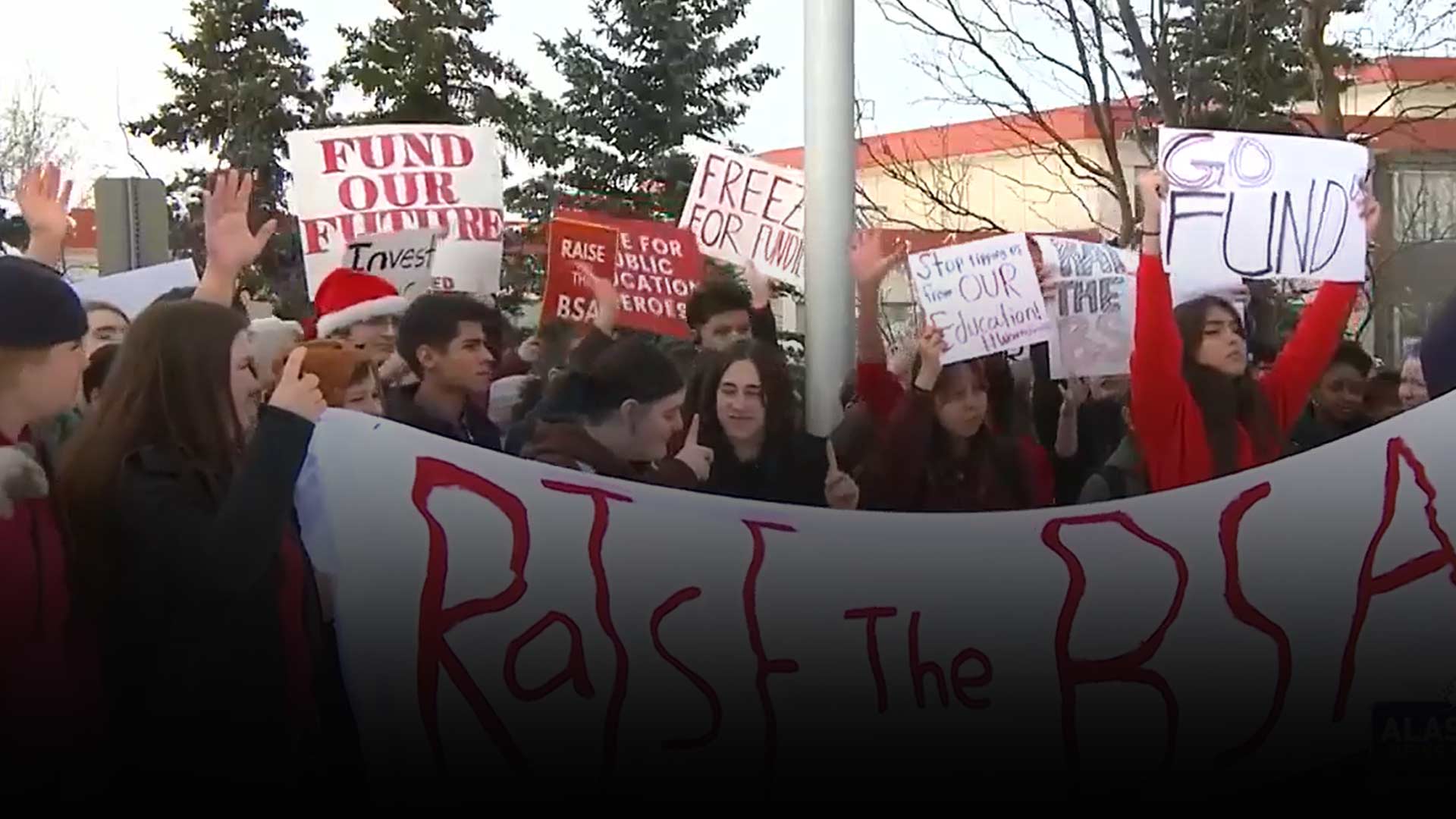
A disturbing pattern emerged in Alaska in both 2024 and 2026. On April 4, 2024, hundreds of public-school students left their classrooms during the instructional day to participate in a coordinated statewide political walkout protesting Governor Mike Dunleavy’s veto of an education-funding bill and the Legislature’s failure to override it. That action was organized through the Alaska Association of Student Governments, a statewide student-government structure supported by the Alaska School Activities Association, and it advanced a political objective that NEA-Alaska was simultaneously pursuing as a major legislative priority.
Then, in 2026, Anchorage School District itself reported another district-wide student walkout, this time in response to proposed budget cuts, with particularly strong participation at Polaris K–12.

When school-day political walkouts become recurring instruments of pressure on elected officials, and when those actions arise within an educational environment surrounded by powerful institutional actors advancing the same policy objectives, a dangerous boundary begins to disappear. The school risks ceasing to be merely the place where students learn how citizens exercise political power and becoming instead one of the places from which that political power is organized, amplified, and projected through the students themselves.
Anchorage School District stated that it did not advocate student participation and that classes continued normally, an important factual distinction from direct institutional sponsorship. Yet the District’s response also risked creating plausible deniability by distancing leadership from the walkout itself while leaving unresolved the more fundamental question of whether existing attendance, truancy, and student-conduct policies were enforced against participants in these school-day walkouts.
Yet the deeper concern remains. Once organized political action is embedded in or closely connected to the public-school system, occurs during the school day, and advances causes simultaneously championed by powerful institutional actors within public education, the distinction between teaching students how democracy works and drawing them into an organized political campaign begins to erode.
At that point, the danger is no longer merely theoretical: the public education system risks becoming not simply a place where political ideas are examined, but an environment through which political power can be cultivated, organized, and projected through the students themselves.
Students possess the same fundamental rights in civic life as other citizens. But those rights belong to the students themselves; they are not a license for public officials or taxpayer-funded institutions to steer students toward politically preferred causes. A public education worthy of a free society should give young people the history, evidence, constitutional knowledge, and intellectual tools necessary to decide what they believe; not place the authority and prestige of government behind an effort to decide it for them.
ALASKA WATCHMAN DIRECT TO YOUR INBOX
Education unions illustrate another dimension of the problem. Alaska law does not define a public employee organization ideologically. Its legal purpose concerns representation of employees regarding wages, hours, grievances, benefits, and working conditions. Yet organizations such as NEA-Alaska and the Anchorage Education Association have voluntarily moved well beyond the traditional functions of collective bargaining, wages, benefits, grievances, and working conditions.
They have embraced a much broader political and social mission to influence the direction of government and public institutions. Viewed in that broader context, the convergence with the political program advanced by organizations such as the Democratic Socialists of America is not merely striking, it is deeply troubling and contrary to American values and norms.
The significance lies in the convergence of objectives and methods: organized labor as a vehicle for political power, control and broader efforts to reshape economic and governmental policy. What began as an employee organization created to represent teachers in their employment relationship has therefore become something substantially different. When a well-financed political and ideological institution operates inside, alongside, and with significant access to the very public education system whose employees it represents, the risk is that collective bargaining power becomes institutional political influence and the classroom becomes indirectly exposed to agendas far beyond wages, hours, and working conditions.
And how much of this institutional political machinery is ultimately underwritten, directly or indirectly, by taxpayers?
Public education must develop independent political judgment rather than manufacture political participation.
The views expressed here are those of the author.





8 Comments
But you like the dissent if it benefits YOUR side, right?
No, Paul. That is precisely the distinction the article makes. Students have every right to dissent, protest, organize, and advocate for causes I agree with or strongly oppose. Those rights belong to them. My objection begins when a taxpayer-funded public institution uses instructional time, institutional structures, personnel, resources, or its authority to facilitate political mobilization. And I would apply exactly the same standard if students were being mobilized for a conservative, socialist, pro-life, environmental, gun-rights, labor, or any other political cause. If students independently choose to protest for a cause I support, the same attendance and conduct rules should apply to them as to students protesting for a cause I oppose. Otherwise, we are no longer defending dissent; we are deciding which dissent government will favor. That is the entire point: the school should teach students how to think, speak, dissent, and participate. It should not decide which political movement deserves their participation.
Do you disagree ?
I think both sides of the political spectrum should “dissent” each other out of existence and leave the rest of us alone. You Republicans and Democrats do nothing to actually help humanity. You only virtue signal and blovate about some stupid social justice issue that isn’t a problem to the rest of us common folk. “Boo hoo my Christianity” “Boo hoo my child’s taxpayer funded gender affirming care.’
We don’t care! Deal with your own problems for God’s sake. I have had to deal with mine.
When did humanity become so damn petty and pathetic?
Please meteor, just end it all!
Not the point at all . The fact that American students are taught just about everything else but the three r’s are the problem , you can’t even hold kids back anymore . They graduate at about a fifth grade level now
Man, way too many words but these stuck out to me: “ Some of the greatest political catastrophes of the 20th century occurred when ideology ceased to be an idea open to examination and became a doctrine enforced through institutions.” Talerico, do you think your statement applies to the Trump administration’s rewrite of history within the National Park Service and the Smithsonian Institution? How about Texas demanding the christian 10 commandments be displayed in public schools?
Captive children are the easy target for culture change agents. Just take a glimpse of an NEA annual convention to see their real goals. There are many decent teachers, but they are participants in a system promoting radical ideas that were classified as mental illness twenty-five yrs ago. It’s how you get a WNBA basketball league that doesn’t know what the W means.
Per the Constitution of the State of Alaska, ‘ Article Vll Section1, The legislature shall by general law establish and maintain a system of public schools open to all children of the State and may provide for other public educational institutions. Schools and institutions so established SHALL BE FREE FROM SECTARIAN CONTROL. No money shall be paid from public funds for the direct benefit of any religious or other private educational institution.
In other words, NO UNION POLITICS IN OUR SCHOOLS!
NO PARTISAN POLITICS IN OUR SCHOOLS.