



Alaska is rich, its people are strong, but its government is fat and afraid, and now the reckoning comes. After decades of unchecked bureaucratic growth, structural inefficiency, and a dangerous dependence on volatile oil revenues and federal handouts, the state is drifting toward unsustainability.
This isn’t the result of fate, but of political complacency driven by a fragmented leadership class more concerned with preserving power than with protecting the long-term interests of Alaskans. What we face now is not just a fiscal challenge, but a test of principle: Will we continue to feed a government that grows while producing less, or will we return to the sobriety of limited, responsible, and accountable governance – one that lives within its means, serves its people efficiently, and safeguards their future?
It must be fixed.
With the strategic use of existing federal funds, Alaska can reinvent itself. It starts by cutting its bloated government, restoring the original Permanent Fund Dividend (PFD) statute, transitioning public workers into private sector resource development, and reclaiming its fiscal sovereignty.
In addition to restoring the full statutory PFD going forward, this plan includes a structured mechanism to repay eligible Alaskans for the portions of their dividends unlawfully withheld in past years. The state has diverted tens of thousands of dollars per person from rightful dividend payments since 2016. These funds that were promised under AS 37.13.145 but denied through budget maneuvering and political betrayal.
This reform plan makes repayment feasible without harming the Permanent Fund corpus, raising taxes, or increasing state spending. Using reformed budget savings and earnings-based transfers, repayment would occur over a multi-year period and reflect the original legal formula. It is not only fiscally achievable under this model, it is a moral imperative. Alaskans were deprived of their lawful share of the state’s resource wealth, and this plan treats repayment as a foundational act of fiscal justice and public trust restoration.
This transformation can be fully launched without spending a single new dollar from the state treasury. At the same time, it enables Alaska to survive and thrive even at $40 per barrel of oil; a price that would cripple the current model but can sustain a lean, reformed government.
Alaska must convert its vast natural resource potential into active private-sector development by using the government’s own reorganization and federal transition funds to eliminate the very regulatory blocks that prevent growth.
The key insight is this: Alaska’s problem is not a lack of resources. Alaska’s problem is a surplus of interference.
Alaska must develop a detailed, preemptive regulatory strategy to dismantle its own bureaucratic roadblocks – without increasing state spending—by using existing federal funding programs to unlock private-sector growth through natural resource development.
Pursue the goal of transforming Alaska from stagnant to self-funded by using existing federal funds to fully cover the costs of the state’s transition.
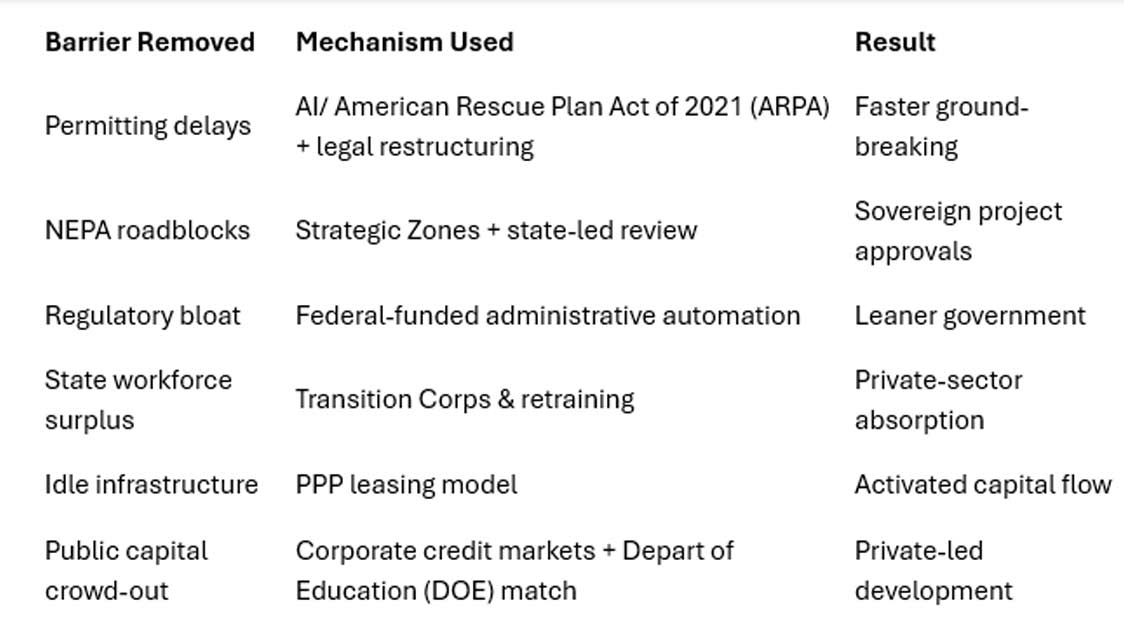
WHY THIS CAN BE DONE WITHOUT STATE FUNDS
Federal Funds Can Fully Cover the Transition Costs
Each key component of the reform plan aligns with federal programs already in place. These programs are not theoretical. They exist, are funded, and have been used by other states and tribal governments for similar purposes. The key is designing Alaska’s reform to align with eligible uses.
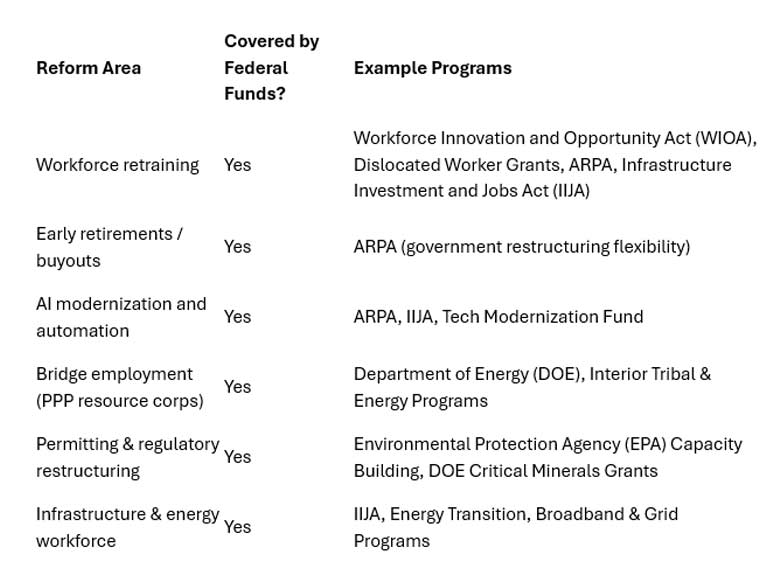
With intelligent design, Alaska can fund a full reorganization of its government, transition thousands of workers into the private economy, and establish modern, streamlined systems. This is all without increasing state spending.
Alaska must simultaneously deregulate, decentralize, and de-federalize its economic policy environment by using federal transition funds not only to shrink government but to remove the regulatory roadblocks that currently prevent private-sector growth.
The economic growth Alaska needs to absorb transitioned workers and replace government dependency will not come from grants or top-down planning, it will come from removing the barriers that government itself has erected.
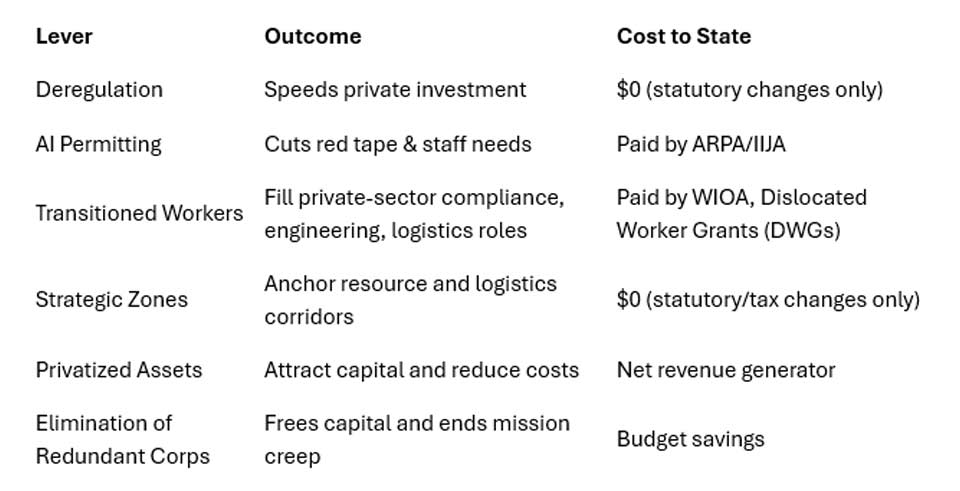
Temporary Use, Permanent Benefits
Federal funds are temporary, but that’s the point. These funds act as a bridge to long-term sustainability. When used strategically, they:
— Retrain and reassign public employees into productive private industries
— Modernize state operations, reducing the need for redundant staff
— Replace compliance-heavy federal programs with locally controlled solutions
The result is an annual savings of $600–900 million, which permanently reduces the state’s reliance on oil and federal transfers. This is not about growing government. It’s about replacing it with efficiency, discipline, and private productivity.
No Match Required for Many Federal Programs
One common misconception is that federal funding requires state matches. While this is sometimes true, most of the programs relevant to Alaska’s transition do not require general fund participation:
— WIOA and ARPA grant programs offer full federal cost coverage.
— DOE tribal and energy programs include direct disbursements for workforce, permitting, and infrastructure support.
— For programs like IIJA that do require a match, in-kind contributions (e.g., state staff time, public data access, office space) are often sufficient.
That means Alaska can access hundreds of millions in transition funding without spending down the Permanent Fund or levying new taxes.
Caveats: State Must Still Administer, Oversee, and Exit Dependency
While federal dollars can fund the transition, success still requires responsible execution. Three guardrails are essential:
Cash Flow Management
Federal reimbursements may be delayed. To cover startup costs, Alaska should prepare:
— A short-term revolving fund
— Flexible drawdown authority using existing reserves
Temporary Funds, Long-Term Discipline
Federal funds will expire. ARPA must be obligated by 2026 and spent by 2027. Therefore, Alaska must exit dependency by building a self-sustaining, post-transition structure in under five years.
Administrative Oversight
The state must:
— Ensure legal compliance
— Report use and outcomes
— Audit expenditures
— Monitor reforms and personnel transitions
This oversight does not require new general fund spending. It requires competent management and clear accountability.
Will This Work at $40 Oil?
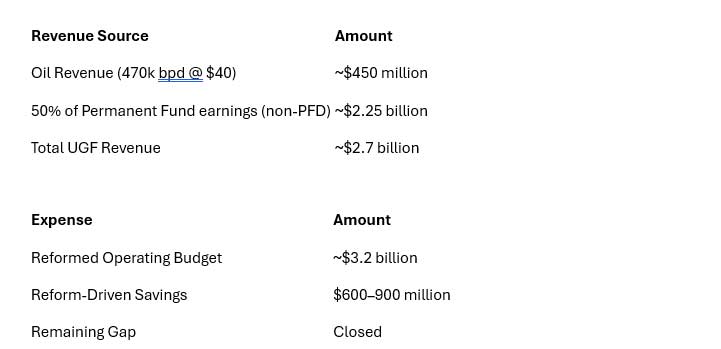
Under this model:
— No taxes are needed
— The PFD is fully restored under the original statute
— The Permanent Fund corpus is untouched and continues to grow
No — Under the Status Quo
Without reform, the math fails. At $40 oil, unrestricted revenues are under $500 million. With a bloated state budget of over $7 billion and heavy reliance on (Percentage of Market Value) POMV, Alaska cannot:
— Pay the full statutory PFD
— Avoid drawing from the Permanent Fund corpus
— Fund basic services without taxes or borrowing
In this scenario, either the PFD is gutted, taxes are introduced, or the state burns through savings. This will yield all politically radioactive and economically damaging outcomes.
In Summary
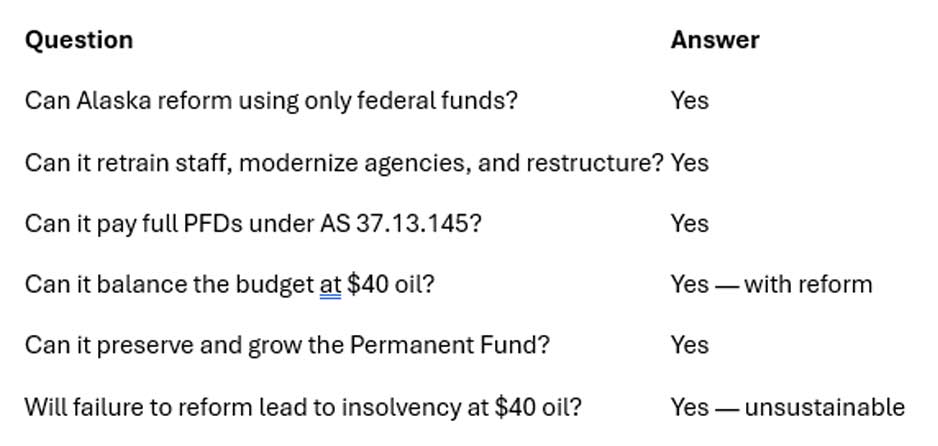
Final Word: The Last Window of Opportunity
Alaska has a rare opportunity to use Washington’s money to become independent from Washington. Federal funds that once enabled dependence can now be used to end it only if the state has the courage and discipline to act.
We will use federal funds as a temporary ladder to climb out of federal dependence, not as another chain to keep us bound to it.
The alternative is decline: shrinking dividends, growing bureaucracy, and creeping taxation. But with reform, Alaska can stand on its own, sovereign, solvent, and secure, even at $40 a barrel.
In Alaska, one path leads to dignity through self-reliance, the other to decay through dependence. The choice is not just economic — it is moral, and it is now.
The views expressed here are those of the author.






12 Comments
Working from home offers flexibility and convenience, allowing you to create a personalized workspace. However, it also requires discipline and clear boundaries to
stay productive….. Www.Jobs99.site
I just came across this amazing way to get this opportunity just a simple system that anyone can follow. so can you!
Don’t miss out on this life-changing opportunity…. Www.Worksprofit1.online
Working from home offers flexibility and convenience, allowing you to create a personalized workspace. However, it also requires discipline and clear boundaries to
stay productive….. Www.Jobs99.site
Make extra profit every week… This is a great part-time job for everyone… Best part about it is that you can work from your home and earn from 100-2000 Dollars each week … Start today and have your first payment at the end of the week………
Open This…………………. Www.Paycash1.site
Okay, I’m all ears and ready to hear more!
Steps to accomplish the stated goals? Bills? Votes?
Wow, some thoughtful discussion – now to kick some legisiative *** into gear to make it happen while sacrificing their cash cow being used since 2016. That will be the hard part, getting a majority in control to approve doing more with less State money while paying a full statutory permanent fund dividend. I don’t see it happening in my lifetime without a changing of the “guard” down there with new legislative conservative bodies.
nice
Join.Work43.Com
Michael, I had high hopes, but with common sense like that, you will never become a politician!
LETS BEGIN THIS REASONABLE ACCENT BACK TO A LOGICAL,MORAL, SENSIBLE, AND SUSTAINABLE FUTURE BR FIRST FIRING USELESS DUNLEAVY AND CREW! DEAD WEIGHT MUST BE REMOVED!!!!
Can reform happem without first reforming corrupted grand-jury, election, and voter registration systems? No.
.
Can reform happen while “dark money” is allowed to influence Alaska’s elections? No.
.
Can reform happen without benchmark data provided by forensic audits of Alaska’s finances and management practices? No.
.
Can reform happen when registered special interests outnumber legislators 7 to 1? No.
.
Can reform happen without legislative term limits? No.
.
Can reform happen while Alaska’s education industry is “owned” and operated in its present form, and ranks among the most overpriced and underperforming in the country? No.
.
Can reform happen while Alaska’s capital remains isolated in Juneau? No.
.
Can reform happen without clearly specified incentives, deadlines, and penalties for specified penalties for noncompliance? No.
.
Can reform happen with the present number of number of iieligible recipients on Medicaid?
.
If the answer to any question were “yes”, why isn’t reform a done deal already?
.
Bottom line: War talk’s fun, but how do you force the issue …make them take you seriously when they have all the lawyers, guns, and money, can that even be done?
.
Maybe $39 per barrel oil is exactly what we need; a 1980’s-style exodus starts, there aren’t enough left-behinds who can be taxed enough to support state government officials in the manner to which they’ve become entitled, their Permanent Fund life support runs out, and down goes this house of cards, to the disappointment of no one outside the Ruling Class.
.
Rats desert the ship they helped sink, maybe left-behinds can make their own state government: small, user-friendly, reasonably economical, something like our Founding fathers envisioned? Why not?
.
Now that’s “reform”, no?