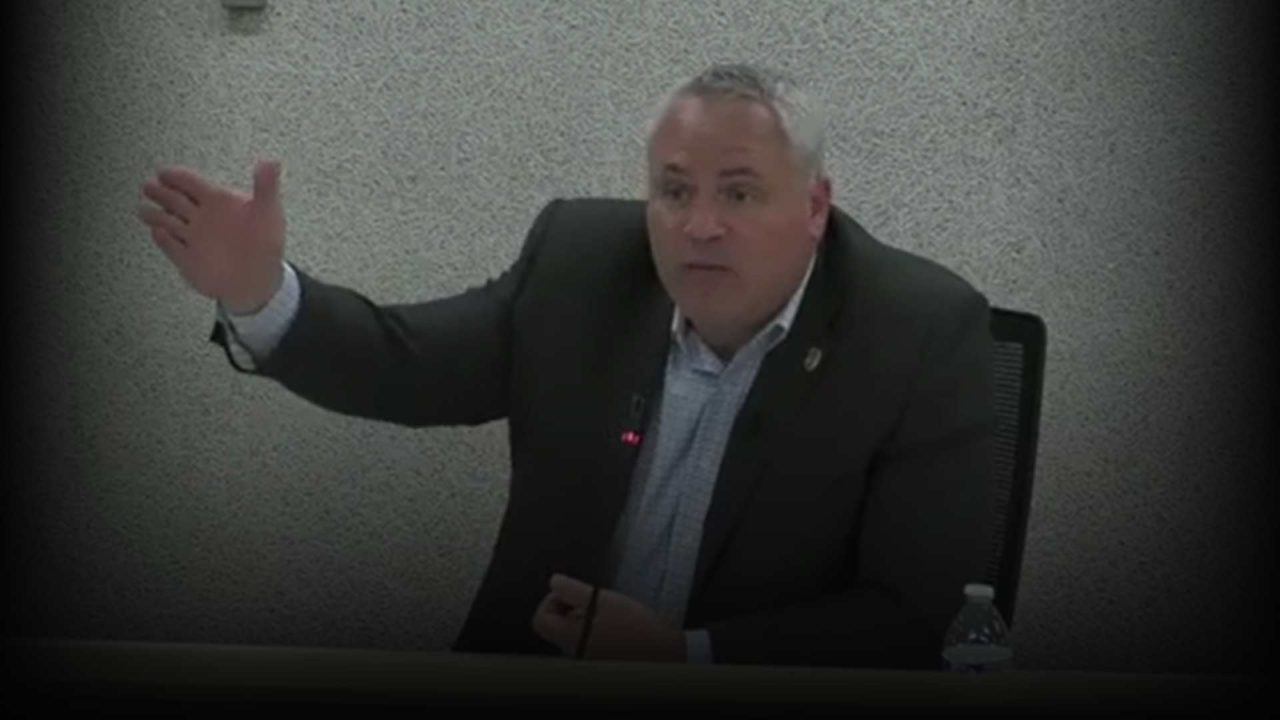


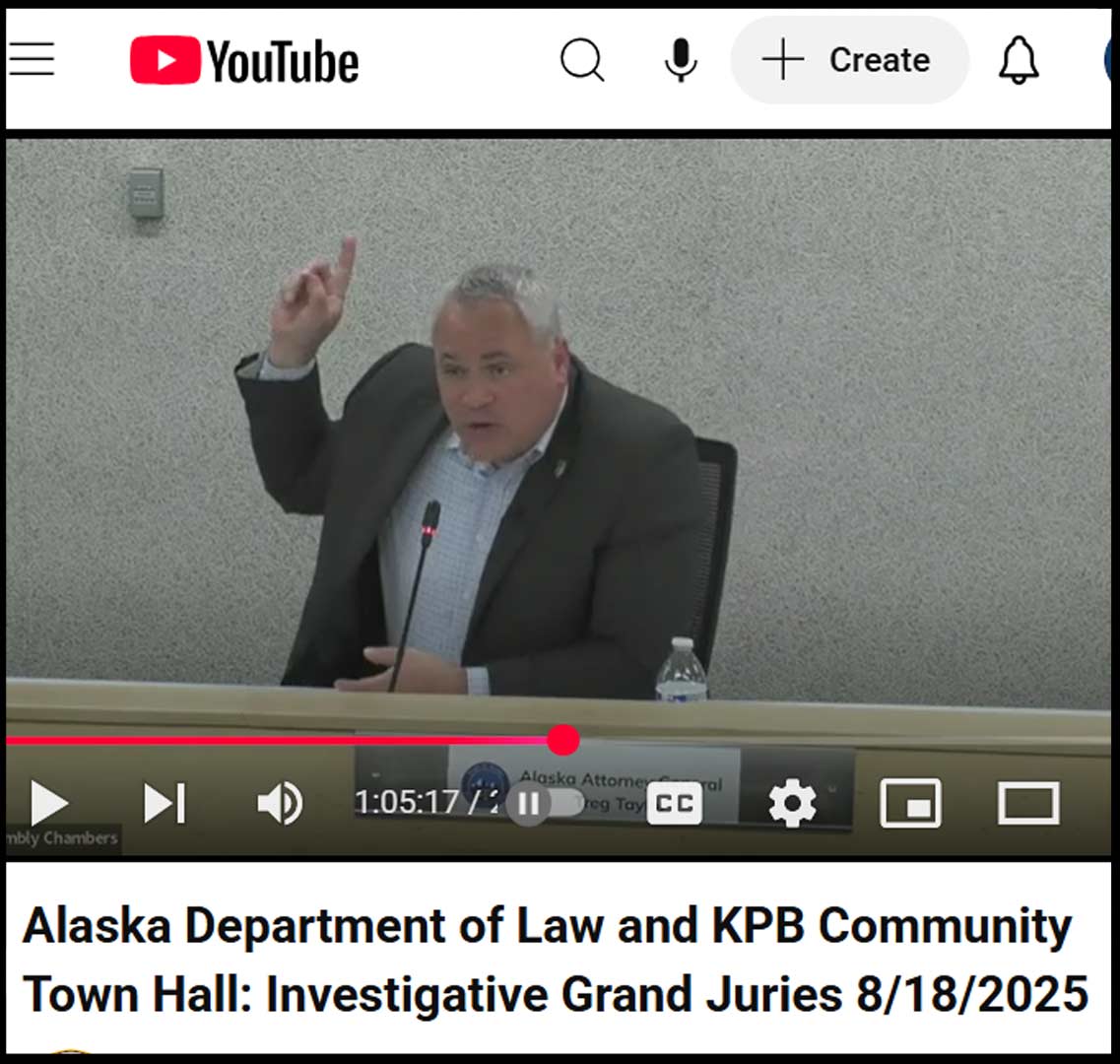
On August 18, Alaska Attorney General Treg Taylor gave a town hall presentation in Soldotna to “restore public confidence in the system,” and defend his new “process” wherein he is now the “gatekeeper” to all citizens’ access to investigative Alaska’s Grand Juries.
Kenai Borough Assembly chambers were packed with angry citizens, while Zoom participants buzzed with testimony and questions from one end of Alaska to the other. Taylor tried, but failed, to answer a non-stop stream of simple questions. Watch the video here.
Questions Taylor could not answer:
— Does your new process, which specifically prohibits citizens from appealing directly to the Grand Jury “directly,” violate Alaska’s Constitution, given that the 55 Delegates who wrote our Alaska Constitution stated the following – without a single voice raised in opposition: “The Grand Jury can be appealed to directly, which is an invaluable right to the citizen.” (See AK Constitutional Convention, transcript page 1328.)
— Does your new process, which specifically prohibits the grand jury from considering issues that affect only one citizen or from looking at court cases, violate Alaska’s Constitution, given that the 55 Delegates – without a single objection – stated the following: “[T]he Grand Jury can be utterly vital…in its investigative power as well as for the fact it is sitting there as a panel sometimes is the only recourse for a citizen to get justice, to get redress from abuse in lower courts. …it is the only safeguard a citizen occasionally has when for any reason, and very often for political reasons, a case is not dealt with properly.” (AK Constitutional Convention transcript page 1328.)
— You promise to provide “independent” counsel to any Grand Jury investigating your Department of Law (DOL). How do you explain the 2022 Kenai Grand Jury, which was exploring allegations that your Dept. of Law was covering up evidence that might show that the sole investigator of Alaska’s judges for the last 36 years has falsified official investigations to keep corrupt judges on the bench – 8,000 plus investigations so far? The 2022 Kenai Grand Jury specifically asked for “independent” counsel but instead was provided an attorney who once, while working for the DOL, personally investigated and exonerated the very judge investigator from the exact same evidence the Kenai Grand Jury was reinvestigating.
— How do you explain that when this “independent” counsel was asked about how he was selected to assist the 2022 Kenai Grand Jury, he never informed the jurors of his conflict in representing them? He is recorded stating: “The system wants this to go away, and they pushed it to me because they thought I would be a conduit to kill this.” (Recording at alaskastateofcorruption.com)
— You claim that since Alaska had no written process explaining how citizens could appeal to the Grand Jury, you had to make one up. In fact, however, the original Alaska Grand Jury Handbook (written by Alaska’s first Supreme Court) contains a clear written process for citizens to appeal to the Grand Jury: “A citizen is at liberty to apply to the Grand Jury for permission to appear before it in order to suggest or urge that a certain situation should be investigated by it. Charges of crime may be brought to your attention in several ways: (4) by private citizens heard by the Grand Jury in formal session, with the Grand Jury’s consent.” (See pages 5 and 6 of the original Alaska Grand Jury Handbook.)
— By what authority did our current Alaska Supreme Court remove from the Alaska Grand Jury Handbook, the verbiage that explains to citizens how they can appeal directly to the Grand Jury? By what authority did the Supreme Court then insert verbiage ordering citizens to first give their evidence of government corruption to the government, who then decides if it will be passed on to a grand jury for investigation? (See original and subsequent Alaska Grand Jury Handbooks)
Questions Taylor answered:
After Taylor claimed Supreme Court Order (SCO) 1993 authorized his new “process,” one citizen claimed SCO 1993 was unconstitutional and asked Taylor if he agreed. Taylor said he did agree that SCO 1993 was unconstitutional.
When questioned on whether the Kenai Grand Jury recommendation should be released to the public, Taylor agreed it should be released, because not doing so contributed to the public’s distrust of the system. Alaska’s judges, however, permanently sealed the recommendation before the public could ever see it, even though it contains the results of the Grand Jury’s year-long investigation into a DOL cover-up for Alaska’s only judge investigator. This, now sealed, grand jury recommendation was specifically written to the public.
Article 1, Section 8 of the Alaska Constitution states: “The power of Grand Juries to investigate and make recommendations concerning the public welfare or safety shall never be suspended.” Additionally,Alaska Constitution Bill of Rights preamble states: “The Grand Jury is preserved, for all purposes, particularly for investigation of public officials.”
False Statement by Taylor
During the Aug. 18 meeting, citizens asked Taylor why the 2022 Kenai Grand Jury was only empaneled with 12 Jurors and zero alternates, when court rules require 18 jurors, not including alternates, six of which are provided for all other Alaska Grand Juries, for a total of 24. Citizens also asked how it was possible that one juror disappeared, rendering the Kenai Grand Jury powerless and causing the dismissal of their felony indictment of Judge Margaret Murphy. (Alaska’s Constitution requires a minimum of 12 Jurors for a quorum.) Taylor said he could do nothing because it was the “independent” prosecutor who had impaneled only 12 Grand Jurors, not someone who worked for him. That is not true. In fact, the 2022 Kenai Grand Jury was impaneled by Chief Assistant Attorney General Jenna Gruenstein, who works directly for Attorney General Taylor. Only after the Grand Jury had been empaneled, and it discovered evidence of DOL corruption, did the Kenai Grand Jury realize they needed “independent” counsel.
Riveting Highlight
On Zoom, one caller identified himself as a former FBI agent who had worked on government corruption cases in Puerto Rico and Detroit before being assigned to do the same in Alaska for six years. He noted that while government corruption was bad elsewhere, it didn’t even compare to Alaska’s levels. He then testified, “Every time I worked a corruption case [in Alaska] it was corrupted by either federal or state officials.”
Conclusion
Taylor urged all Alaskans to accept and use his new “process,” claiming he would be a benevolent and kind “gatekeeper,” willing to let all kinds of things be investigated by the Grand Jury. But this is the same as asking We-The-People to submit as slaves, simply because our master promises to be benevolent and kind. What happens when Taylor is replaced? And what happens if he is lying or covering up corruption regarding his entire tenure as our attorney general?
Before accepting anything, we need a thorough, independent and – most importantly – public investigation into everything discussed above. How can we possibly fix the system or know who to trust before we know how extensive the corruption is, and who is involved?
This was the exact situation in 1994 New York City:
New York City’s 1994 Mollen Commission Report (independent commission appointed by Mayor Dinkins to investigate in public): “To cover up their corruption, officers created even more: they falsified official reports and perjured themselves to conceal their misdeeds. In the face of this problem, the Department allowed its systems for fighting corruption virtually to collapse. It had become more concerned about the bad publicity that corruption disclosures generate than the devastating consequences of corruption itself. As a result, its corruption controls minimized, ignored and at times concealed corruption rather than rooting it out. Such an institutional reluctance to uncover corruption is not surprising. No institution wants its reputation tainted – especially a Department that needs the public’s confidence and partnership to be effective. Since no entity outside the Department was responsible for reviewing the Department’s success in policing itself, years of self-protection continued unabated until this Commission commenced its independent inquiries.”
ALASKA WATCHMAN DIRECT TO YOUR INBOX
Please join me in demanding that the governor appoint a Mollen-type commission that can investigate in public. Gov. Michael Dunleavy and AG Taylor have refuse to respond to numerous requests by a group of five individuals (including two borough mayors) to meet for one hour, in order to present evidence that would require the governor to appoint such a commission. (See certified letters to Governor Dunleavy and AG Taylor, and the evidence of corruption supporting them, at alaskastateofcorruption.com)
Please ask all gubernatorial candidates to pledge that, if elected, they will appoint such a commission to investigate – a commission that includes the 11 Kenai Grand Jurors who have yet to disappear.
If none of this works, please join me in conducting a sit-in on December 11, 2026, (about a week after the swearing in of Alaska’s new governor). We plan to gather outside the governor’s office at the Robert B. Atwood Building in Anchorage, and remain there until Alaska’s new governor appoints an independent commission – one that includes the 11 remaining Kenai Grand Jurors – to fully, fairly and effectively investigate all the above in public.
If you are willing to join me, please send me your name, email, and phone number.
Most Sincerely,
David Haeg – haeg@alaska.net or (907) 398-6403
The views expressed here are those of the author.





4 Comments
We have an Alaskan Governor Administration that will adhere’ to garbage and illegal means for what ever the problem or to correct in this administration’s distorted end.
Wow! Taylor gets visibly flustered and wants to lash out at the public. There’s more than a gatekeeper’s position he shouldn’t be responsible for. Bummer to see up close such an ineffectual functionary.
TAYLOR WAS DEALING WITH A HEMROID AT THE TIME!!!
When Alaska’s constitution was drafted, it aimed to insulate judges and district attorneys from the whims of public opinion by establishing an appointment system instead of elections. The governor selects from nominees provided by the Judicial Council, which maintains a permanent majority of lawyers. This structure was intended to uphold the impartial rule of law. Regrettably, the constitution was crafted by honorable men for a world of honorable men, and the experiment has largely failed to achieve its noble ideals.