

In the 1970s, awash with new money from the North Slope oil leases, the Alaska Legislature understood the historic need for Alaska food security. It is a centuries-old problem, which the Russians tried to solve by establishing a ranch in northern California. The problem continued well into the 20th century, when gold rush prospectors battled scurvy during winter months, in need of fresh vegetables.
Government subsidies, however, are a proven failure, as FDR’s New Deal in the Matanuska Valley homesteading experience proved in the 1930s. Sure, some farms held on, but the romance of the effort has exceeded the reality. Matanuska Maid Dairy also went the same way, pouring milk down the gutters because imported milk from the Pacific northwest and even the Midwest was more economical, despite state subsidies.
The same general failure applied to the Delta Barley Project. Mostly, the lack of infrastructure was its undoing. Grandiose plans would have had grain being trucked to Fairbanks, with maybe even a spur line of the railroad extending to Delta. Then, it would go down the line to Seward for export to Asia. But attracting venture capital for Alaskan farming is too risky. Meat packing plants, mills, storage silos and docks are expensive, and banks are understandably hard-headed about loans for farming in the Far North.
To modify a phrase from the movie Field of Dreams, “If you build it, will they come?”
ALASKA WATCHMAN DIRECT TO YOUR INBOX
The soil in Delta, and with a more predictable climate than southcentral, has proven worthy enough to make it work. Summers are warmer than in southcentral. But the subsidized farms that were cleared have left about 20,000 acres of land fallow and unused, not because it doesn’t work, but because there is no place to process the meats and grains. One livestock farmer said he operates at about 20% capacity because of this problem. Then, there’s the problem with federal subsidies, paying landowners to leave the fields alone.
Recently, new land was cleared for farming near Nenana, but some Alaskans have scoffed at the effort. Those 20,000 acres already lie awaiting in Delta, like a wall-flower at a dance, hoping for a suitor. In the meantime, left to their own devices, a few savvy farmers are making quite a success story, which might pilot the way for a renewed effort at Alaskan food security.
The Alaska Flour Company, run by Bryce and Milo Wrigley and their families, have a full line of various products, found in many of Alaska’s grocery stores, and available for order online anywhere in the world. As owners of the state’s only grist mill, imported from Denmark, their plant makes flours for various and creative baking needs: bread, pancakes, brownies, cous-cous, cupcakes and more.
This award-winning commercial is hilarious, and the Wrigley’s business savvy extends even to guided tours of their operation through cooperation with the big busing companies. Visitors, already amazed at our scenery, can see how farming is done at 64* north latitude.
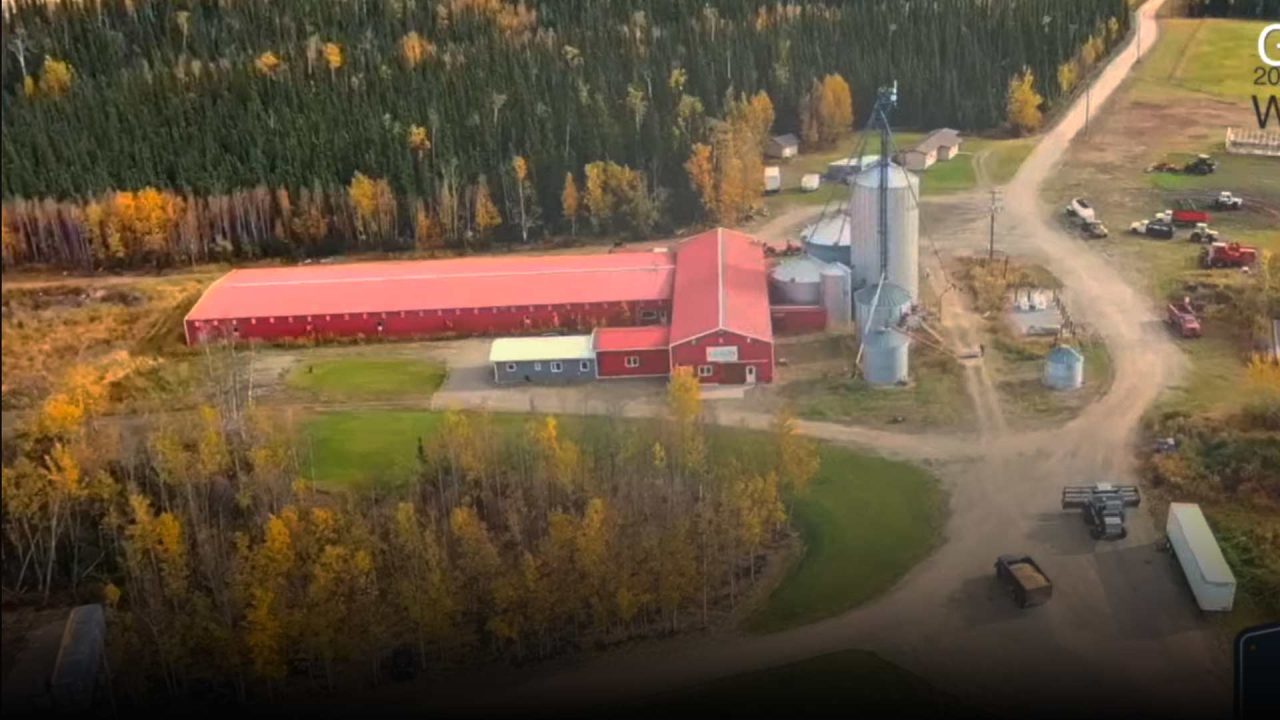
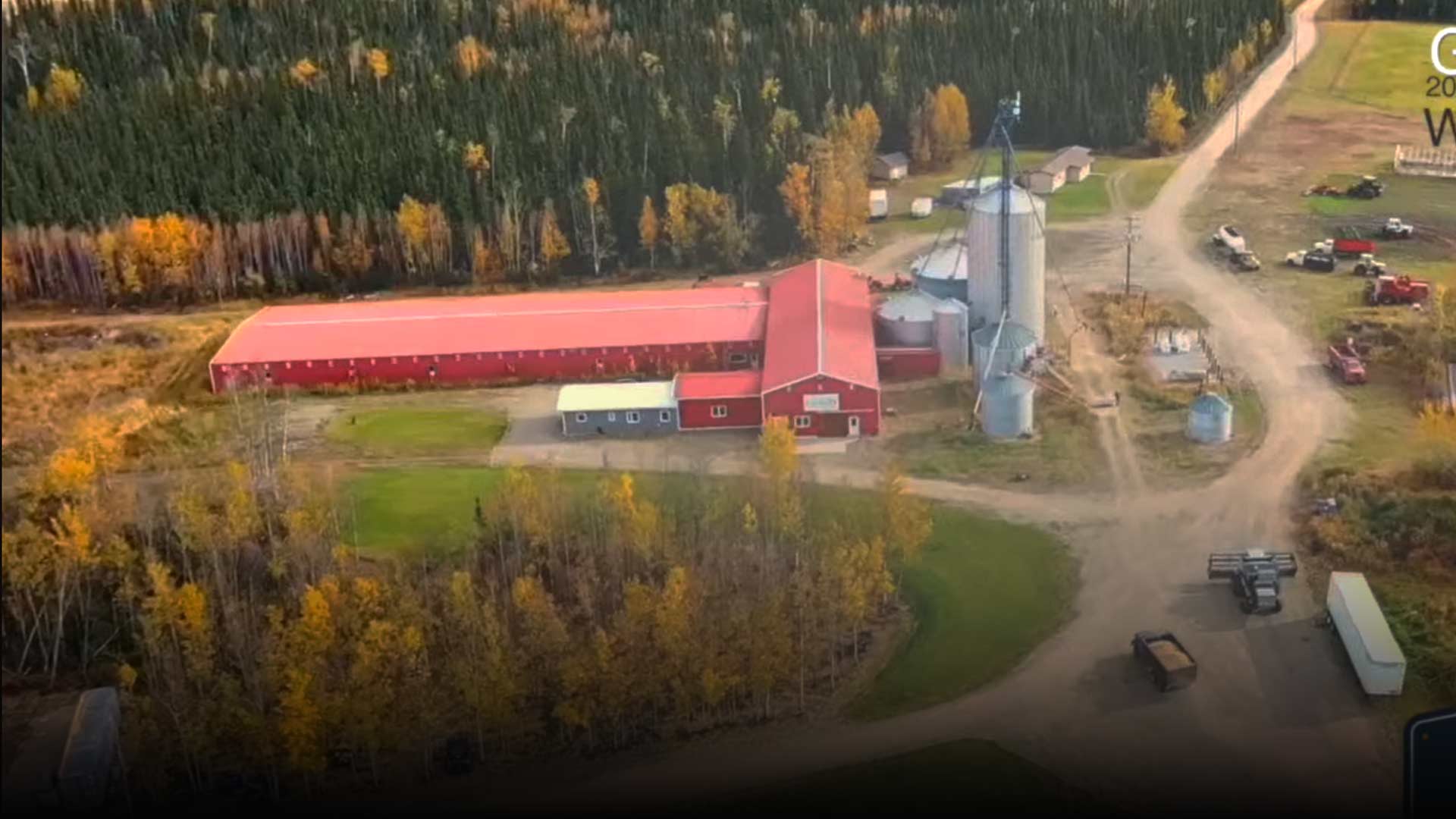
I recently visited the Wrigley farm operation for the second time. Its million-dollar line of combines was impressive, along with the mill, the silos, the enormous acreage and the optimism their family had in what they were doing. Bryce is motivated to serve Alaska’s fragile thread of food security, a fact that has become increasingly obvious. The politics of the Pacific northwest and the Covid crisis renewed that historic awareness to many Alaskans for the first time.
The Delta agricultural experience is truly Alaskan: hundreds of wild buffalo roam the area, along with thousands of migrating sandhill cranes and Canada geese. For myself, I am content to hunt the windrows for sharptail and ruffed grouse.
Then, there is the Alaska Range Dairy, whose ship has definitely come in. When the Matanuska Maid Dairy closed in Palmer, Delta farmer Scott Plagerman and his family purchased the cows. He already raised livestock, feeding them with his own field peas and hay. He installed a laser-guided milking operation, and instituted a true “quality control” of his milk.
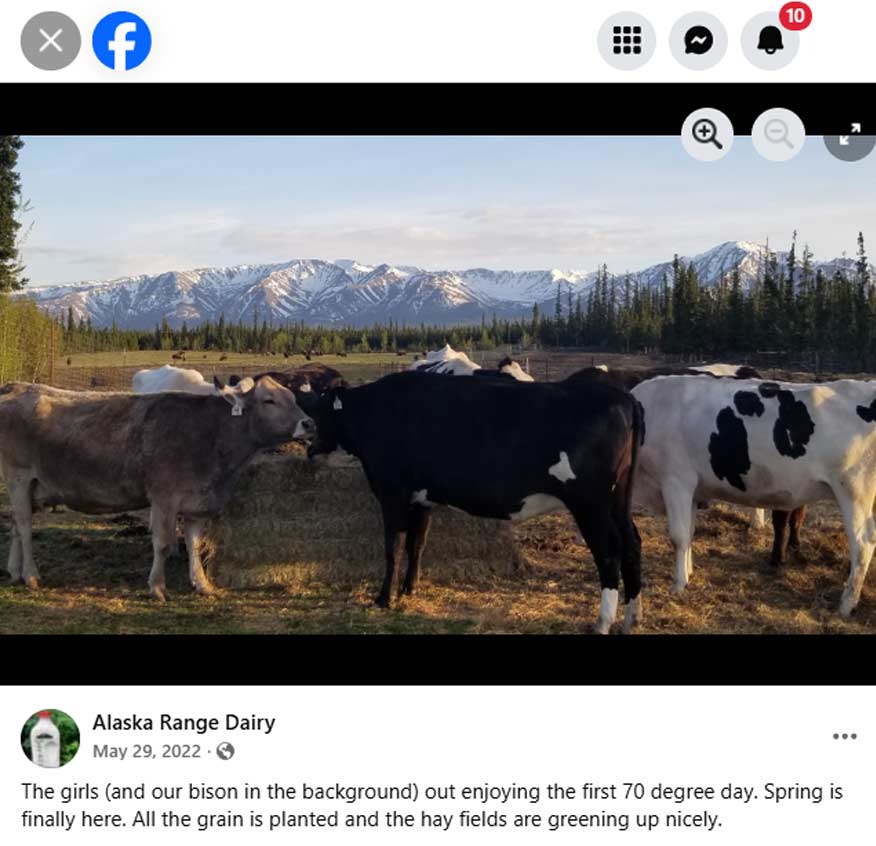
This included a slower pasteurization process, which was just one way to produce better-tasting milk. But the most daring effort was to not homogenize it. This would entail the need for glass-deposit bottles, plus a healthy shaking before each use, to mix the cream back into the entire bottle.
And while it’s no guarantee, the lack of homogenization often leads to the ability for lactose-sensitive consumers to once again enjoy a glass of milk, a glass that I often compare to a rich milk shake. I saw this play out with one of my home schooled students, who suffered from lactose sensitivity. It was an emotional moment for his parents, who were so grateful that their son could once again enjoy milk, long considered an essential staple for growing children! And now the Alaska Range products include yogurt, chocolate and strawberry-flavored milk.
I myself had never heard of strawberry milk, but I found it delightful, and absolutely perfect for use in cold cereals. Yes, these products are expensive, but people will pay for quality, like it’s a fine wine.
The Plagerman dairy now has 70 cows. Originally targeting a niche market of natural, health and Mom-and-Pop stores, it now serves some of the larger grocers. The big stores do not want to handle the glass-deposit bottles. A plastic container does not release the creamy residue as easily as glass, but it has also proven a great favorite for this delicious Alaskan-produced milk.
Ken and Barbara Greenleaf’s Big Delta Brewing Company in “downtown” Delta serves a fabulous, All-Alaska pizza: Alaskan barley crust, Alaskan beer, Alaskan meats. It’s just an opinion, but I think it is the best pizza in the state.
A shopworn marketing phrase is definitely applicable to both the Alaska Flour Company and Alaska Range Dairy products – because it really is true:
“Taste the difference!”
The views expressed here are those of the author.





15 Comments
Interesting that you failed to mention all the state and federal subsidies aka handouts that funded these farms.
Did you read the article? An experienced troll should do that before posting.
“Government subsidies, however, are a proven failure, as FDR’s New Deal in the Matanuska Valley homesteading experience proved in the 1930s. Sure, some farms held on, but the romance of the effort has exceeded the reality. Matanuska Maid Dairy also went the same way, pouring milk down the gutters because imported milk from the Pacific northwest and even the Midwest was more economical, despite state subsidies.”
research 4t% in Soldotna. your backyard Bob? what happened there? our state failed IMHO.
How did the state fail?
Thank you for a great article bringing more awareness to Delta food availability. I just have to add my ten cents. We use all the Alaska Flour Company products and also send creative Alaskan ‘care packages’ to family in the lower 48 to enjoy. Some family members now order the products through Azure standard organic food company based in Dufur Oregon who carry the Alaska Flour Company products.
We also for years have ordered bison from Delta through Delta Meat and Sausage who do a spectacular job with processing. The meat is purchased, technically on the hoof – whole, 1/2 or quarter, then they process and can deliver to South Central. The meat is lean, range fed, healthy and delicious. They also process Alaska raised hogs.
Lastly, our extended family here in south central have been enjoying Alaska Range dairy milk for about year now and I get to drink milk again! Homogenization changes the molecular structure of milk making it more difficult to digest. Pasteurization too kills good bacteria as well as the bad. I cannot remember if Alaska Range is doing minimal or vat pasteurization and would have to go look although for such volume they may have to use a standard pasteurizer. One bonus that I so appreciate is they sell their milk in 1/2 gallon reusable glass jugs – Natural Pantry and Bushes and Bunches are two locations the glass bottled milk can be purchased. You pay a deposit for the bottle and then get the deposit back each time you return a bottle.
I hope for and pray for success for all three of these enterprises. Our family are committed to supporting grown in Alaska and have managed to budget for a bit more cost as it is also better quality.
Lastly again – there are now a couple farms raising and selling whole chicken and also eggs in the valley. Bushes and Bunches sells Polaris farms chicken and eggs and there is a young couple who sell frozen whole
Chicken, rabbit and fresh eggs at the Palmer Wednesday evening market.
I might be guilty of using a neutral platform for personal gain, but we’re in Palmer and if you’d like to try a quart of unpasteurized (read: ‘raw’) milk gratis, you’re welcome to do so. We’re listed with the state for raw milk sales, “Hooligan Forest” (two eighty, ninety seven eleven, local to AK).
(If AK Range does well with you, best stick with them, we’re more expensive))
I’ve been buying the Alaska Range yogurt at my local Three Bears and I LOVE it. It’s a thicker yogurt and is great for making smoothies. I noticed on the package that said that it’s not homogenized. I have a neighbor that is lactose intolerant, so I will let her know about this. I love buying local and I will continue to buy any of their products that I can find on the peninsula. Now I will be going to their websites to see what I can order.
Sorry to see your article linked a brewing es, but not the company your article is about!
I would think there are MANY people who would like to farm land, especially if it’s cleared! We certainly would, and are having a hugely difficult time finding good grazing land for our cow(s) at a non-inflated price (we’re in Matsu). I don’t think I agree that huge complexes are a sustainable solution, honestly. The scale necessary to provide food for all the people who want food but not to grow/raise it might be too much to solve in Alaska, considering all the challenges, but if there is a hope of it, land has to be affordable. Here in southcentral, the developers, I think, are driving it up. Sixty acres for millions, basically vacant. Ten acres for nearly a third of a million, vacant and uncleared. Twenty acres with fields decent buildings for nine million. This is insanity! We could keep five cows and provide actual scores of families with milk and dairy products, esp at the rate most people consume them (gallpn a week for drinking and a couple quarts of yogurt plus a few pounds of cheese). Heck, our one cow in milk now provides milk, yogurt, kefir, and cheese to more than twenty families, including our own! Not only this, but she could feed a few pigs and manure and fuel the compost for a very large garden that would partially feed her. But for that we’d need a good ten acres, likely twenty. Try and find it here! Maybe we should try Delta ;]
Oops, didn’t intend for this ^^ to be a response to a different comment. Ignore, will try again.
Delta has a big advantage: as an unorganized borough, it has ZERO property taxes. Small farms in southcentral help, and their produce is high quality and appreciated, but “Farmer’s Market” Saturdays only fill a niche market. Plagerman’s fabulous milk finally got the bigger grocers interested, and Alaska Flour now has a serious following, with their products on the shelves in the big stores. However, the #1 solution right now is to somehow attract processors. If an Alaskan venture capital company began, with the purpose of boosting our food security with flour mills and meat packers, the Delta acreage, the MatSu and Kenai Peninsula might be able to make a big difference. But this needs advice — NOT from government, but from the farmers and landowners. There was a bill — was it not passed? — exempting farmers from borough property taxes.
I am seemingly incapable of operating this reply function, ha, sorry.
Anyway my point here is that I disagree with huge industry being the solution, I guess. Maybe it is unrealistic that there will be enough interest in farming on a small scale to cover needs the state over, BUT I am certainly *not* suggesting farmer’s markets and market farms as a solution. I am saying, hey, we need meat, potatoes and some form of grain, vegetables of some nature preferably storage-capable, and dairy to live decently. If everyone who was willing to farm was able to farm, I would like to think that small farms’ surpluses would go a long way to making us sustainable, as a state. I mean like, an acre of potatoes, an acre of carrots&beets&cabbage, a few acres of barley, and a few of pasture (rotationally grazed to improve its quality for grazing and for hay). This should do for quite a few families. If we could have ten percent of the population doing this, plus another unknown percent just keeping gardens and chickens and rabbits, I think that this would be a far more sustainable solution than huge (if relatively) companies doing a single thing. I do not see how reliance on trucking anywhere can possibly be termed sustainable.. in the end, if we somehow were cut off from the rest of the states and the port was closed or another semi crashed into the ER overpass or or or or.. these larger thjngs wouldn’t be able to keep operating beyond their immediate vicinity.
We need to restore a culture of producing our own food and advocate for affordable land. It’s the latter that I know nothing about and am interested in discussing.
(tp be clear, I appreciate what the big companies are doing as well, not saying there’s no place for them, but am saying such a ‘solution’.would not solve the issue)
(we were very glad to find vat-pasteurized&nonhomogenized milk in our gap between milk cows!)
It’s always great to read articles about farming in Alaska, especially in our beautiful Tanana Valley.
As the climate shifts we are able to grow a much wider variety of produce, up to and including artichokes ! However, we are also, here in the Interior, dealing with extreme early to midsummer droughts and their associated wildfires, followed by very heavy and intense rain events which make harvesting really challenging (as in trying to dig potatoes out of water-logged soil, or getting a second cutting of hay up in usable condition). High tunnels are making it easier to grow heat loving crops, and provide protection against the elements. But field crops must necessarily be grown in the field. All that said, it’s a learning process, even for experienced farmers !
One note — I think the ‘barley project’ grain was intended to be shipped to Valdez, hence the huge silos you see on your left as you
enter Valdez.
Trying again:
I would think there are MANY people who would like to farm land, especially if it’s cleared! We certainly would, and are having a hugely difficult time finding good grazing land for our cow(s) at a non-inflated price (we’re in Matsu). I don’t think I agree that huge complexes are a sustainable solution, honestly. The scale necessary to provide food for all the people who want food but not to grow/raise it might be too much to solve in Alaska, considering all the challenges, but if there is a hope of it, land has to be affordable. Here in southcentral, the developers, I think, are driving it up. Sixty acres for millions, basically vacant. Ten acres for nearly a third of a million, vacant and uncleared. Twenty acres with fields decent buildings for nine million. This is insanity! We could keep five cows and provide actual scores of families with milk and dairy products, esp at the rate most people consume them (gallpn a week for drinking and a couple quarts of yogurt plus a few pounds of cheese). Heck, our one cow in milk now provides milk, yogurt, kefir, and cheese to more than twenty families, including our own! Not only this, but she could feed a few pigs and manure and fuel the compost for a very large garden that would partially feed her. But for that we’d need a good ten acres, likely twenty. Try and find it here! Maybe we should try Delta ;]