Readers of my columns will have the opportunity to listen to a first-hand account of the 70th anniversary of an historic disaster, the July 1956 collision between the Italian luxury liner, Andrea Doria, and the Swedish Stockholm.
As the years have passed, living survivors become increasingly rare and are highly sought after, just as the last surviving Titanic’s passengers were in the late 20th century. Author Pierette Simpson will be my guest on KSRM Radio 92, online at www.radiokenai.com, at 3 p.m. Alaska time, this Wednesday, June 17. I am interviewing her a month early to respect the enormous demands that journalists will be placing upon her.
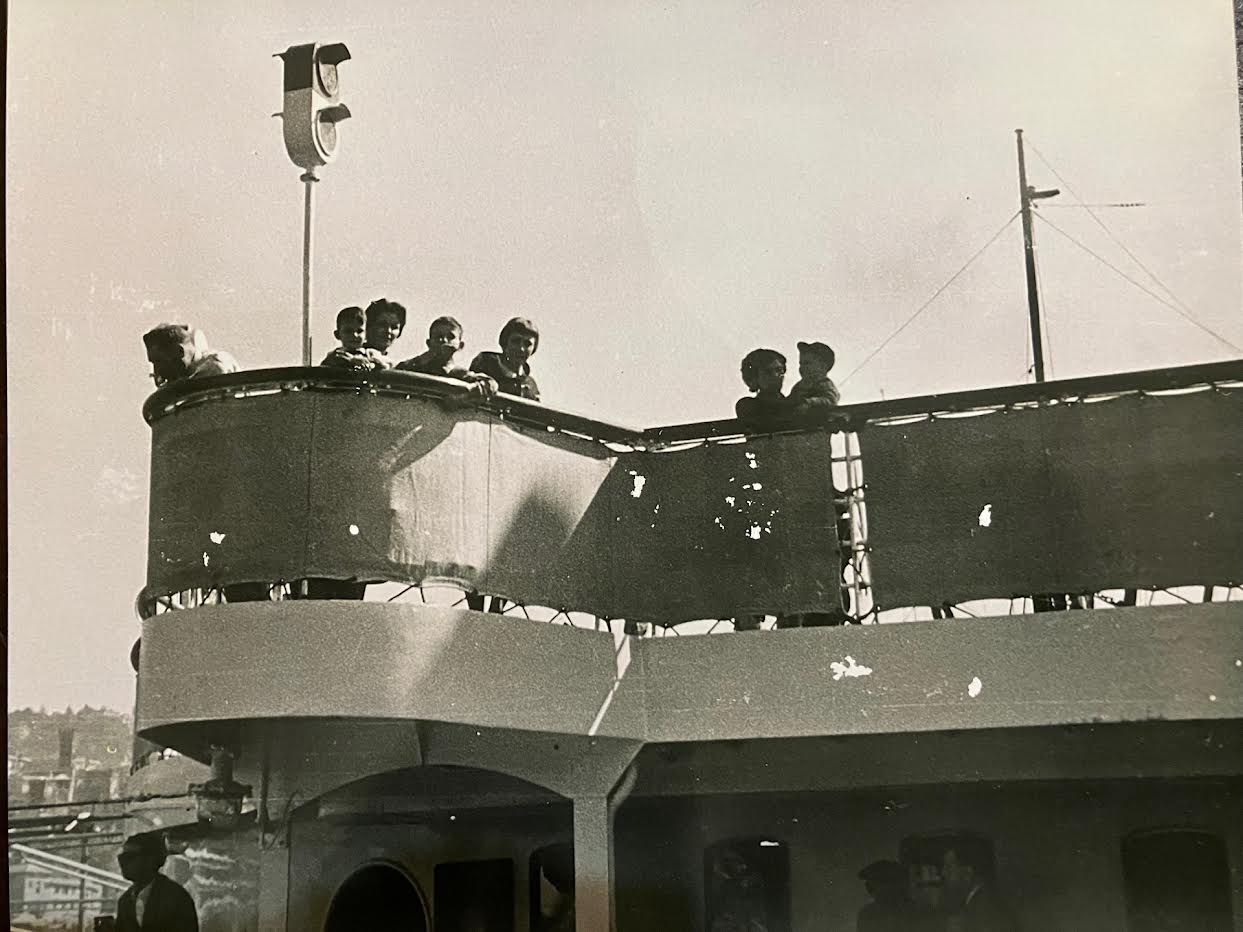
This photo shows me with my family on the Doria’s starboard stern bridge, in April 1955, a year before the collision. Like the Titanic’s twin sister, Olympic, I recall crossing to Italy on the Doria’s twin, the Cristoforo Colombo, and then the spectacular mid-Atlantic “fly-by” between the two ships on the return trip, on the Doria: horns blaring, people waving, confetti flying.
Fifteen months later, the Doria and the Stockholm met at the edge of a fog bank, in the late evening of July 26. It was a classic “T-bone” smash, with experienced navigators mutually at fault, and accurately called a “radar-assisted collision.” Like the Titanic, Mother Nature had also lined up a rare series of coincidences, each necessary to cause the accident. The Stockholm was in clear skies, but the Doria was in thick fog, sounding the foghorn for hours. The young, but very competent and thorough officer on the Stockholm’s bridge, could not understand why the image on his radar screen showed no lights as they approached. His inexperience never dreamed that he was approaching a fog bank of pea-soup variety.
Both ships misread their radar from distances of 17 and 12 miles apart: the Doria’s captain, Piero Calamai, concluded that the approaching ship was to his starboard, so he properly kept adjusting his course to port to ensure a safe passing. However, the Stockholm saw it the opposite way, and so kept increasing her own course for a normal port-to-port passage.
It gets worse: the Doria was coming into New York, just 50 miles away, in the proper northern lane. Ships exiting NY were to take a southern lane, but Sweden ignored this for good reason: the Stockholm’s skipper, Gunnar Nordenson, preferred to dodge oncoming ships head-to-head, instead of exposing his side while crossing through the northern lane, on his way to Scandinavia. He had successfully done this many times before.
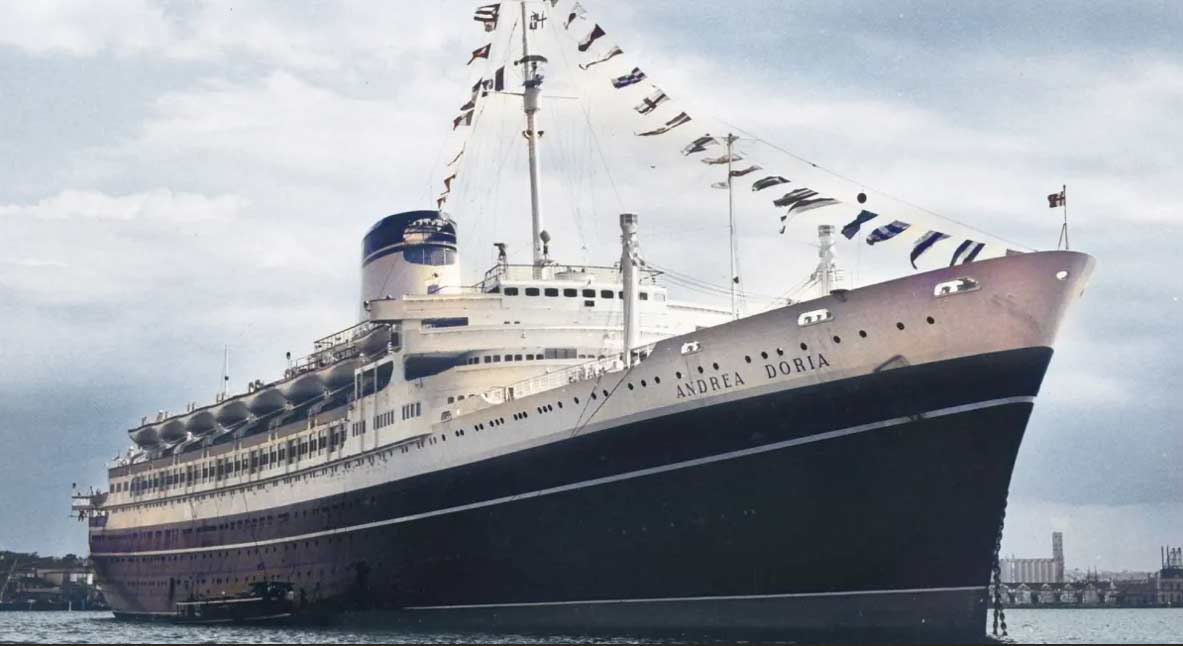
The Andrea Doria at port.
The two ships caught a glimpse of their lights when a mile away, then lost them again in the patchy fog. The Stockholm was still under clear skies. Both read their lights in a way that confirmed their radar. But then, as they saw each other again, it reversed their understandings, and it was way too late. Huge ships cannot turn on a dime, nor “step on the brakes.”
Calamai made a desperate turn to port, trying to outrun his surprise tormentor. Angling towards another ship might have brought a “scraping” collision, but it also might have cut the smaller Stockholm completely and instantly in half — which would have led to an even greater loss of life than occurred.
So, Piero Calamai “took the punch” for his beloved Andrea Doria, the one everyone called “the most beautiful ship in the world.” It killed 46 people instantly in the Doria’s starboard side, just below the flying bridge, and five crewmen sleeping in the bow of the Stockholm. None of their bodies were ever found.
The Stockholm, with a severely damaged bow, could close its forward watertight doors, and isolate the flooding. But the Doria, at the end of an Atlantic voyage, had her fuel and freshwater tanks nearly empty … precisely where the Stockholm rammed her. Thus, she took an immediate severe list to starboard. This was no “faint, grinding jar” that disturbed few passengers on the Titanic. The Doria soon was listing 22 degrees, and a capsizing seemed imminent. But the pumps slowed the intake for hours, a near miraculous and still largely inexplicable puzzle for maritime engineers.
The Titanic lost over 1,500 passengers, but the Doria disaster saved 1,660. It is the greatest peacetime rescue in history, but the evacuation does little credit to the captain. Calamai knew that the entire port or “high side” of his list made half of his lifeboats useless. He refused to explain this to passengers in order to avoid panic. Visions of fights and rushing the boats undoubtedly were what he was thinking. That decision may have been right, or it may have been wrong.
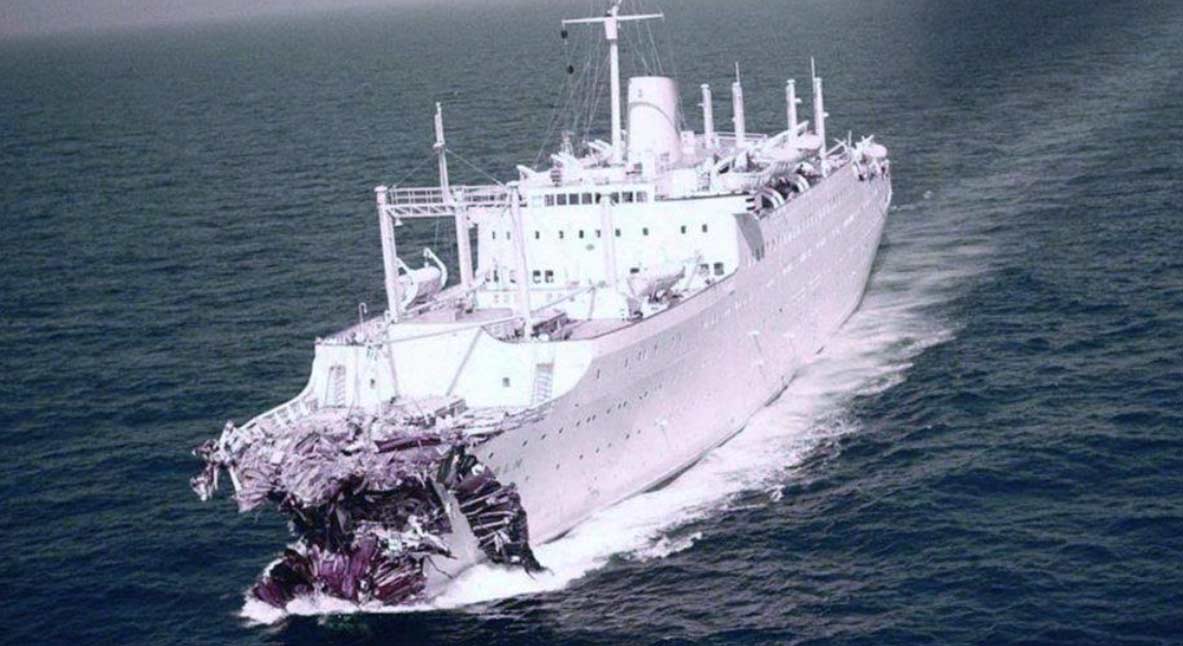
The bow of the Stockholm after the collision.
The Stockholm, after steadying her damage, showed up with her own lifeboats and ferried Doria passengers to herself. Other ships showed up, as this was the world’s busiest shipping lane: The Cape Ann, Edward H. Allen, William H. Thomas. But all they could do was to row to the sloping ship’s starboard side.
Yet some Doria passengers obediently went to their high-side boat stations, awaiting instructions that never came, and in their land-lubber ignorance, never realized that these boats could never be used. It was hours before they got word that people were being evacuated, through ropes and cargo nets, to waiting lifeboats. They had to literally slide down the sloping decks. The wife of Philadelphia’s mayor slammed her face into a bulkhead, getting a black eye worthy of a prize fighter. Many other passengers had similar accidents.
Other injuries were totally unnecessary, but only in hindsight. No one knew how long the ship would last, the list was severe and immediate, and it was perfectly reasonable to assume that she would “turn turtle” at any moment. Thus, an infant was tossed 30-40 feet into a lifeboat, which missed catching it. After daylight, a hospital helicopter from Boston heroically tried to save it, but to no avail.
We do know that many crew members used the starboard side boats before the passengers, to the great disgrace of Italian maritime history. However, the term “crew” might well mean waiters, musicians and bar-tenders. All the pursers, officers and many crewmen did, in fact, risk their lives getting passengers extracted from the wreckage, assisting them aboard the lifeboats, rigging cargo nets, ropes and hawsers so people could lower themselves into the waiting boats.
Then there were the priests, and there were many of them on board. They used Italian Line ships to go to and from Rome. They said Mass daily in the Doria’s famously decorated chapel. Now they heard confessions, granted general absolutions and led prayers to St. Anne, whose feast day it was.
ALASKA WATCHMAN DIRECT TO YOUR INBOX
Just like the Titanic, then, the Doria disaster demonstrated the apex of both human courage and cowardice.
At around 2 a.m., the most dramatic moment of the night occurred. With many passengers huddling on promenade decks, the fog as thick as ever, and receiving no instructions, they seemed alone and doomed. Then, in answer to the many prayers, a curtain rose and revealed the heroine of the night seas: an enormous French luxury liner appeared as the fog at last lifted, her porthole and deck lights blazing, with the 10-foot neon lights on the top deck announcing her name: ILE DE FRANCE.
There were also preposterous miracles. Linda Cianfarra, age 14, lost her stepfather and sister at the “ground zero” impact in 1st class. Asleep at impact, she awoke with people frantically extracting her from the wreckage. She spoke English and Spanish, but these folks were speaking … Swedish! They asked her name, she replied, “Cianfarra — but it may be listed as Morgan. Cianfarra is my step-father.”
“You are not on the manifest of the Stockholm.”
“But I’m on the Andrea Doria!”
Incredibly, the ship’s wrecked bow lifted her bed from the Doria into the bowels of the Swedish ship, breaking only her ankle. Her mother, who was more severely injured, also survived.
Then there was the American merchant mariner deckhand, injured in an industrial accident while at sea on a freighter, with numerous contusions and broken bones. He was returning to the states in the Doria’s hospital, kept under heavy sedation, and making only one painful walk topside during his week at sea.
At dawn, with all passengers ferried to the rescue ships, Capt. Calamai was prepared to go down, and ordered his officers into a waiting boat. They refused and said they would gladly share his fate. That did it. He could not bear the thought of them going down as well, especially being needed at the inevitable inquiry. He got into a boat and was saved, suffering for the rest of his broken-hearted life.
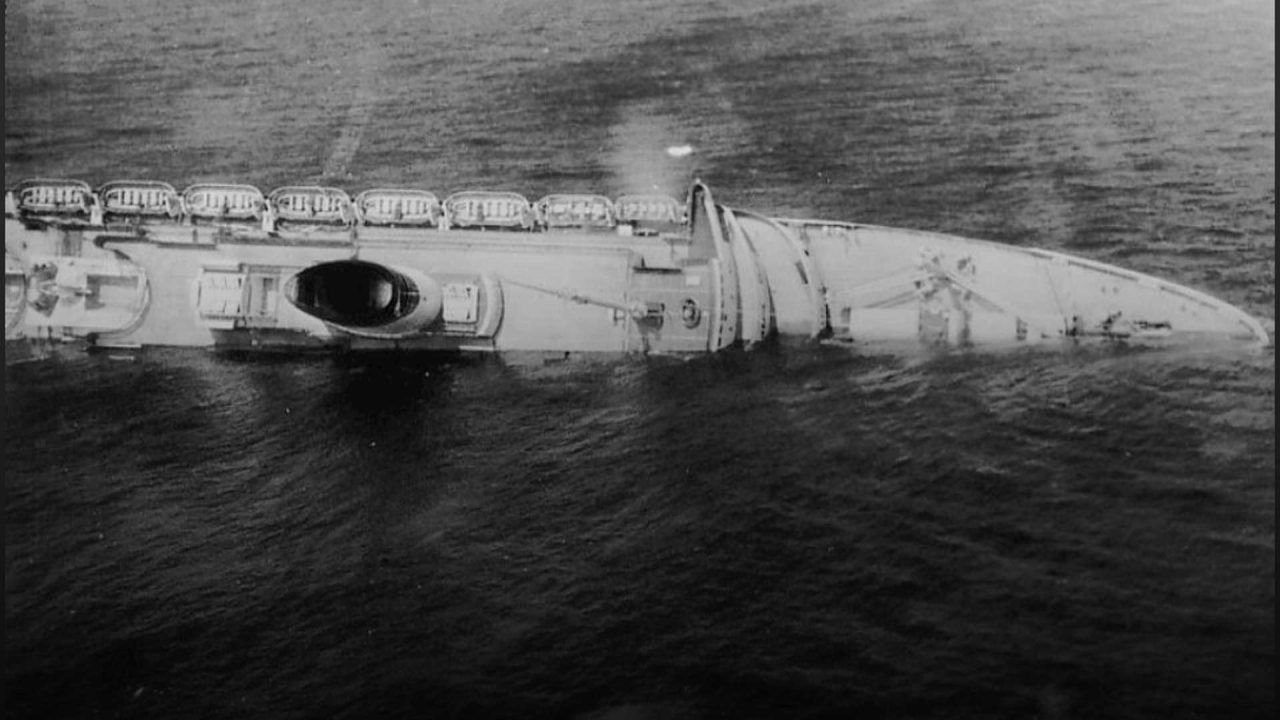
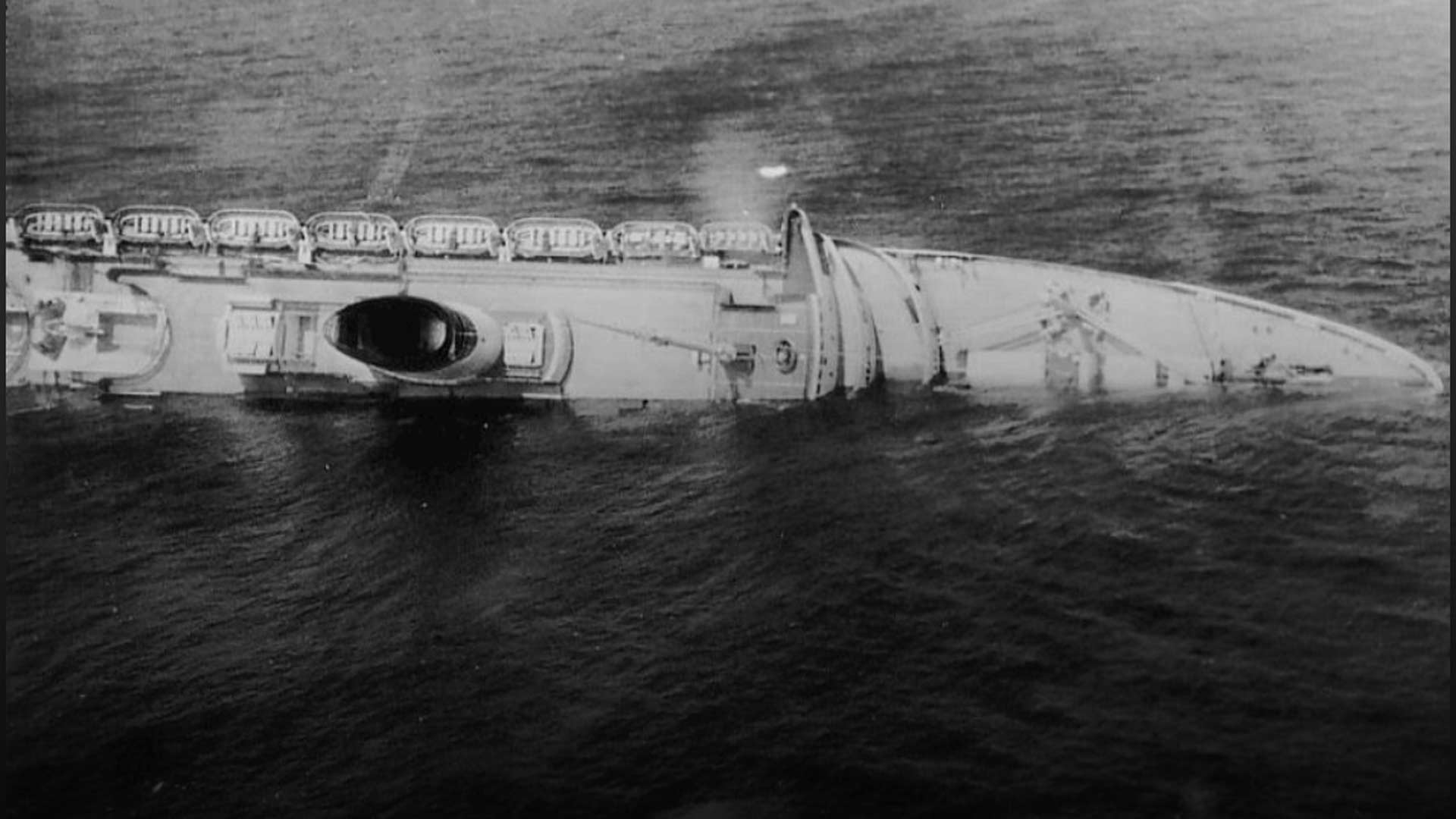
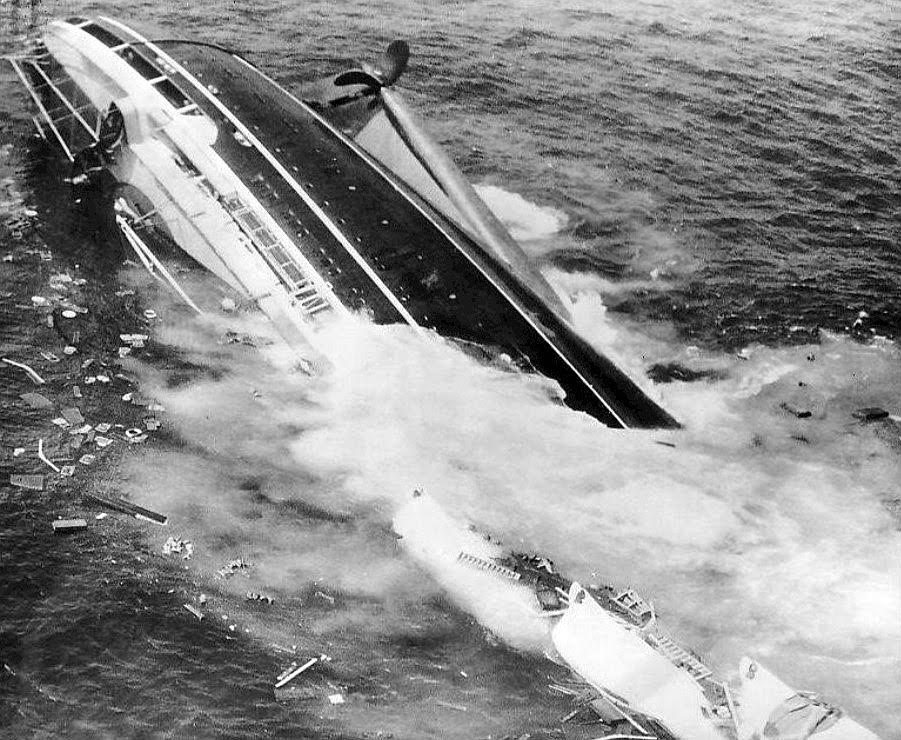
Andrea Doria at last surrendered and capsized.
But the American mariner awoke to a ghost ship! Painfully struggling through the maze of stairwells and corridors, he saw a lifeboat off the stern and hailed it.
It stayed glued to where it was, about 300 yards off, where a mariner’s standard training ordered boats to hover to avoid suction and any explosions that might occur when a ship foundered. He begged and prayed — then changed to the type of vile expletives and curses that sailors are world famous for, until the boat — incredibly — risked it and took him safely off, awash in the waters sloshing along the Doria’s rail.
In the now clear morning skies, airplanes from Boston and New York circled the dying Doria like so many vultures, but in one was Harry Trask, whose Pulitzer Prize-winning photos are seen here, as the beautiful Andrea Doria at last surrendered, capsized and foundered shortly after 10 a.m.
Five years ago, the late Pat Mastrincola was my guest on the Doria’s 65th anniversary. It was a fantastic interview, and you can find him on National Geographic videos on the internet. But I have not learned of the story that Pierette Simpson will tell us on Wednesday. I am saving that for the show.
Bob Bird ran for U.S. Senate in 1990 and 2008. He is a past president of Alaska Right to Life, a 49-year Alaska resident, a retired public school teacher, and currently a home-school tutor. Bird lectures on the Shroud of Turin, speaks Italian, lives on the Kenai Peninsula and is currently a daily radio talk-show host for The Talk of the Kenai. It is heard on KSRM 920 AM from 3-5 pm and heard online at radiokenai.com.




1 Comment
great