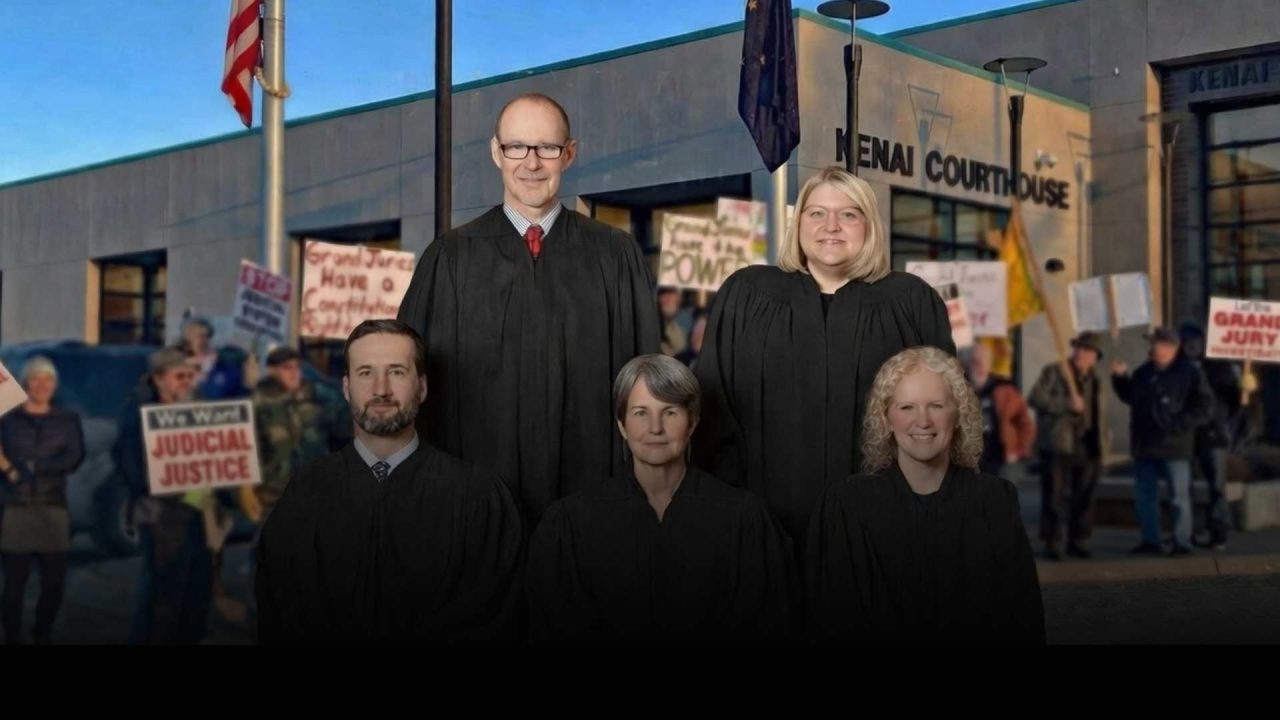


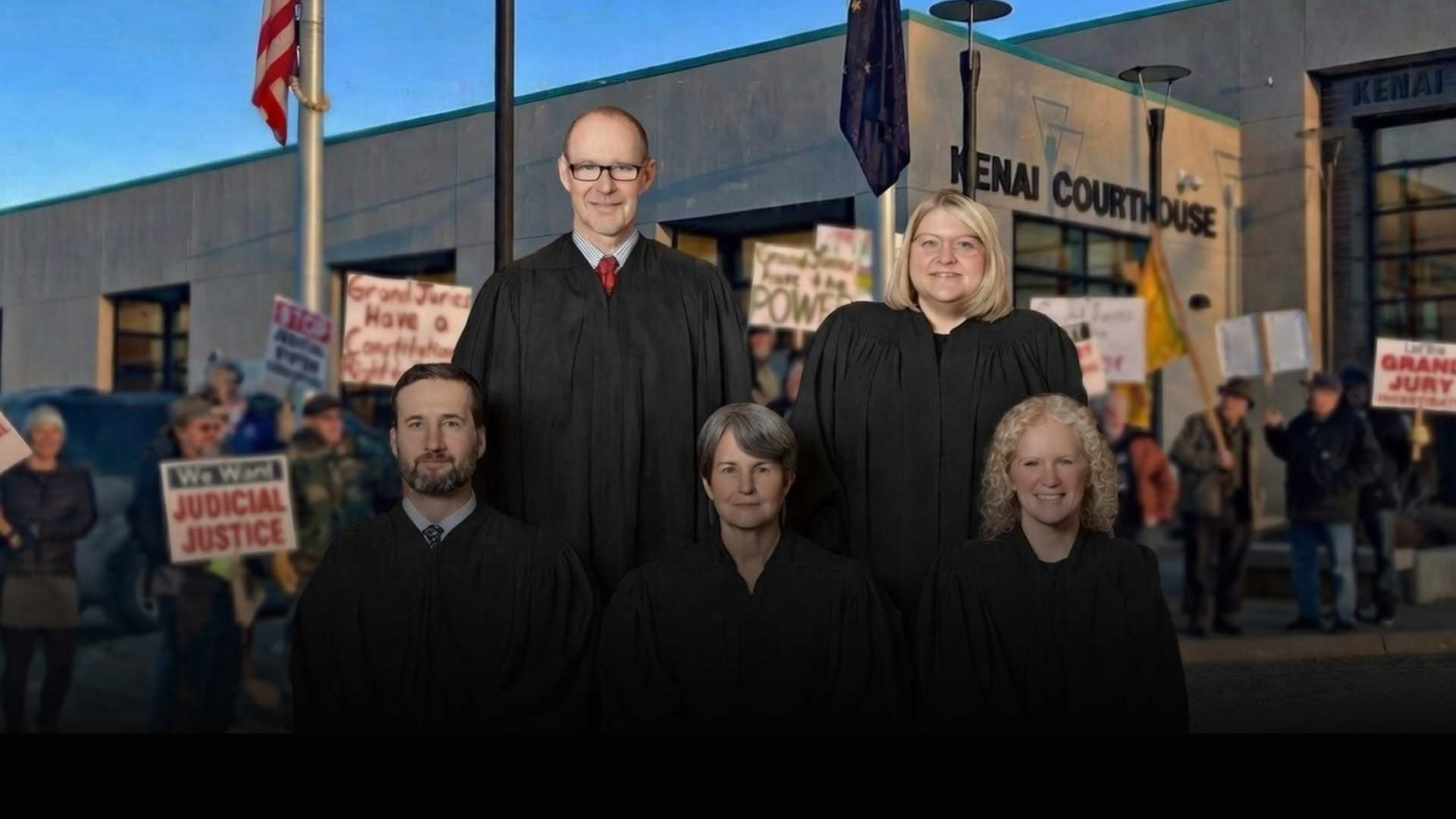
Amid swirling controversy, public protests, and mounting political interest, the Alaska Supreme Court has decided to revise hotly debated rules it imposed on citizen grand juries three years ago, and is now seeking public comment on a litany of proposed revisions aimed at addressing the festering disputes.
The proposed changes follow intense debate that erupted in 2022, as a sitting Kenai grand jury was investigating alleged high-profile corruption in the judicial branch and the Department of Law. Amid this investigation, the Alaska Supreme Court abruptly intervened with a novel procedural order (SCO 1993), effectively stifling the grand jury’s historic ability to conduct independent investigations without being managed and controlled by the very branches of government they intended to investigate.
The initial 2022 rules also prohibited a grand jury from both investigating a public issue and then indicting related criminal conduct discovered during the probe. However, the high court abruptly reversed this in early 2023 after it was pointed out that the new rule violated a grand jury’s dual constitutional role to both accuse and investigate.
In the wake of these rule changes, grand jury rights advocates held multiple rallies, met with government officials and presented material to lawmakers, local boroughs and city councils in an effort to restore the full authority of grand juries to freely investigate corrupt judges and government officials, while also issuing reports on their findings to the general public.
The issue has become a key issue in the current gubernatorial race with multiple candidates weighing in on how how they would work to restore grand jury rights.
Last year, the dispute was addressed by Alaska’s then-Attorney General Treg Taylor, who is currently running for governor. According to the Supreme Court rules, the Department of Law is now the gatekeeper of all citizens’ requests that a grand jury investigate allegations of corruption, even corruption that might involve the Department of Law itself.
While Taylor publicly stated last summer that he believed the Supreme Court’s rules were a violation of grand juries’ constitutional rights to independently hear allegations directly from citizens, he complied with the rules anyway and set up a system that attempted to both satisfy the high court and simultaneously mitigate some of the growing concerns.
Taylor admitted, however, that his new system was not ideal. It essentially formalized a process that now requires citizens to first submit allegations to the attorney general’s office, after which a team decides whether the allegations are suitable to forward on to a grand jury.
The new request for public comments will be open until April 6 of this year.
This gives the Attorney General’s office immense power over what criminal allegations a grand jury can consider, and critics note that it violates the right of citizens to petition a grand jury, directly, as is explicitly stated in the original Grand Jurors Handbook.
Prominent grand jury advocate David Haeg, along with many others, has repeatedly called on the attorney general’s office to boldly challenge the Supreme Court’s rules, especially if they are deemed to be unconstitutional. To date, that has not happened.
On Feb. 18, however, the Alaska Supreme Court issued a call for comments and recommendations on a newly revised set of rules pertaining to grand jury protocols. These revisions touch on some of the most hotly debated elements of the 2022 rules.
The proposed updates deal with Criminal Rules 6 and 6.1, which address grand juries’ dual roles – issuing criminal indictments (Rule 6) and conducting investigations into matters of public welfare or safety (Rule 6.1). Both actions are protected by Article I, Section 8 of the Alaska Constitution: “The power of grand juries to investigate and make recommendations concerning the public welfare or safety shall never be suspended.”
The request for public comments will be open until April 6 of this year.
While the changes attempt to address some of the concerns by grand jury advocates, they have already stirred critical responses by at least one prominent Alaska attorney.
The major proposed changes include the following:
— Grand juror-initiated requests: The revised rules would require the Attorney General to assign neutral attorneys for advice/assistance to grand juries.
— Non-grand juror (citizen) requests: Alaska residents could bypass the Attorney General and submit allegations of wrongdoing to a grand jury through a superior court filing. If the filings are knowingly false, there could be a $500 fine imposed by the court. Once the request is sent to the court, a clerk must seal the allegation and forward it to a presiding judge who must transmit it to a grand jury within 30 days and then notify the complainant of the outcome.
— Evidence and proceedings: The revisions would allow inadmissible evidence during grand jury investigations but limit final grand jury reports to a preponderance of “admissible” evidence.
— Review and release of grand jury reports: The revisions shift from automatic initial review by a judge to an objection-driven process, which allows both individuals and organizations or government agencies to formally object to grand jury reports and their release to the public.
While the changes attempt to address some of the concerns by grand jury advocates, they have already stirred critical responses by at least one prominent Alaska attorney who is concerned that the proposed amendments still undermine the constitutionally protected rights of grand juries to independently hear, investigate, indict and publish public reports of their findings.
The Anchorage-based attorney recently submitted comments pointing out that the revisions still undermine a grand jury’s independent oversight, chill citizen initiation, and enable governmental entities to delay or prevent public disclosure of grand jury reports.
Other points of contention deal with the fact that the newly proposed rules still restrict a grand jury’s indictment authority.
In particular, a concern has been raised that the Attorney General’s office still has the authority to assign an attorney of his choice to provide advice and assistance to the grand jury on whether to investigate an allegation.
“This creates a structural conflict when investigations involve government conduct or systemic failures: the executive branch would control the grand jury’s legal advisor for initiating, framing, and conducting investigative work,” the respondent noted. “Regardless of intent, that arrangement risks weakening independence and can operate as a practical veto – particularly for investigations that are sensitive or institutional.”
He suggested that the revised rule should “require independent counsel for the grand jury,” and “if the Court retains Attorney General involvement, it should include clear standards limiting gatekeeping discretion and ensuring the grand jury can pursue lawful inquiries.”
He also noted that the $500 proposed fine for knowingly sending flawed allegations to the grand jury could discourage citizens from alerting grand juries of legitimate wrongdoing. Additionally, he pointed out that the process of submitting allegations is not sufficiently transparent.
ALASKA WATCHMAN DIRECT TO YOUR INBOX
Recommended changes include removing the monetary sanctions or giving citizens a chance to amend or withdraw them if they are deemed frivolous by the grand jury. The attorney also suggested adding a clear tracking and notice requirement so citizens “receive written notice” of what happened to their request and when it was transmitted to the grand jury.
Another point of contention is the fact that the proposed changes would add governmental agencies as “persons” who have a legal right to object to a grand jury’s decision to release its findings to the public.
This essentially grants government entities the right to resist disclosure of investigative findings about their own performance or misconduct, thereby creating a means for delay, suppression, or over-redaction of reports that address institutional failures.
Suggestions to address this include limiting governmental objections to “narrow, concrete harms, like witness safety, active criminal investigations or legally protected confidential information, but not reputational or institutional interests.”
Other points of contention deal with the fact that the newly proposed rules still restrict a grand jury’s indictment authority.
TAKING ACTION
— Click here to read the proposed changes in their entirety and to offer suggestions on needed changes.




6 Comments
Maybe they should just pick up the phone and call David Haeg?
That’s an easy fix, just return the Grand Juries power as written in the States Constitution. But this time have a clause that any court that messes with it get automatically 25 year prison sentence.
Start a return to credibility by throwing Treg Taylor in prison!
Alaska Supreme Court public comments page
https://courts.alaska.gov/rules/index.htm#comments:~:text=July%2024%2C%202025-,Request%20for%20Comments,-REQUEST%20FOR%20COMMENTS
Letter to the Editor — AlaskaWatchman.com
Re: “Alaska Supremes want input on how to fix Grand Jury rights controversy” (Feb. 20, 2026)
Your article correctly identifies the central tension in the Alaska Supreme Court’s proposed revisions to Criminal Rules 6 and 6.1: while the revisions attempt to address citizen concerns, they still leave the Attorney General’s office with structural influence over the very investigations it may be subject to. That tension deserves to be named for what it is — not merely a legal dispute, but a systemic institutional safety failure and, as the record now makes clear, a failure that was litigated, documented, and largely vindicated before a single rule was changed.
I. THE SAFETY MANAGEMENT FAILURE
I have submitted a formal analysis applying the world’s most rigorous institutional safety management frameworks — OSHA’s Safety and Health Management System, ISO 45001, the Nuclear Regulatory Commission’s Safety Culture Policy Statement, and High Reliability Organization theory developed in the wake of the Columbia Space Shuttle disaster — to the Alaska judicial system’s conduct surrounding Supreme Court Order 1993 (SCO 1993). The conclusions are unambiguous.
Every one of these frameworks begins with the same principle: an organization’s actual safety culture is defined not by its written policies, but by what its top management does. OSHA calls this the “System of Expected Behavior.” The Alaska Supreme Court issued SCO 1993 in secret, bypassing its own Criminal Rules Committee, without public comment, on the same day Thomas Garbers’ constitutional grand jury hearing was vacated. That is what management did. That action — not the Alaska Code of Judicial Conduct — defines the system’s expected behavior for every attorney and citizen who interacts with it.
ISO 45001, the international standard for organizational safety culture, requires that top management take direct accountability for changes that eliminate safety controls, and mandates formal stakeholder participation before any such change is implemented. SCO 1993 eliminated citizens’ direct access to grand juries — a foundational safety control — with no hazard assessment, no stakeholder input, and no appeal mechanism. The Criminal Rules Committee’s own two-year corrective review, culminating in the proposals now open for public comment, is itself institutional confirmation that the original rule was deficient. That is what a safety audit looks like after the fact.
The Nuclear Regulatory Commission Safety Culture framework is explicit that organizations must provide “an environment in which workers feel free to raise safety concerns without fear of harassment, intimidation, retaliation, or discrimination.” Routing a grand jury’s legal advice through the Attorney General’s office — when the executive branch is the subject of the inquiry — structurally compromises that environment, regardless of individual intentions.
Sociologist Diane Vaughan, in her landmark study of the Challenger disaster, documented how organizations normalize deviation from safety controls over time until an intervention corrects — or a catastrophe exposes — the accumulated risk. The pattern surrounding SCO 1993 fits that model: citizen petitions redirected in 2016, again in 2018, again in 2022, each instance treated as routine until three simultaneous cases made the pattern impossible to ignore. The Alaska Judicial Council’s own 1987 report confirmed that “State Grand Juries have often exercised investigative powers to battle political corruption. At times, they have acted on their own initiative in the face of opposition from a district attorney.” By 2022, the system had inverted that constitutional design — and then codified the inversion through SCO 1993.
II. THE LEGAL RECORD: WHAT THE COURTS AND THE RULES COMMITTEE CONFIRMED
The legal history of this dispute adds a dimension the safety management analysis alone cannot fully capture: the process Garber sought was not radical or unprecedented — it was the process the system had quietly practiced for decades and then abandoned.
In November 2025, the Alaska Supreme Court issued Opinion No. 7797, affirming the Superior Court’s dismissal of Garber’s petition and holding that Article I, Section 8 of the Alaska Constitution protects the grand jury’s institutional power to investigate, not an individual citizen’s right to petition the grand jury directly. The Court held that routing citizen requests through the Attorney General did not “suspend” the grand jury’s constitutional authority.
But the Court’s holding is narrower than it may appear — and what happened in the three months following Opinion 7797 is far more significant than the opinion itself.
On February 18, 2026 — fewer than ninety days after Opinion 7797 was issued — the Alaska Court System published proposed amendments to Criminal Rule 6.1. Those proposed amendments implement, in nearly verbatim terms, the judicial pathway Garber had argued for since 2022: a citizen files a request with the clerk of court; the clerk seals it and transmits it to the presiding judge; the judge transmits it to the grand jury within 30 days; the grand jury — not the Attorney General — votes on whether to investigate. The Attorney General is removed entirely as the threshold gatekeeper.
THIS IS NOT A COINCIDENCE. IT IS A STRUCTURAL VINDICATION.
The Constitutional Convention record is instructive on why these matters. Delegate Yule Kilcher stated on the floor of the Convention on January 6, 1956: “The grand jury can be appealed to directly, which is an invaluable right to the citizen.” That same page of the Convention transcript contains additional language that Opinion 7797 did not directly address: “The grand jury in its investigative power…is sometimes the only recourse for a citizen to get justice, to get redress from abuse in lower courts…it is the only safeguard a citizen occasionally has when for any reason and very often for political reasons, a case is not dealt with properly.” A separate delegate stated plainly that the grand jury’s investigative power was “extremely broad” and that broad power was “proper and healthy.”
The December 15, 1955, Convention commentary on the anti-suspension clause was even more direct: “The grand jury is preserved, for all purposes, particularly for investigation of public officials.” SCO 1993 — which routed citizen requests about state agencies through the Attorney General, a public official who supervises those agencies — inverted that precisely targeted constitutional protection.
III. THE GRAND JURY HANDBOOK: RIGHTS THAT EXISTED — AND WERE ERASED
Perhaps the most striking evidentiary element of the legal record is what happened to the Alaska Grand Jury Handbook. For decades, the official Handbook given to grand jurors stated plainly: “A citizen is at liberty to apply to the Grand Jury for permission to appear before it in order to suggest or urge that a certain situation should be investigated by it.” The Handbook also listed “private citizens heard by the Grand Jury in formal session, with the Grand Jury’s consent” as one of the four ways charges could come before the grand jury.
Prior to SCO 1993 being issued, those passages were removed. In their place, the revised Handbook stated that citizens have “never” had a constitutional right to bring issues directly to a grand jury for investigation.
This is not clarification of pre-existing law. It is the rewriting of an official institutional record. The Alaska Court System’s claim that citizen petition rights “never” existed is directly contradicted by the Handbook it distributed to grand jurors for decades. The proposed February 2026 amendments — restoring a judicial pathway for citizen petitions — are more consistent with the original Handbook than the executive-branch gatekeeping model that replaced it.
IV. WHAT THE JUDGES ON THE RULES COMMITTEE SAID
The conflict-of-interest concern at the heart of both the safety management analysis and Garber’s legal arguments was not unique to a pro se petitioner. It was identified independently by sitting judges serving on the Criminal Rules Committee — the body charged with reforming the very rule at issue.
Judge Paul Lyle, in a January 8, 2024, memorandum to the Criminal Rules Committee, raised the core question directly: “The committee may wish to discuss whether a private citizen should have some sort of access to the grand jury to request investigations into health and welfare issues when the attorney general refuses to initiate an investigation.” Judge Lyle also cited Alabama precedent recognizing that “public policy demands that a citizen, without hazard to himself, may freely bring before the grand jury the fact that a crime has been committed.”
Judge Hanley, also a committee member, identified an additional structural flaw: even when a majority of grand jurors sought to initiate an investigation, a conflicted prosecutor could still block it during the screening process. Judge Hanley wrote that the solution was to keep “the process within the scope and decision of the citizens of Alaska and its grand juries” not to route it through the executive branch.
These are not the views of a lay petitioner. They are the independent conclusions of judicial officers who reviewed the same structural problem Garber identified and reached the same conclusion.
V. THE MULTI-JURISDICTIONAL CONSENSUS
Alaska, under the old Rule 6.1(c), was a national outlier. Courts across multiple states have recognized that when a prosecutor declines to act, a citizen has some form of recourse to the grand jury. The West Virginia Supreme Court in State ex rel. Miller v. Smith (1981) put it plainly: requiring all complaints to pass through the prosecutor “would render the grand jury nothing more than a prosecutorial tool.” Minnesota, Maryland, New Jersey, Texas, Alabama, Georgia, and Louisiana courts had recognized similar principles. The Mollen Commission, investigating New York City’s Department of Investigations in 1994, found that institutional collapse occurs precisely when “no entity outside the Department was responsible for reviewing the Department’s success in policing itself.”
That is the structural condition SCO 1993 created in Alaska: no pathway for citizens to initiate grand jury scrutiny of executive branch agencies that the Attorney General supervised and declined to investigate. The proposed rule change corrects that condition. But as your article correctly notes, the AG’s continued role in assigning legal counsel to grand juries investigating potential government misconduct still warrants close scrutiny in the comment process.
VI. WHAT THE PUBLIC COMMENT PERIOD SHOULD ADDRESS
The public comment period, open until April 6, 2026, is an opportunity to apply these standards constructively. The proposed amendments represent genuine progress. The 30-day mandatory judicial transmission deadline, the sealing requirement that protects petitioner privacy, and the elimination of executive-branch gatekeeping are meaningful structural improvements. But several specific refinements remain warranted:
Independent legal counsel for grand juries: When an investigation involves government conduct or systemic failures, the executive branch should not control the grand jury’s legal advisor. The revised rules should require appointment of independent counsel — insulated from Attorney General direction — for any investigation touching on executive branch performance or conduct.
Removal or modification of the $500 sanction: Any financial penalty for citizen petitions, however well-intentioned as a deterrent against frivolous filings, risks chilling legitimate concerns from lower-income Alaskans and contradicts the Convention’s framing of grand jury access as a citizen’s “last resort” when political forces prevent proper action. If a sanction is retained, citizens should be permitted to amend or withdraw a petition before any penalty is imposed.
Narrow limits on governmental objections to report release: The proposed rules would allow governmental agencies to formally object to grand jury reports before public release. This creates a mechanism for delay, suppression, or over-reaction of reports addressing the very institutional failures the grand jury was constituted to examine. Objections by governmental entities should be limited to concrete, articulable harms — witness safety, active criminal investigations, legally protected confidential information — and should expressly exclude reputational or institutional interests.
Transparency requirements: Citizens who file petitions should receive written notice at each stage of the process, including the grand jury’s ultimate decision on whether to investigate. The proposed rule should specify minimum notice requirements so that the sealing process does not become a mechanism for opacity rather than protection. Clarity for why the superior court judge needs to unseal the petition before transmitting the petition to the grand jury within 30 days. What is the benchmark the judge is to evaluate before the petition proceeds to the grand jury?
VII. CONCLUSION
The Alaska Supreme Court issued SCO 1993 in secret, bypassed its own review committee, and in doing so eliminated a safety control that had existed in one form or another for the entire history of Alaska statehood. Attorney General Taylor admitted publicly in June 2025 that the system is “currently constrained… and it’s not according to the constitution.” The Criminal Rules Committee’s two-year reform process — twelve meetings, published proposals, open comment — produced rules that implement what Garber asked for in 2022 and what the Convention delegates intended in 1956.
This is what institutional correction looks like. It is also a textbook demonstration of what OSHA’s safety management framework calls the difference between what management says and what management does. The proposed rule changes represent management beginning to align its actions with its stated constitutional obligations.
The comment period is the public’s opportunity to ensure that alignment is complete — and that the System of Expected Behavior the Alaska judicial system ultimately establishes is one where citizens can petition their grand juries without routing that petition through the executive branch, they are asking the grand jury to examine.
Finally! I am not as learned about the Grand Jury process many have been upset about but finally the only branch of government that can deal with it is stepping in. People screamed at the last AG for doing nothing. Perhaps they needed to understand these issues are for the Judical part of our government to deal with, regardless of how liberal they are. Comments like “throw Taylor in jail” are not very smart comments. Study the branches of government. The Judiciary is being forced to deal with it, just as they should.