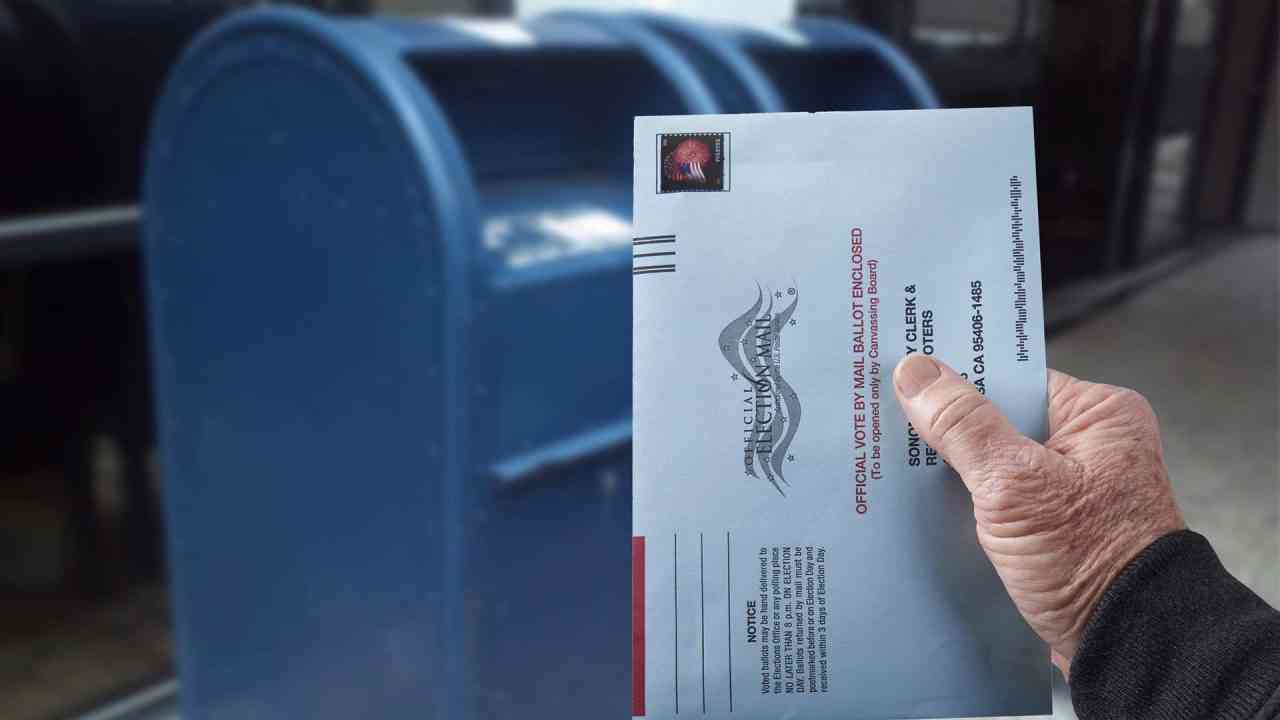


In a narrow 5-4 decision with major implications for election administration across Alaska, the U.S. Supreme Court ruled on June 29 that federal law does not require absentee ballots or mail-in ballots to be physically received by election officials on Election Day itself.
The ruling in Watson v. Republican National Committee means that states like Alaska, which allow ballots to arrive weeks after election day, can continue to do so despite concerns about ballot stuffing in tight races and delayed results for the public.
Under Alaska Statute (15.20.081), in-state absentee ballots postmarked by Election Day may be received up to the close of business on the 10th day after the election (15 days for overseas voters).
Justice Amy Coney Barrett wrote the majority opinion, joined by Chief Justice John Roberts and Justices Sonia Sotomayor, Elena Kagan, and Ketanji Brown Jackson. The slim majority held that the federal election-day statutes set a uniform day for voters to “cast” their ballots but do not dictate when states must receive those ballots.
“The term ‘election’ refers to the electorate’s choice of candidate,” the majority explained, and that choice occurs when the voter completes the act of voting, not when officials later process the ballot.
While the case directly impacts Alaska, it arose from Mississippi’s law allowing certain absentee ballots postmarked by Election Day to be received up to five business days later. The Republican National Committee and others argued that federal law preempted the provision because an “election” is not final until ballots are in official custody. The Fifth Circuit had agreed, but the Supreme Court reversed the lower court.
ALASKA WATCHMAN DIRECT TO YOUR INBOX
Justice Samuel Alito dissented, joined by Justices Clarence Thomas and Neil Gorsuch and, in part, by Justice Brett Kavanaugh.
Alito argued that the majority misread the federal election-day statutes. An “election” requires the electorate’s authoritative choice – through the complete collection of ballots – to occur on the single day set by Congress. Receipt by officials is integral to this process and allowing ballots to arrive days later postpones the election’s “consummation,” and thus violates the statutes, Alito maintained.
The dissent noted that for over a century after the federal election date was established, states understood that Election Day meant ballots must be received by then. Even Civil War-era absentee rules reinforced strict deadlines.
Alito also warned that late receipt creates fraud risks like ballot stuffing in tight races and erodes public confidence through prolonged uncertainty and delayed outcomes. He also noted that the majority’s ruling undermines election finality and trust, leaving states and officials with unclear rules.






4 Comments
More ways to cheat in our elections. Remember to vote Yes on prop #2, to rid Alaska of RCV which is cheating. You can be last in the votes and still win, makes no sense.
I don’t trust, Justice Amy Coney Barrett.
Try to imagine a scenario involving endless Alaska mail in voting –
Republicans for re-election of Dan Sullivan (the incumbent) harvest a large group of ballots whose envelopes are postmarked on ‘that special day’. But in the ‘scheme’ of things they hold those ballots back.
Where do harvested ballots come from? The harvested ballots are from people who normally would not have voted or the homeless, or villagers from far away small towns, or seniors in care centers etc.. All republicans, all on the rolls, or independants.
As witnessed by recent elections, Republicans and Independants are lazy voters.
BUT! there are lists of registered voters who just don’t get out to vote. How to use this: With some hired help (paid by National offered NGO funds), those lazy voters are contacted and ‘urged’ to accept help to get their mail in vote submitted. (just sign here…I’ll be your witness)
When it is time to begin the count of the received ballots, when the election office or the ‘news media’ reports that a candidate pulls ahead, a block of the postmarked ballots for Senator Dan Sullivan get released, not all the (harvested) ballots but just enough to effect the number to the positive for the Senator.
Then, if the needle moves in the other direction, another block of Dan Sullivan (incumbent) ballots is released within a week or so, and they get counted.
So on and on this goes – where it stops nobody knows.
The votes keep getting counted until …. …. …. (well, ask California residents).
Relax – This is only a hypothetical example. No way Republicans would do this. We all know that.
AND
Election corruption would never happen in Alaska – right?
In the previous major Presidential election, we watched day by day Alaska’s results, and noted that we were ahead concerning the elimination of RCV at the beginning of the twelfth day of voting and at the end of the twelfth day we were way behind. cheating was done over the 12th day of voting. Perhaps as ballots were flown around to the villages, creating a loss of ballots and the gain of other ballots with no witnesses. Those in the minority on the US Supreme Court were exactly right. Roberts and Barrett are naive to believe that cheating was not possible. Aren’t they following what is happening in the US Senate with disgraceful Murkowski? “Murky” has NEVER won a national election honestly. This state is full of lawlessness including the Alaska Supreme Court whose members need to be impeached.
If Alaska had a worthwhile Legislative Branch they’d correct this wrong of dragging out ballot counting for days and days after the official election day, but we don’t!