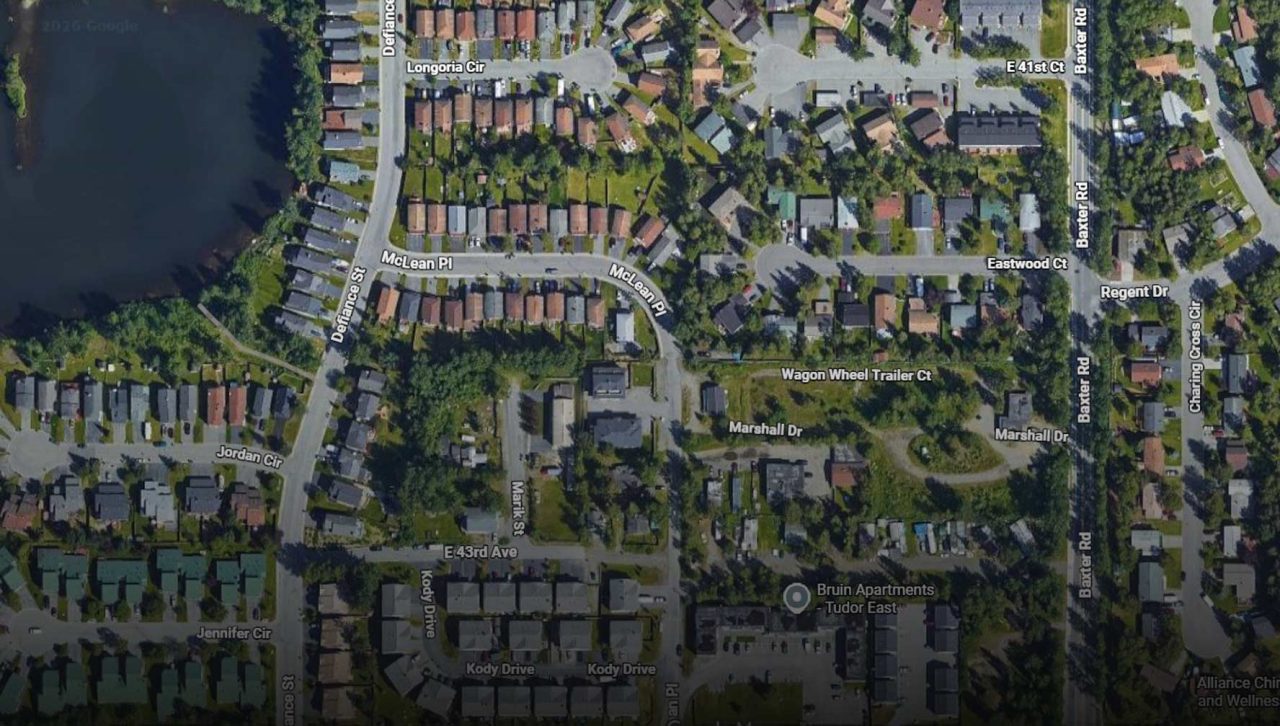


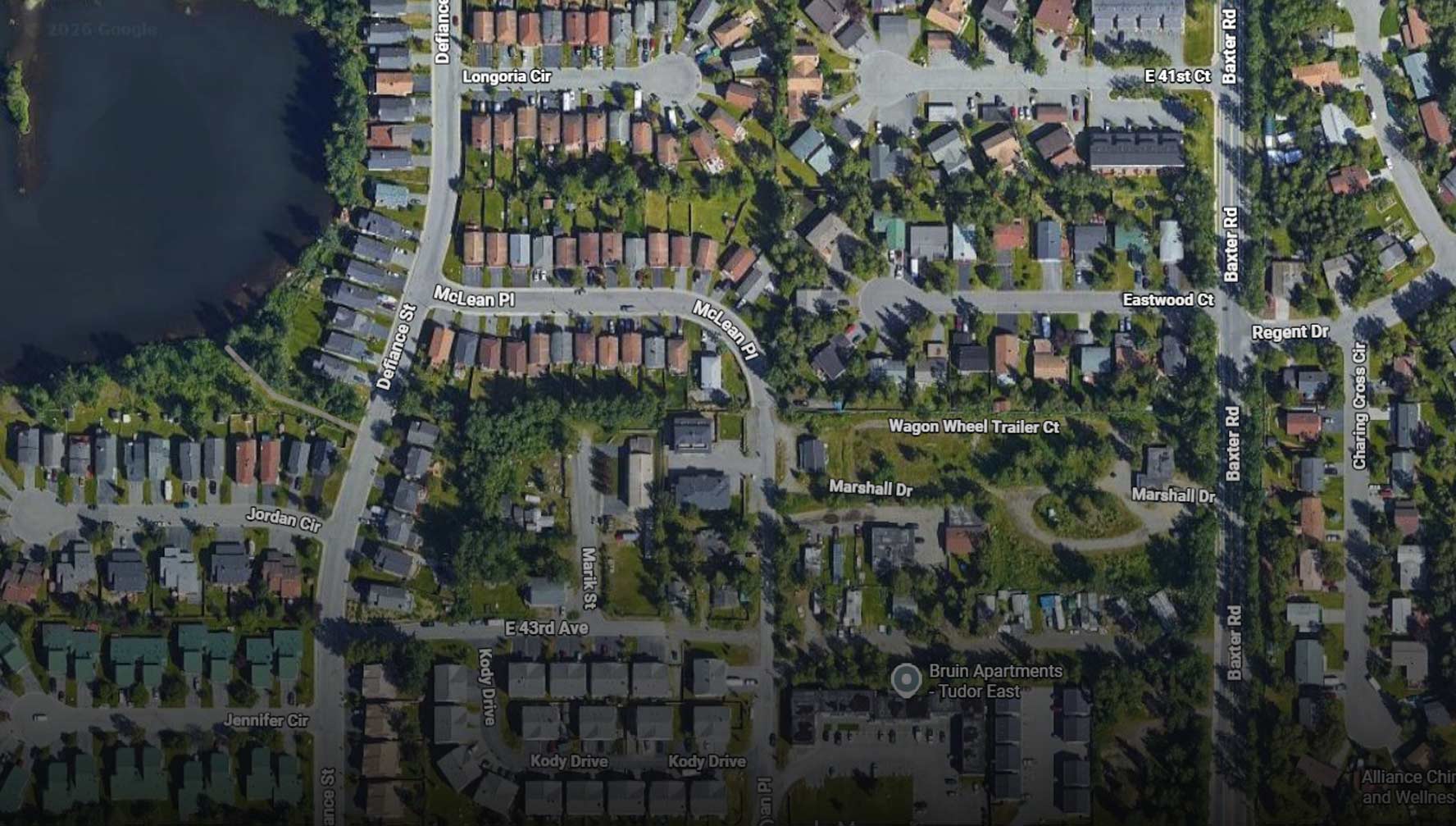
Residents of Eastwood Court Estates are calling on the Municipality of Anchorage, Cook Inlet Housing Authority, and future housing-development decision-makers to place greater weight on neighborhood compatibility when approving or accelerating multi-family rental housing beside established single-family homes.
The request follows the construction of The Nest development adjacent to Eastwood Court, where longtime homeowners say the removal of the former wooded buffer and the close placement of multi-story rental buildings have created immediate concerns involving privacy, nighttime lighting, noise, wind exposure, security, visual impacts, and the loss of a meaningful transition between higher-density housing and family homes.
Eastwood Court residents are not opposing needed housing. They are asking that housing development be paired with reasonable, enforceable mitigation measures when it directly abuts established residential neighborhoods.
Growth should not mean that existing homeowners, children, pets, and families are expected to absorb all of the consequences after the plans are already approved. Housing can be built responsibly, but compatibility must be part of the project from the beginning – not an afterthought once trees are removed and buildings are already rising.
The Eastwood Court proposal also raises a broader public-policy question for Anchorage: whether the Municipality is moving too quickly to expand multi-family and rental housing
Residents are requesting a developer-funded, wind-engineered privacy and security barrier providing an effective height of ten feet along the portions of the shared boundary most directly affected by the three-story buildings. The requested solution could include an engineered eight-foot solid fence with a two-foot upper privacy screen or another professionally designed alternative that provides equivalent protection without creating an unsafe wind-load structure.
The proposal also requests:
— Shielded, downward-facing lighting that prevents glare and light trespass into neighboring bedrooms, yards, and backyards;
— Noise controls during construction and enforceable quiet-hour expectations after occupancy;
— Landscaped buffers and evergreen vegetation to restore privacy, reduce noise, and replace part of the lost visual and environmental separation;
— Controlled access, camera coverage, parking management, and clear property-management accountability;
— Protection against vehicle-headlight intrusion, trash-area impacts, gathering-area noise, and direct views from upper-story windows and balconies;
— A meaningful process for neighboring residents to report and resolve recurring lighting, noise, privacy, parking, trespass, or property-management concerns.
The Eastwood Court proposal also raises a broader public-policy question for Anchorage: whether the Municipality is moving too quickly to expand multi-family and rental housing without requiring adequate safeguards for adjacent single-family neighborhoods.
Municipal zoning standards can permit relatively close building placement in certain multi-family configurations, including setbacks as low as ten feet in some circumstances. While minimum setbacks may satisfy a technical zoning standard, Eastwood Court residents argue that minimum compliance does not automatically protect privacy, quiet enjoyment, safety, or the long-term character of an established neighborhood.
Anchorage should not force existing neighborhoods to choose between housing development and the basic protections every family expects in its own backyard.
Ten feet of separation may meet a line in a zoning table, but it does not necessarily create a livable boundary between multi-story rental buildings, parking areas, headlights, stairwells, balconies, and the backyards of families who have lived here for decades.
Residents are also concerned about the public-input process. Several Eastwood Court homeowners report that they received little or no meaningful notice before the project advanced, despite being directly affected by its visual presence, environmental change, and long-term neighborhood impacts. Residents state that technical compliance with public-notice requirements is not the same as genuine public awareness or an opportunity for affected homeowners to be heard before construction begins.
The group is asking the Municipality to review whether notice procedures are sufficient when multi-family projects directly border established single-family neighborhoods, particularly where the development removes mature trees, changes drainage and wind exposure, introduces elevated windows and lighting, and increases traffic and activity near private yards.
Residents further question whether taxpayer-supported housing incentives, tax benefits, public funding, or other government-assisted development tools should require stronger neighborhood-protection standards as a condition of approval.
ALASKA WATCHMAN DIRECT TO YOUR INBOX
If public policy is being used to encourage or subsidize additional housing construction, then public policy should also require responsible design. Taxpayer-supported incentives should not simply accelerate construction. They should require developers to protect neighboring homes from predictable impacts involving privacy, noise, lighting, wind, security, drainage, and loss of natural buffers.
Eastwood Court residents are seeking a meeting with Cook Inlet Housing Authority, project leadership, and appropriate municipal representatives to review the boundary conditions at The Nest development and establish a written commitment for appropriate mitigation, maintenance, and long-term accountability.
The group emphasizes that its request is constructive and practical.
We support quality housing and we welcome responsible growth. But responsible growth means respecting the people already living next door. Anchorage should not force existing neighborhoods to choose between housing development and the basic protections every family expects in its own backyard.
Requested Action
— Eastwood Court residents respectfully request that Cook Inlet Housing Authority and the Municipality of Anchorage:
— Provide a developer-funded, engineered privacy and security barrier with an effective height of ten feet along the most directly affected boundary.
— Require lighting, noise, parking, landscaping, drainage, and security mitigation appropriate to the project’s proximity to existing homes.
— Establish a written resident-contact and issue-resolution process for ongoing concerns.
— Review public-notice standards for developments that directly abut established single-family neighborhoods.
— Condition taxpayer-supported incentives, public assistance, and expedited housing approvals on measurable neighborhood-compatibility protections.
The views expressed here are those of the author, who is a 35-year Eastwood Court resident.






5 Comments
Paul,
it sounds like you’re upset that development is happening next to your house. This is a free-market issue, why would such a principled conservative be asking for the Government to step in? If you wanted to have a say on what happens on private land next to your house, you should have bought it. If you want to live away from other people, there is plenty of space outside of Anchorage without those pesky renters and poor people.
This all sounds reasonable and so worth fighting for. I remember starting back in the late 70’s there was a housing shortage in Anchorage due to the huge influx of Alaska Pipeline workers and the oil field development. Multi unit housing shot up, a large number in both south and north Mountain View. Well look how that turned out. Mountain View, in the 50’s-early 70’s was a quiet and nice single family home neighborhood until all the large multi residential structures were dumped on them. It went south from there and after the pipeline boom wained it became low income drug infested housing. Then in mid 80’s when the oil boom ended and we had an economic collapse, most of those buildings were foreclosed on and became vacant, except for illegal squatters. It was a mess and has never recovered. It is still low income drug infested housing and property values are rock bottom. One would think that those making the decisions would pay attention to history and try not to repeat it.
Residents further question taxpayer-supported housing incentives, tax benefits, public funding, or other government-assisted development tools should require stronger neighborhood-protection standards as a condition of approval. Answer – NO. Just because it is a taxpayer funded project doesn’t mean it has to meet a higher neighborhood requested standard, criteria, design, threshold etc than privately funded housing projects, state funded housing projects, federally funding housing projects. Sounds like NIMBY to me from Eastwood Court Estates residents.
Build it anywhere but here, however if you do it here you have a stack of additional requirements you must follow per our direction in order to build it here, but our own homes don’t have to meet these additional criteria. Interesting to see where this goes and if Eastwood Court Estates have new neighbors.
Change the 6’ rule to the 6” rule! Baffoons!
We’ll end up with communist-style collective apartments in all our neighborhoods and the higher crime that goes with them. And, Anchorage taxpayers will foot the bill because these dumps will get a tax break. Anchorage assembly members and their cronies will profit from this stupid idea.