


It would be easy for conservative Republicans to get discouraged with the results of Tuesday’s primary. The Democrats did well in the statewide races, and they are going to be using that success as a talking point right up until the general election.
In reality, this year’s primary election was remarkably similar to the last time we elected a new governor. In the 2018 primary, only about 20% of Alaskans voted, and the Dems did very well, but in the general election Alaska elected a Republican governor, U.S. Senator, and U.S. Representative. We need to look at this year’s jungle primary using that perspective to understand how the general election might turn out.
Governor’s Race
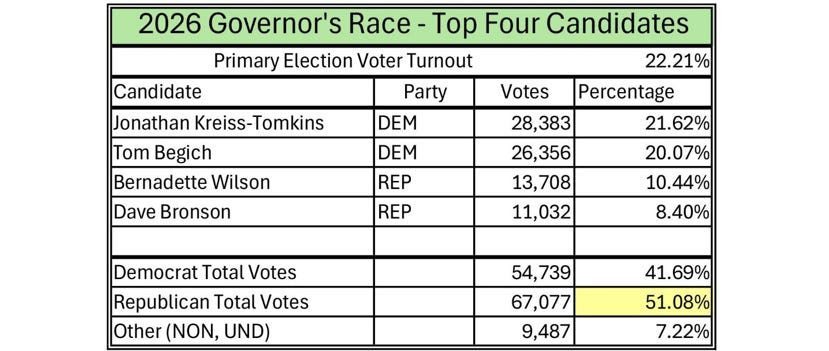
In the governor’s primary, the top two vote-getters were both Democrats. However, they might want to take a closer look at the numbers. Although the two Democrats received the most votes, nobody got enough to win in the general election. The low Republican vote counts for Wilson and Bronson were diluted by the 12 Republicans in the race, who split the vote.
Democrats won’t have that advantage in the general election. There will only be four candidates running; right now, there are two from each party. The important numbers in this race are the total votes cast, broken down by party. The Democratic candidates received 41.69% of the vote, while the Republicans received 51.08%, which is enough to easily win the governor’s race. Republicans are getting used to the screwy RCV election system and have learned to rank the red. As long as the Republicans don’t attack each other for the next 76 days, one of the Republicans should win this race.
The wild card will be if one of the top four candidates drops out. That is currently being considered by both parties, and if it happens, the current fifth-place candidate in the primary would move onto the ballot. That person is former Alaska Attorney General Treg Taylor.
Taylor is a divisive candidate and very unpopular with some Republican groups. Both parties are aware of the advantage this would give Democrats. If the Ds were smart, they would do whatever it took to get Taylor on the ballot to stir up conflict between the Republicans, perhaps even have one of the Democrat candidates strategically quit the race to do so. Taylor could be the disruptive force that would get a Democrat elected governor in this red state – similar to Mary Peltola’s victory in the 2022 U.S. House election.
US Representative
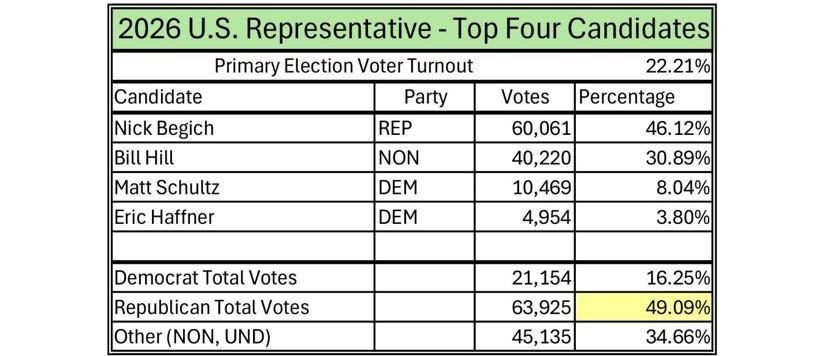
Nick Begich handily led the primary election over his closest competitor by 16%. Coming in second was Bill Hill, a man from southwest Alaska. Hill is a retired schoolteacher whose policies align with the Democrats. While not an official Democrat by party affiliation, Hill will get stuck with the liberal label during the campaign and will not resonate with statewide voters. This race for U.S. Representative should be an easy victory for incumbent Nick Begich.
U.S. Senate
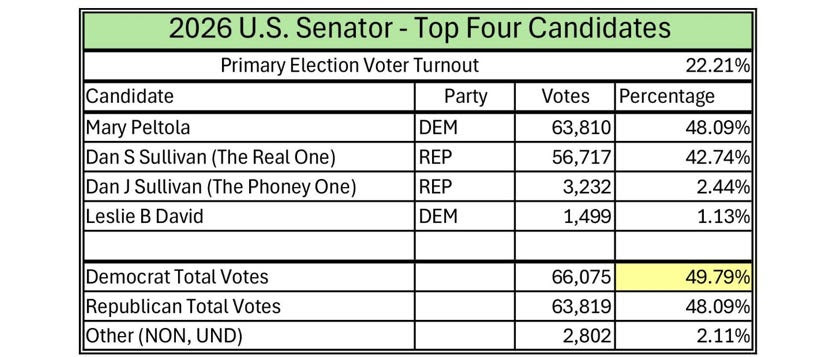
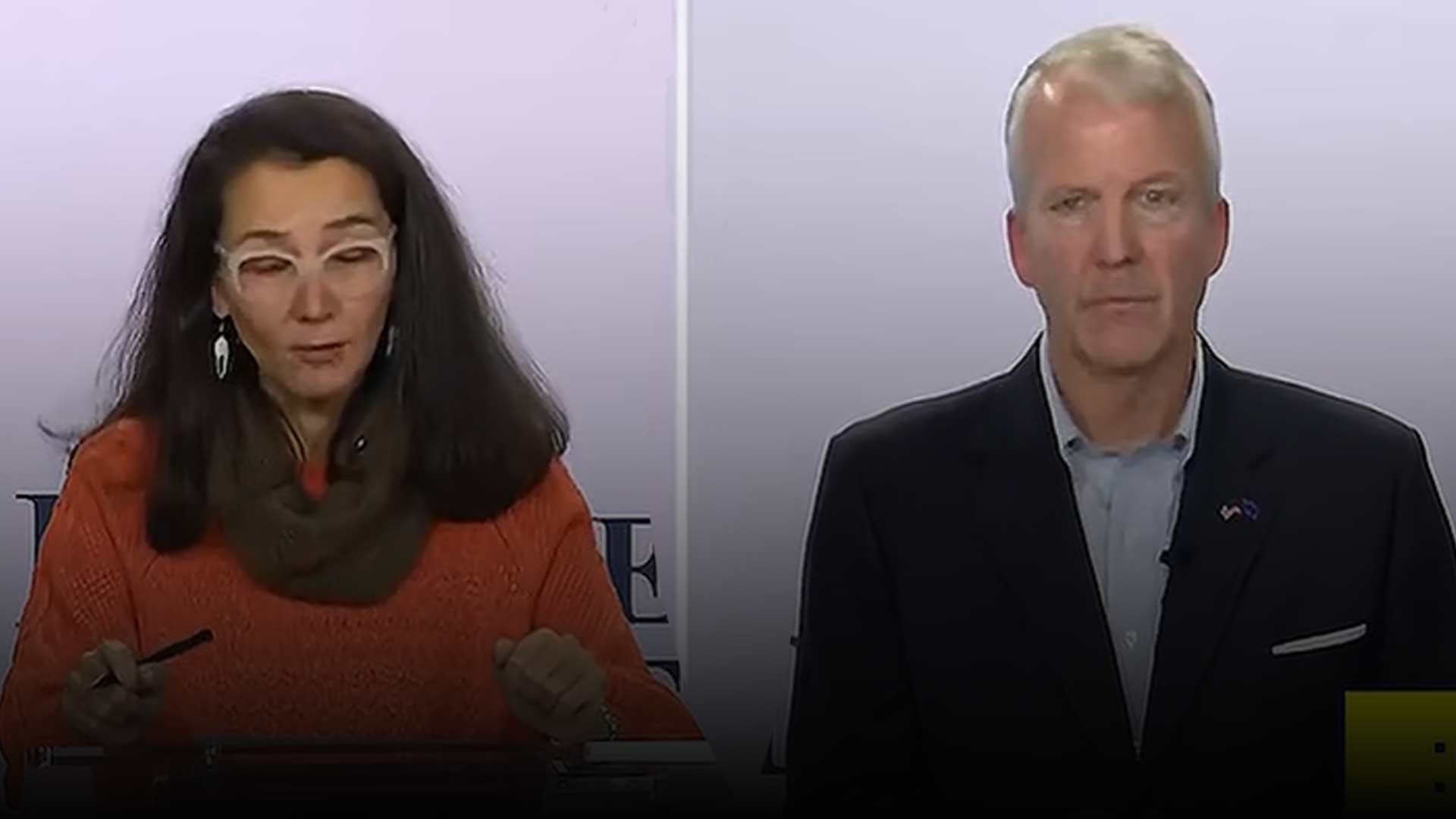
Democrat Mary Peltola did well on Tuesday, with a 5% lead in vote count over incumbent Senator Dan S Sullivan. However, she did not receive enough to win outright. Like the governor’s race, there were a very large number of candidates running for the U.S. Senate – 16 in total. This diluted the votes for incumbent Dan Sullivan.
Twelve of those candidates have now been eliminated, and voters will have a clearer choice in November. If that race is as competitive as the primary, it will come down to an automatic ranked-choice runoff, the results of which are anybody’s guess. Peltola could win. This is the most competitive race for the Democrats in this year’s election.
As far as how all of these statewide races shake out in November, voters need to keep in mind that the last time we elected a new governor in 2018, Republican candidates did better in all 2018 statewide races in the general election than they did in the primary. Should we see the same patterns this year, Alaska will elect a Republican governor and U.S. Representative. The U.S. Senate seat is a toss-up, but Dan Sullivan should pull out a victory.
However, this will only happen if conservative voters do not get discouraged by the news in the mainstream press about how the Democrats “won” the primary. Winning a primary election is similar to winning the preseason in the NFL. It doesn’t matter once the regular season starts, and for Alaska politicians, the regular season starts on November 3.
The views expressed here are those of Greg Sarber. Read more Sarber posts at his Seward’s Folly substack.




2 Comments
Nice spin Sarber. Republicans refuse to cut the Trump anchor rode. Sullivan especially.
22.21% voter turnout! How pathetic Alaskan’s have become. They’re either just plan lazy, or too busy playing with themselves!