

An Oregon mother who was denied public reimbursement for Christian homeschool materials is asking a federal court to decide a question that Alaska families already face: whether public correspondence and homeschool funds may be spent on private or religious-based education options.
Tessa Bulzan, a mother of five, enrolled two of her children in an Oregon school district’s homeschool partnership program last year. Similar to Alaska’s state-funded correspondence system, the Oregon program reimburses homeschooling families for curriculum, supplies, and classes.
According to reports from Alliance Defending Freedom, an Oregon program administrator initially told Bulzan that she could use any curriculum she wanted, including a religious one, and that predominantly academic materials would likely qualify, even while noting that material had to be “non-religious” to be reimbursed.
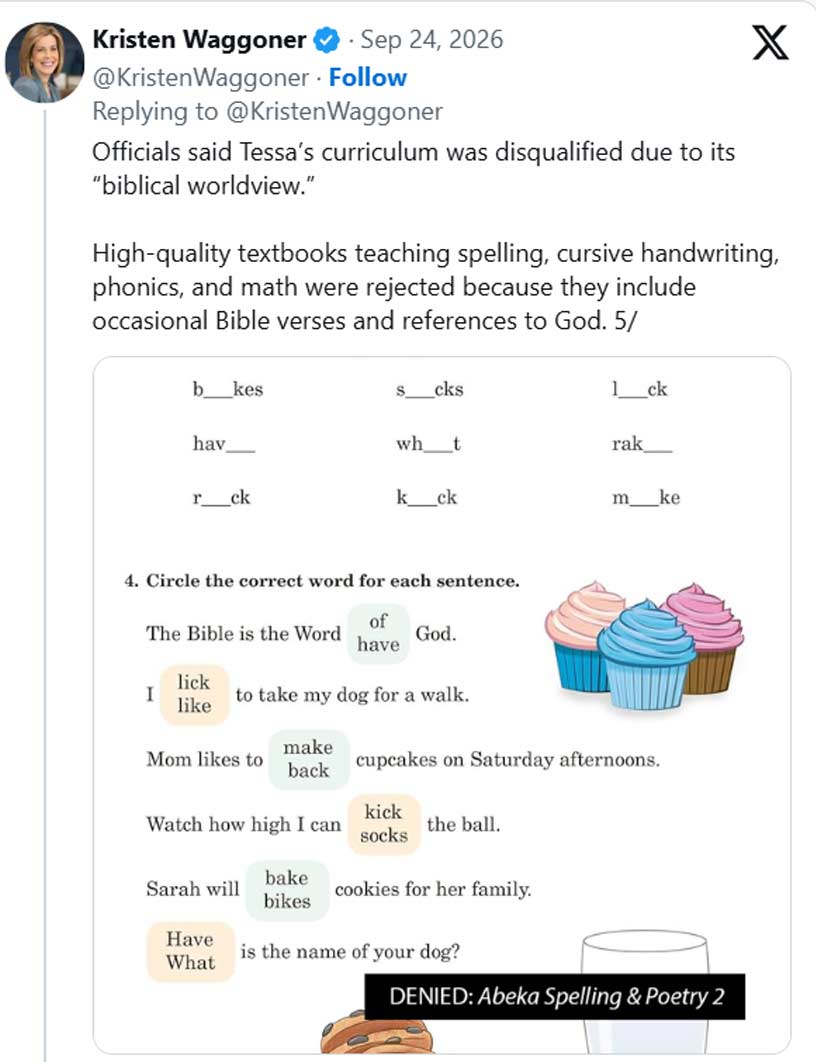
Bulzan built the academic year around Abeka and Classical Conversations, both explicitly Christian curricula, and a local Christian co-op. The district exercised almost no oversight of what she taught. In January 2026, however, the district denied every dollar for those materials, citing “the Christian and biblical worldview that is taught” and “Christian beliefs and themes” running through the courses.
Alliance Defending Freedom, a legal group now representing Bulzan in federal court, says the denial was not about academics, as the materials far exceeded Oregon standards. Bulzan appealed four times through the district’s discrimination process. This past May, the district declared the denial final. For 2026–27, it added a written agreement barring reimbursement for curriculum that is “religious in nature,” and named Abeka and Classical Conversations as disqualifying examples.
Bulzan sued the district in federal court last month. The complaint argues that a generally available benefit – such as homeschool allotments – cannot be conditioned on stripping a religious viewpoint out of otherwise academic materials, and that the district already reimburses materials reflecting other worldviews, including a children’s book about a boy who joins a parade of men in drag and a book centered on the sacredness of “Mother Earth.”
District officials claim reimbursing curricula with religious ideas embedded in the core subjects would violate the Establishment Clause in the U.S. Constitution.
That fight shares some similarities with a case still moving through Alaska’s courts. In Alexander v. State of Alaska, public-school parents, backed by the Alaska teachers’ union, sued in 2023, arguing that the state’s increasingly popular correspondence program violates the Alaska Constitution’s prohibition on using public funds “for the direct benefit of any religious or other private educational institution.”
Currently, the state allows correspondence programs to reimburse parents with an allotment for educational expenses, including for non-religious services and materials bought from public, private, or religious entities. Roughly 23,000 Alaska students are now enrolled in roughly 30 correspondence programs across the state.
In April 2024, Anchorage Superior Court Judge Adolf Zeman struck down the allotment statutes as facially unconstitutional. The Alaska Supreme Court reversed his decision, stating that the statutes have many valid uses, such as buying books and supplies, so they cannot be invalidated entirely. The justices did not decide whether using allotments for private-school tuition is constitutional, nor did they rule on whether funds can be spent on materials that include a religious worldview. Rather, they sent the case back, requiring the plaintiffs to sue the individual districts that actually approve the spending. Additionally, the high court told the lower court to decide first whether state law even allows families to use their allotments to pay tuition at private or religious schools.
Plaintiffs now name the Anchorage, Mat-Su, Denali Borough, and Galena City school districts in the suit, which is currently in the discovery phase.
If plaintiffs get their way, Alaska’s homeschool allotment program will cease reimbursing parents for money used to pay for educational instruction and services provided by private and religious institutions.
The state has maintained that the Alaska Constitution does not forbid parent-directed purchases of approved educational materials, and that federal constitutional issues could arise if the state court permits public funds for secular options while banning religious ones.
The two cases differ in that the Oregon one involves a plaintiff who says a public reimbursement program may not single out and exclude Christian curricula. In Alaska, plaintiffs are claiming that the state constitution forbids using state correspondence funds to benefit private or religious schools at all. Both cases, however, raise the question of whether a public education benefit, once offered by the state, can then be limited based on religion.
A federal ruling in favor of Bulzan would not bind Alaska courts, which are interpreting a state constitutional ban, but it would expose the larger federal question already lurking beneath the surface of the Alaska case: if a state pays for homeschool materials generally, may it then refuse to pay when those materials or services include perspectives from a religious worldview?