

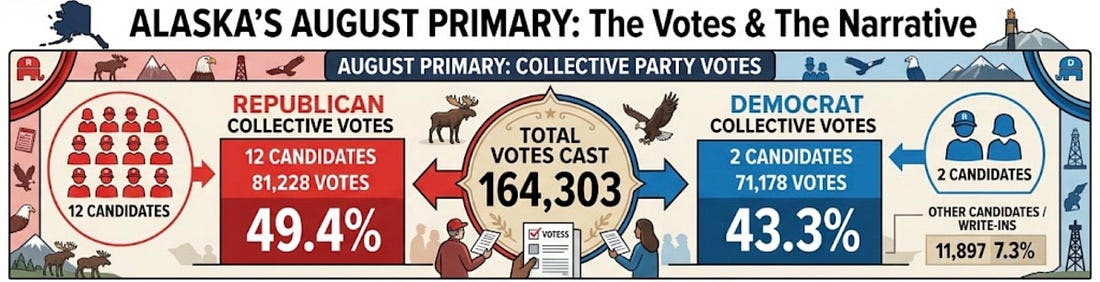
Twelve Republicans ran for Alaska governor in August. Together they got 81,228 votes out of 164,303 cast. That is 49.4 percent.
The two Democrats got 71,178 between them: 43.3 percent.
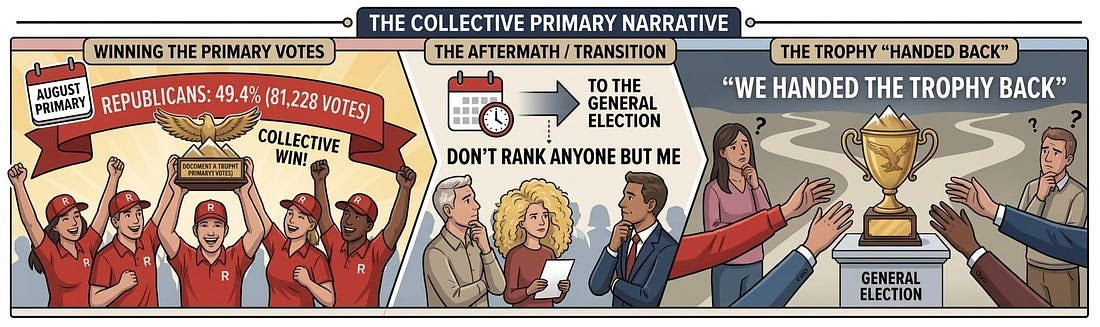
We won the August primary. Then we handed the trophy back.
Here is how.
Only 41,760 of those votes went to the three Republicans who will be on your November ballot. Wilson got 16,468. Bronson got 13,364. Taylor got 11,928.
The other 39,468 went to candidates who are not on the ballot anymore. Click Bishop. Adam Crum. Shelley Hughes. Matt Heilala. Edna DeVries. Lesil McGuire. And the rest.
39,468 is the first number.
Almost half our vote in this state belongs to Alaskans whose candidate was eliminated. That is more votes than Kreiss-Tomkins got in the entire primary. He got 37,006.
Think about those voters.
They picked somebody else.
They have no first choice left.
And right now, they are being told to write one name in the upcoming November election, and stop.
Now the second number.
Wilson got 16,468 votes. Kreiss-Tomkins got 37,006.
The second number is 20,538. That is how far behind him the leading Republican starts.
There is no way to add the numbers up where any of the three wins on first choices alone. All of them need second choices. That is not an attack on anyone’s campaign.
It’s math.
Here is the part that matters.
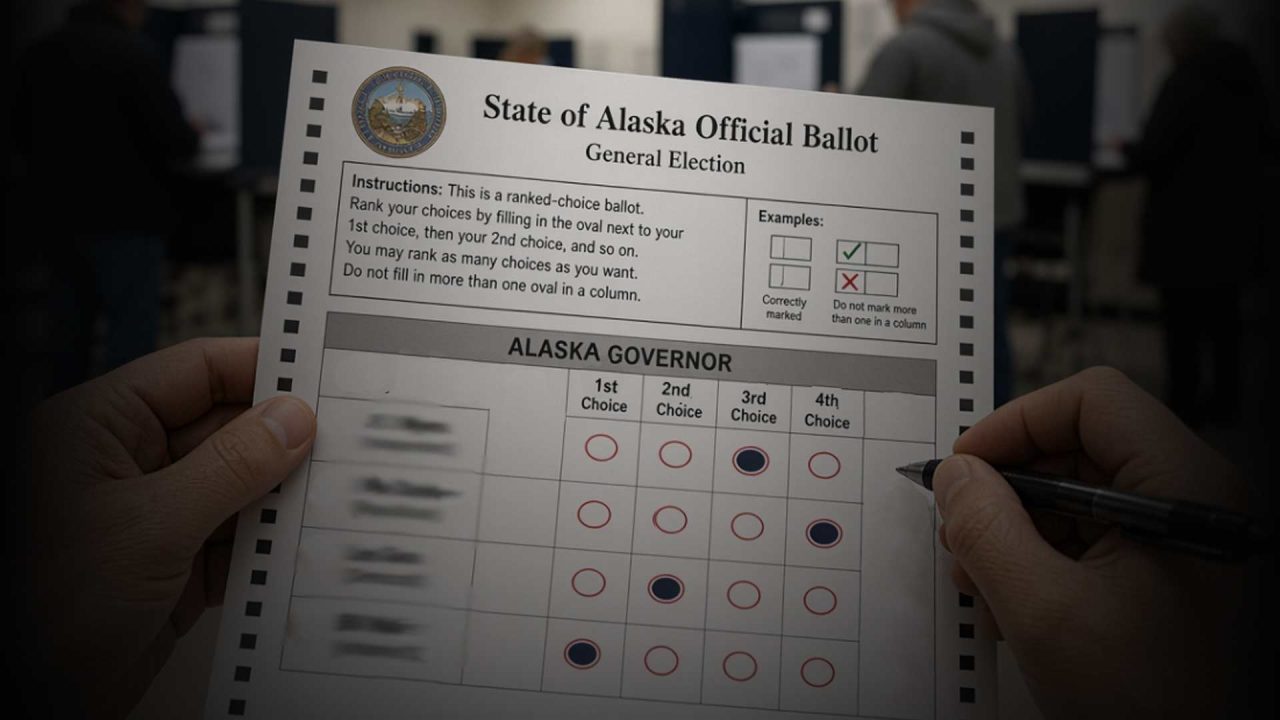
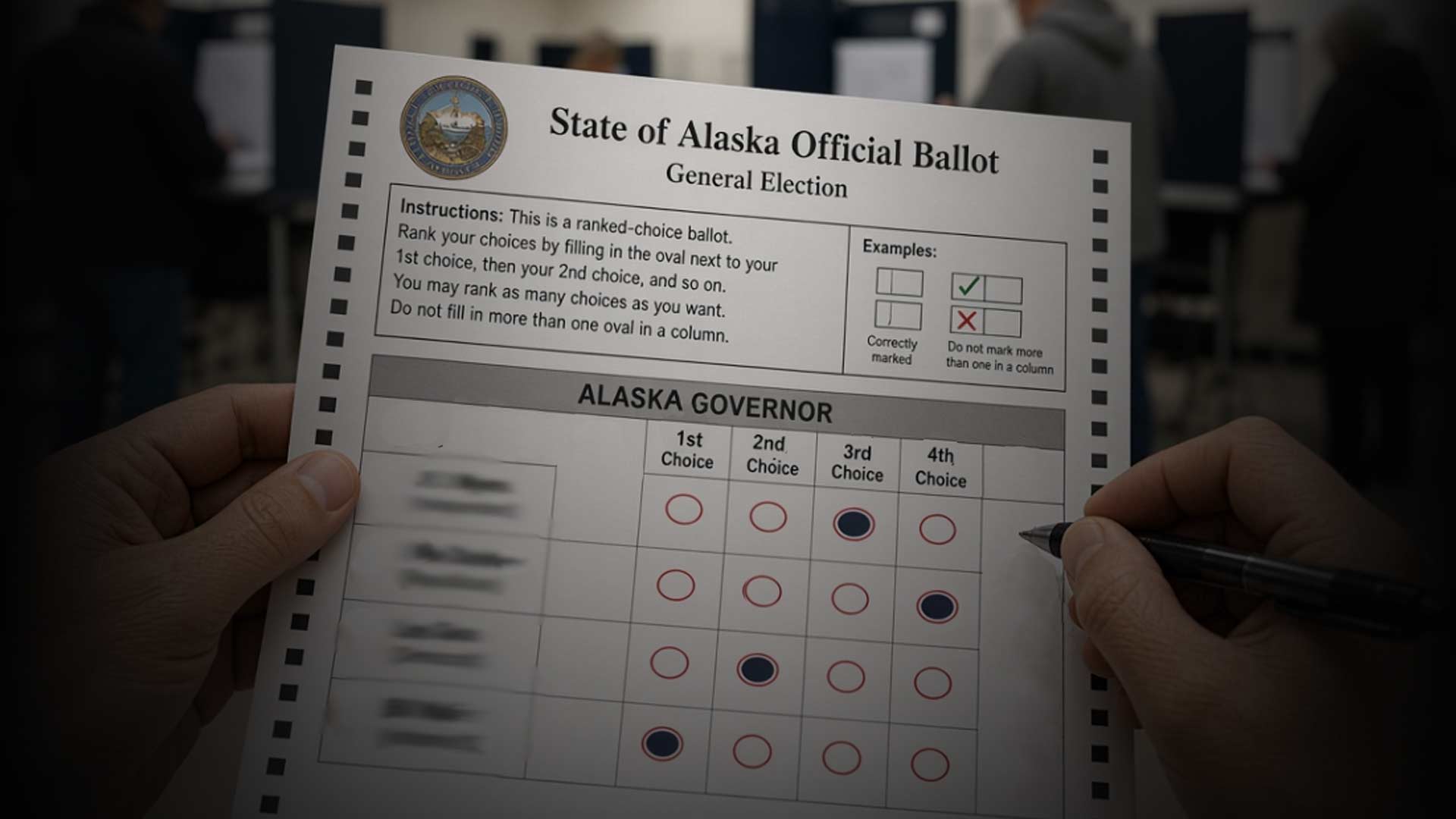
In the upcoming general election, your second choice is not counted so long as your first choice is still in the race. It does not compete with your first choice. It does not water it down.
It is tallied only if your first choice is knocked out of the race.
Ranking a second candidate will not cost your first candidate a single vote. Period.
Ranking them is not a love letter to them. Nor is it disloyalty to any other candidate. It is a strategic chess move to help preserve a state that you will actually still want to live in.

So long as your first-choice candidate remains in the hunt, your second oval does nothing at all.
The minute your candidate is knocked out, that second oval is the only thing keeping your ballot alive for a second round.
The machine does not reach into the pile and pull your ballot out if you fail to rank a second choice. Your ballot simply dies because you stopped writing.
We have already run this test.
August 2022. The special election for Congress. Almost six in ten Alaskans marked a Republican as their first choice, but a Democrat won the seat. The state counted 11,243 exhausted ballots that were not counted in the final tally.
Measure Peltola’s 91,266 votes against the 188,582 ballots active in the first round and she lands at 48.40 percent. That is Professor Jeanne Clelland’s math, from the state’s own report. That’s less than half the votes in a state where six in ten had just picked a Republican.
Fairbanks taught the same lesson that year. Bart LeBon won House District 1 in 2018 by one vote. In 2022, he ran in District 31 against Maxine Dibert and a second Republican.
A voter on a public Facebook thread asked people to rank the Republicans. That second candidate answered that she was telling people to vote only for her, since there were only three names.
Dibert won the seat. Nobody in Fairbanks got confused. That was the plan, and it worked.
Some Alaskans hate this system too much to fill out more than one line. Others honestly prefer the Democrat to one of the three.
But telling your own voters to bullet vote costs the frontrunner nothing. Those second choices are never going to be read as long as they were ahead.
It costs them nothing.
It costs Alaska everything.
That is why this piece of advice always comes from whoever thinks they are ahead. It is not a plan for beating Democrats. It’s a plan for beating the candidate standing next to you, dressed up as principle.
One campaign has said publicly that it is asking voters to rank all three.
Another has told its voters not to rank anyone else. Can we please learn from the past? You can hope for the general election to bring in enough votes – but hope is never a successful strategy, and statistics prove that it will not work.
ALASKA WATCHMAN DIRECT TO YOUR INBOX
That hope will almost certainly mean a Democrat governor.
Here is the trouble with the second message. The Republican who led the August primary got 16,468 votes. Kreiss-Tomkins got 37,006. That is the 20,538.
So, the candidate out front is the one who needs those second-choice votes the most. Asking Alaskans to hold them back is a recipe for defeat. Somebody either has not done the math or has done it and decided that finishing first among Republicans matters more than beating the Democrat.
Anyone who says, “There can be only one” is trading the governor’s office for a primary grudge. If you are going to tell 40,000 Alaskans how to fill out a ballot, you owe them the math first.
No matter what happens, two of those three candidates are going to be knocked out of the governor’s race. That is math, not a guess. Every voter who only fills an oval for one of those two that get eliminated will throw his vote away. You cannot go back in December and add a name.
Most Alaskans are not registered with either party. A lot of you dropped the R on purpose, worn out from watching Republicans knife each other instead of governing this state.
I understand it. That is exactly what is happening again. Haven’t we learned from the last two cycles under RCV?
So let me be plain about what I am asking, because it is smaller than it sounds.
You do not have to join anything. Ranking is not an endorsement. It is a preference order.
All it says is this: if my first pick is gone, here is who I would rather have deciding the next four years.
I am not asking you to like all three. Rank your favorite first. The one you can barely stand third. The order is yours.
Personally, any candidate who tells people not to rank goes to the bottom of my ballot. If you don’t understand how the system you’re running in actually works, or how the current game is being played, I’m not sure why I’d trust you to run the state.
An issue no one is considering is this: when people hear “don’t rank,” they carry it down the whole ballot. Into the Senate race. Into the House race. Into legislative races where the names and the math are nothing alike. So, any rhetoric that says “do not rank” affects every race.

The first ballots go in the mail on September 18.
There are two questions here, and people keep mixing them up.
Should Alaska do away with choice voting? My answer has not changed. Vote “YES” on Ballot Measure 2 and end this mess. Give us back a system where the winner earns a real majority and nobody needs a math professor to explain the result.
But how should you fill out your ballot while RCV is still the law? Because it is still the law. Simple – Rank all three. A ballot that stops after one name stops mattering the moment that name is eliminated.
The views expressed here are those of the author.
Click here to support the Alaska Watchman.






15 Comments
Listening to the voice of a republiconman! Not a chance!
You never fail to dissappoint Dave. Pee’d in any co-workers bags lately?
You explained it well and you’re exactly right!
I agree!
And you did it dispassionately and without names. Great idea.
Thank you.
Kevin, thanks for the great explanation. I WILL RANK THE RED!
If we lose this governors race, because of these lame uninformed republicans. Then we deserve these crazy,
looney, democrats running our state. Maybe it’s time to leave, think about that, all you conservative voters out there.
It’s a foolish argument to leave a place because of one doesn’t like the leadership there all awhile the rest of the country is going through what we Alaskans are experiencing up here and even worser and greater poverty. 2026 is not 1993 where if you leave a city or state that’s declined there be a better place to live without the poverty, crime, nor higher cost of living.
The only reason to be relocating is because of the Arctic Cold during winter was starting to have an adverse effect on one’s health usually because of the body is aged.
It isn’t the best strategy AKGOP thought would work by having 13 R’s in the Governor’s race. But the voters have no other choice but to rank the red. The sure choice would been to unite behind one and all other twelve respectfully drop out. AKGOP is betting using chance while the Democrats will be putting their first place position on 1 candidate and Republicans will be split on Order of Rank. I have my doubts but I’ll be ranking. But my order will like your’s be different. Wilson ,Bronson2, and Treg 3. We may end watching that our differences of ranking may end eliminating all three Republicans while JKT and the democrats get the 5o plus 1 votes or that no one meets the 50 plus 1 so the top two do a runoff. What happens if that’s Wilson? There will be Republicans who loath her so much they’ll vote for JkT.
To be honest. For the Church in Christ without walls and belongs to no religious organization, JKT could be a blessing to the little scattered Church across Alaska that the increased suffering and persecution may spark a revival in all those nominally Christians who were Christians in their churches ⛪️ but lived like the world outside of church services.
JKT and Democrats controlling the Governor’s office plus the legislature will make life harder on Alaska and people without Christ will likely have hearts hardened even harder because of the harder times. But for those who truly in Christ, persecution and difficult events increases one’s own patience, peace, intelligence and discernment, humility and self control. It makes one a better servant of Christ and better Christian.
Right now AKGOP leaders and its members they are so proud especially in their thinking they got the winning strategy to Rank the Red and I think we will end losing and Republicans at November will be utterly dismayed and shocked and confused. They thought they knew the game and reality will teach some Republicans that despite RCV’s promise to give choices, there will only be one winner and that means if either political party wants their candidate to win they have to Unify behind one, not two. Not three, not 13.
Tina, you are spot-on. I’ve watched Alaska politics for a couple decades now, and the one undeniable truth is AK Dems have a firm grip on their party, allowing only one candidate to move forward to the general, no matter the vote-counting scheme. Until AK GOP finds the intestinal fortitude to do so and figures out how to follow suite, it’s screwed. The Republican Circular Firing Squad is kind of fun to watch, though, as the party consumes itself from within, putting up Democrat-preferred candidates and joining with Democrat minorities to form Democrat-led majorities. Good luck ranking 3 losers.
Maybe conservatives should start addressing current problems Alaskans are facing, let’s start with higher gas prices and inflation. And also not use the words “lower liberal 38” when addressing the issue.
Thank you Kevin, my husband and I will rank our Republicans.
I was working the polls when the first vote using RCV was used. People were terribly confused and too many voted 1x thinking that would elimate the need for others to be in the race – hard to teach an old dog RCV, but us old dogs appreciate the advice on LAST time we use this unbalanced principle to honor what we consider our most important duty in being a citizen of our State and Country.
Also – you said it well and I wish there could be a simple repetitive ad campaign on RCV: VOTE YES TO END THE MESS!!!
1) Me and mine will Rank the Red.
2) Vote Yes on 2 to end Ranked Choice Voting
3) The Alaska Republican Party and Republican candidates need to realize that we have RCV and adjust their tactics. Their actions are not very strategic. They are being outsmarted by a weaker opponent.
I won’t be bothering to vote anymore. I’ve seen the rank corruption in this state continue year after year. Dems, Repubs, they are all the same. It’s honestly not worth my time anymore. Maybe it all needs to burn before we figure it out.
Really? How much time does it take for you to cast your vote?