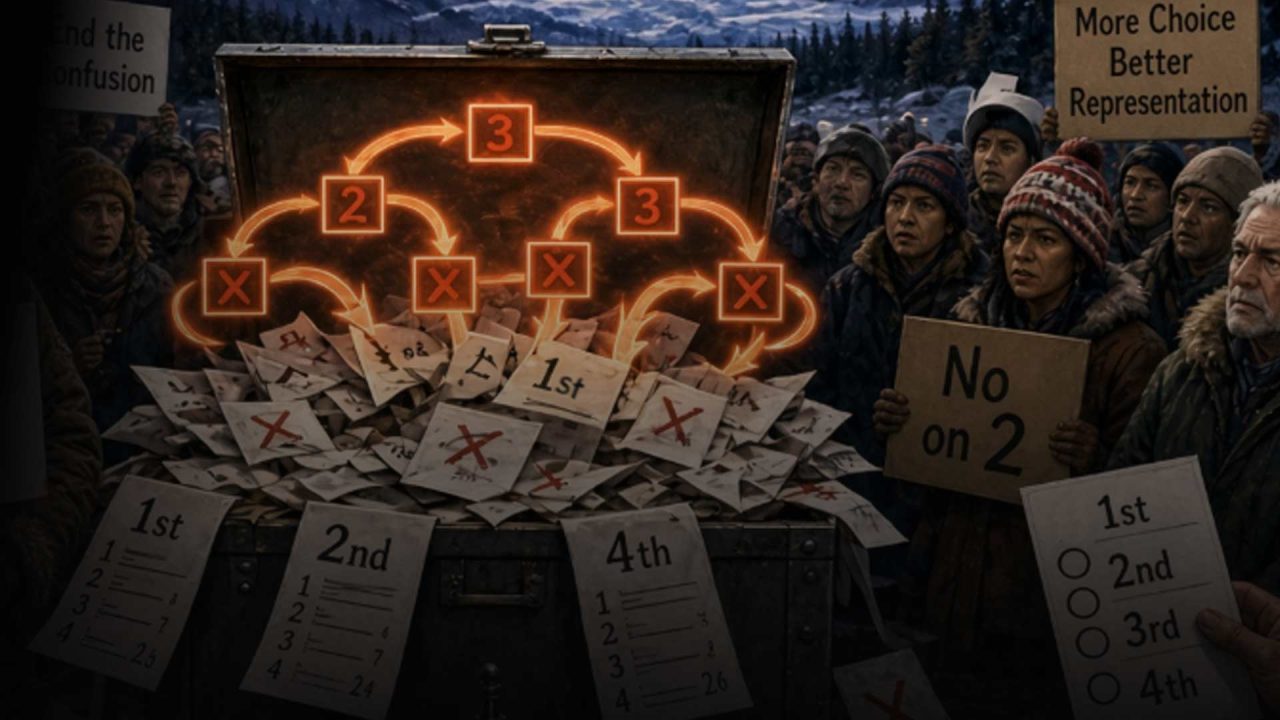


In attempting to convince Alaskans to keep its divisive ranked-choice voting system, left-wing proponents have gone out of their way to avoid mentioning the controversial voting system.
If Ballot Measure 2 passes in November, ranked-choice voting will end, and Alaska will return to its former system of traditional party primaries along with general elections in which voters choose a single candidate in each race, rather than ranking up to four candidates with multiple run-off rounds until a winner is decided.
Conservatives have largely focused on the fact that Ballot Measure 2 will repeal ranked-choice voting, which many Alaskans find confusing and ripe for manipulation by candidates who run with the agenda of siphoning off votes from leading contenders, while having no real chance of winning themselves.
Additionally, opponents of ranked-choice note that Alaska’s current system, which narrowly passed in 2020, never really eliminated so-called “dark money,” despite the fact that this issue was used by ranked-choice advocates as the primary argument for fundamentally altering Alaska’s election laws six years ago.
At that time, voters were told that changing Alaska’s election system would “end dark money” and require transparency about who was financially influencing state elections.
The main group fighting to keep ranked-choice voting consists of a coalition of Democrats and leftist allies, along with unions, liberal nonprofits and pro-abortion advocates.
In reality, the law was narrowly crafted to allow Outside groups to keep pumping unlimited money into Alaska contests for U.S. House and Senate, the presidency and all ballot initiatives. The only “dark money” impacted by the 2020 ballot initiative was money given to candidates running for local or state offices.
Additionally, the 2020 change ended all traditional party primaries. Republicans and Democrats can now no longer vet their candidates through a primary system. This opened the door for any candidate to claim a party affiliation and run under that banner, even if the party adamantly opposes their candidacy.
This has generated headaches both major political parties.
For instance, in both 2024 and 2026, a man serving a 20-year federal prison sentence in New York – Eric Hafner – successfully negotiated the ranked-choice system to appear on the general election ballot in November.
Despite pleading guilty in 2022 to charges involving threats against judges, police officers, and others, plus false bomb threats, he garnered 0.43% of the vote in Alaska’s 2024 top-four primary and still appeared on the November ballot after two Republicans withdrew. The Alaska Democratic Party unsuccessfully sued to keep him off the ballot, and he ultimately took about 1% in the general election when Nick Begich beat Mary Peltola for U.S. Congress.
This year, he finished with about 3.8% in the August primary and has once again advanced to the November ballot after Democrat Matt Schultz and others withdrew from the Congressional race.
In attempting to convince voters to keep ranked-choice voting, No On 2 campaign videos, political signs and social media posts have largely avoided even mentioning the controversial ranking system
Republicans, on the other hand, have had their own problems. Most prominently, U.S. Sen. Dan Sullivan is being forced to run against a man who shares his first and last name. Often referred to as “Decoy Dan,” this teacher from Petersburg claims to be a Republican, but he is actually backed by numerous Democrats who see his entry into the U.S. Senate race as a way to siphon off votes from Sen. Sullivan in his bid to defeat Democrat challenger Mary Peltola.
“Decoy Dan” earned just 2.47% of the jungle primary vote last month, but that was still enough for him to finish in the top four and make it to the general election ballot.
No On 2 is the main group fighting to keep ranked-choice voting in place. It consists of a coalition of Democrats and leftist allies, along with traditionally Democrat supporting organizations, including unions, liberal nonprofits and pro-abortion advocates.
In attempting to convince voters to keep ranked-choice voting, No On 2 campaign videos, political signs and social media posts have largely avoided even mentioning the controversial ranking system that would be repealed if Ballot Measure 2 passes.
Instead, No On 2 focuses almost exclusively on two points – asserting that repealing the 2020 law will result in a return of dark money, and claiming that restoring traditional party primaries will limit voter participation.
This latter assertion has been challenged by those seeking an end to ranked-choice voting, who note that if Ballot Measure 2 passes, Alaska would simply return to its pre-2020 election system, in which each political party could decide who gets to vote in its primary.
ALASKA WATCHMAN DIRECT TO YOUR INBOX
Under that prior system, the GOP allowed registered Republicans plus nonpartisan and undeclared voters to vote in GOP primaries. In order to avoid manipulation of the primary, however, registered Democrats and other party members generally could not vote the Republican primary ballot.
Alaska has an exceptionally large share of undeclared and nonpartisan voters. Under the old GOP rules, most of those independents could still vote in the Republican primary.
Democrats generally allowed voters from any party to participate in their primaries, but voters could not vote in both primaries. They had to choose one or the other. In the general election, voters could vote for whomever they wished.
In effect, repealing the ranked-choice voting system would simply restore party-controlled primaries. It would not outright prohibit non-affiliated or independent voters from participating in a party primary unless the parties decided to change their long-established rules.
On Nov. 3, a successful “yes” vote on Ballot Measure 2 will end ranked-choice voting.






8 Comments
The words “dark money” have had a chilling affect on voters who really do not know what “dark money” means. Right now “dark money” is being used to warn voters that we need to keep ranked-choice voting due to dark money being used in our elections. Dark money has already been involved in all elections. Several blue states are using their money to “flip” Alaska by financing Peltola’s senate campaign to beat Senator Dan S. Sullivan incumbent.. This money is dark money. The blue states are : Washington state, Maryland, Massachusetts, Wisconsin, and California. Wisconsin has a Superpac that several individuals have used. Massachusetts citizen William Harris donated $100,000 against Senator Dan S. Sullivan. Again, the effort is to flip Alaska to “blue.” Decoy Dan is trying to take votes away from our senator to help Peltola.. How does dark money from out of state confuse the voter who thinks they can block dark money? This tactic wreaks of the Soros machine hidden but causing confusion to our Alaska citizens. That is called lying and cheating.
I’m really into it! Vote Yes on 2, vote Yes on 2, vote Yes on 2!! It’s in the dreams of the Republican Party to end the nightmare of Rank choice Voting, and now its in my dreams to Vote Yes on 2!!
Yes… Vote “YES” on 2.. I see a lot of deceptive yard signs saying “Vote No On 2, and Get Rid Of Dark Money”… My granddaughter just got mail claiming (Lying) on the same ballot issue… VOTE YES ON 2…
Please vote yes on Ballot Measure 2 . Do away with RCV.
We need to tell everyone, to get out and vote, so they can’t cheat with all these mailed in ballots. Yes on prop #2
Sen Sullivan will lose but not because of RCV. Look up Mowi ASA and remind yourself that he did nothing about his stocks while eating some delicious wild caught salmon from Alaskan waters.
Also, what would be the alternative to RCV? Surely not the old system, the one riddled with corruption?
The alternative to ranked choice voting is democracy.
RCV – of the left, by the left and for the left…Vote YES on 2 to stop RCV…TV ads show that outside money from Colorado, Washington and California is trying to keep RCV alive in Alaska! That should tell us something. Dark corrupt outside money spenders are saying that outside money is promoting vote yes on 2. It is exactly the opposite!!!…VOTE YES on 2…!!! The liars are the No on 2 folks!…..YES YES YES on 2…!!!