


Last Friday, Alaska’s State House voted to advance a budget that includes the confiscation of the majority of your statutory Permanent Fund Dividend. They do this because they are incapable of balancing our state budget, forcing them to steal your money to help out. For the average Alaskan family of four, the House plans to take $9,200 from you this year, which is a pretty substantial and regressive tax, but they believe it is required due to our bloated state budget and the legislature’s inability to govern responsibly.
It doesn’t have to be this way. Like private individuals who experience a reduction in income, our representatives in Juneau could focus on cutting spending to match our state revenues, but that would require discipline and making tough choices, decisions that politicians are loath to make.
In a previous article, I jokingly said to simplify things, the legislature just needed to go back and use the last budget that passed before the oil boom, as it only spent money on things that were truly needed. After giving it some thought, I decided to explore this idea a bit more. The last state budget passed before the oil windfall was the FY 1969 budget that took effect on July 1, 1968. We didn’t have much money back then, so it was a pretty frugal budget, and a good place to start when trying to reduce our current spending. Here is a comparison of the FY 1969 state budget with the one for FY 2026, which was enacted last June.
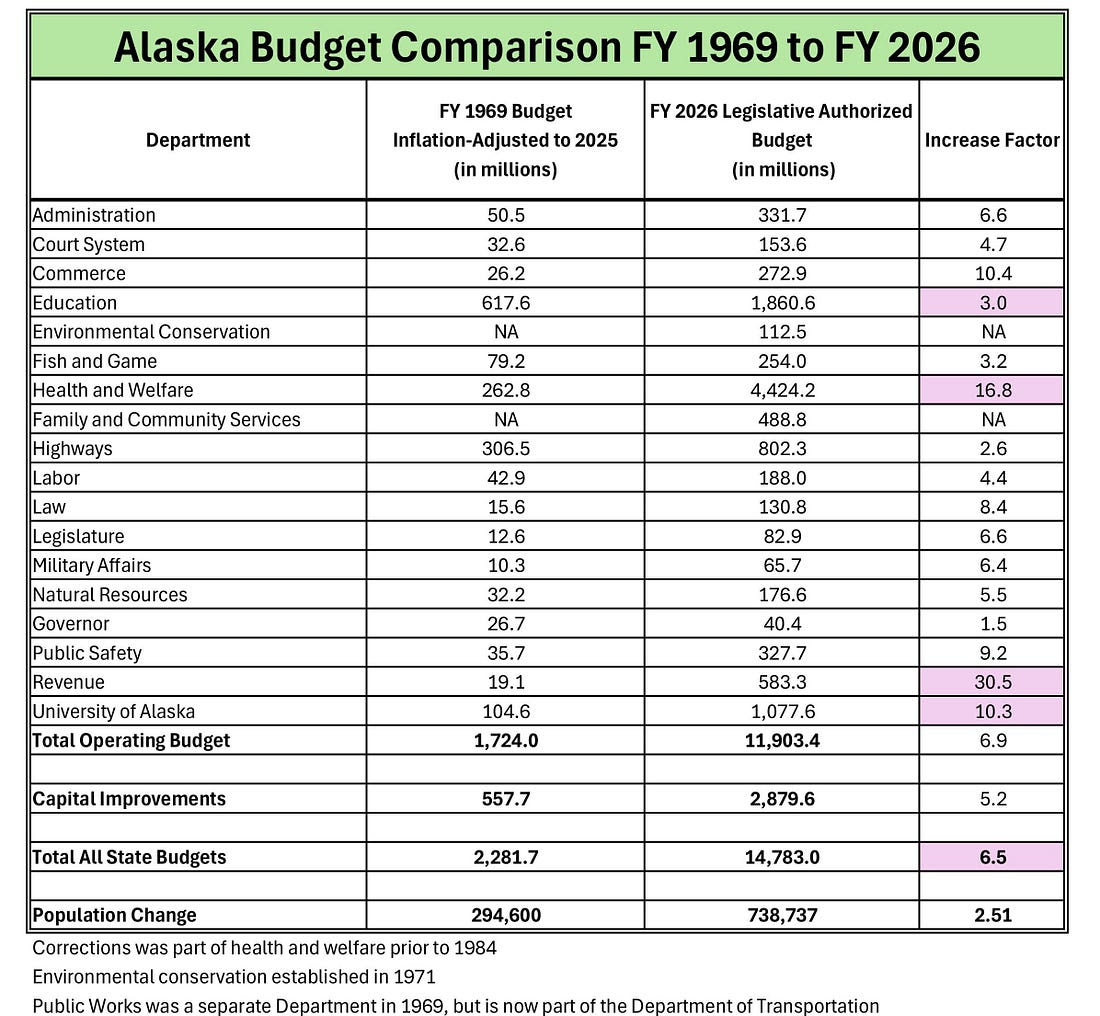
The chart shows the budget for each state department, and importantly, the costs in 1969 have been adjusted for inflation into 2025 dollars, so this is an apples-to-apples comparison. The column on the right shows the number of times each department’s budget has increased since 1969. The chart demonstrates that in real-world dollars, every department has dramatically increased spending levels. Importantly, while the population has gone up about 2.5 times since 1969, our total budget is 6.5 times what it was before the oil windfall, showing the extent to which it has grown.
Starting with the Department of Education, which seems to always be used as an excuse for the legislature when they want to spend more money. It received the highest funding in the 1969 budget and today still has the second-highest funding of any state department. Since 1969, spending on education has increased by a factor of three. Remember, these are using inflation-adjusted dollars.
The Democrat led legislature said last year, and is repeating in the current session, that they needed just a bit more money to fix the education funding problem. Examining the state budget, it appears that they have been making this claim for the past 57 years, with real dollar spending increasing threefold, yet we haven’t resolved the education funding problem by simply throwing money at it.
The solution to Alaska’s budget woes is not robbing the people by stealing an ever-increasing percentage of their dividend.
Education isn’t the least of our problems. For the Department of Health and Welfare, our state now spends ~17 times what it did in 1969. A large part of this increase is due to Governor Walker’s expansion of Medicaid eligibility back in 2015. We now have over 280,000 Alaskans participating in Medicaid, which is almost 40% of the state’s population. Medicaid is a federal program that the state administers intended to provide health care coverage to low-income individuals. According to the census department, 10.2% of Alaskans are considered “poor,” and yet 40% of us receive Medicaid funding, much of which is likely unnecessary.
This was a potential problem that Governor Walker was warned about at the time, but he flippantly said that if we ever got to the point where the program was too expensive, we would just tighten up on eligibility. It looks like now is the time to do so.
If you examine the capital budget for FY 2026, you can see that it has increased fivefold. Unfortunately, we aren’t building new docks, roads, or bridges with the spending. One consequence of building large infrastructure projects in the past is the O&M costs associated with them. RINO Senator Bert Stedman proposes taking even more of your PFD than what is in the House budget to increase the capital budget to pay for deferred maintenance on K-12 schools in this state. Even though Capital spending has increased by a factor of five, Stedman says the state needs even more of your money just to take care of the existing infrastructure.
ALASKA WATCHMAN DIRECT TO YOUR INBOX
I could go on in detail about the bloated spending in every state department, but you get the picture. The problem with state government today is that our legislators figured out how to get elected by giving away the oil windfall and know of no other way to govern. That worked as an election strategy until the oil revenue started falling. Now our government needs to be more fiscally conservative, and they don’t know how to govern in that manner.
The solution to Alaska’s budget woes is not robbing the people by stealing an ever-increasing percentage of their dividend. The solution is simple but requires courage. The legislature needs to cut the budget, paring it back like you would a bush that has grown too large. If the current members of the legislature aren’t up to the task, perhaps it is time to replace a few of them.
The views expressed here are those of Greg Sarber. Read more Sarber posts at his Seward’s Folly substack.





14 Comments
The trouble is you have described every lawmaker we have.
Every lawmaker we have has voted for unsustainable state budgets while in the majority. They equate being in the majority with voting for these same types of budgets, and they aspire to be in the majority. A few new ones haven’t been in a majority yet, but based on their voting record they are already on track to vote for the same types of budget when they do. When the house voted on 4/8 to throw out Dunleavy’s budget and replace it with the House Finance Committee’s substitute (which went from a full statutory dividend of $3,800 to an effective dividend of only $1,450) the vote was 40 to 0. The vote from my colleagues was the same in 2024 (39-to-1) and also in 2023 (39-to-1). Vote after vote in 2024 we voted to cut the bloat from that year’s outrageous capital budget. This was the year that Republicans were “in control” in the house. The vote was the same 39-to-1 almost every single time we voted. Are you willing to vote against the 39 who fear cutting the bloat? It is usually far easier politically to vote to remove the one and then declare “we’ve cut all we can”.
David you nailed it, we should replace all of them.
If the current members of the legislature aren’t up to the task, perhaps it is time to replace a few of them.
Davis, you are on target every time!
First. God has to change the hearts of Alaskans before the budget can be cut over the next 15 election seasons. No heart change then nothing will stop voters from changing lawmakers because the former ones cut the budget reducing the government dependency any laying government employees off, programs closed, departments smaller, and shopping, restaurants, hospitality businesses struggling or closed.
I’m all for harder times that reducing and restructuring government spending. Because my faith is on God already. But Alaskans are not Christians and they are dependent on the things of this world
Even Alaska Watchman’s very homeschool community readers are dependent on State of Alaska Homeschool allotments. They don’t want to live without it. Even Alaska Watchman prompted government dependency to his readers to apply for federal education grants up to 900,000 a piece. People before taking government money they are so selfish that they don’t even ask themselves “who did government leaders forcibly take this money away to give it away to me?”
Ok Tina! I’ve heard my fill of your insightful crap! I’m not necessarily reacting to your insistence that People need a kick in the but reformation, I’m looking realistically at how ignorant Christian’s are today and how impotent and neglectful the churches they attend have stubbornly been!!! Our entire republican party has been stupefied by that very church and we are progressively bowing down not to Almighty God, not at all! We are bowing down to perverts, thieves, liars, and anything that looks at us crosseyed! THIS IS TRUTH!!!
Moving the legislators to the mainland during session would give access to the legislators and family type candidates could participate who will not be away from their homes in Juneau. Willow was a choice to relocate them while in session. The Alaskan citizens are discriminated against when they cannot afford personal travel costs, while the legislators get reimbursed for their travel costs, and the NEA, government leaders spend public money for travel expenses and other lobbyists use union dues to fly down and stay in the faces of the legislators constantly. The rest of the state has little or no access to help make sounder decisions. expecially to balance the budget. One requirement for a candidate should be that the person has to prove that they can balance their own checkbook.. I agree with Tina. The dependency we have on government hand-outs is great. God can help through prayer to change the hearts and minds of those elected to office. Prayer is more powerful than people realize.
the raiders of the public funds own what is supposed to be our legislators
run against them and meet their rath!
they own the media
good luck fighting that
the pot of gold is the corpus of the fund and they want it all
Eastman tells the sad but true story. Plain and simple, 90% of government in this country, and in Alaska, is bloat and grift. This can be proven with simple math. There is no mystery. Most people in government are there to enrich themselves and their friends. They could take the whole PFD, all of it. After a very short time, they’d need more, and a series of broad based taxes would follow.
If they can’t do their job in the allotted time they get no extra pay. That would be the amount they took from the PFD.
This was all very presciently explained all the way back in 1850 by Frederic Bastiat in his timeless (although unfortunately forgotten by too many) publishing of The Law. You can read it here and with a fantastic foreword providing a very astute synopsis of its content:
https://cdn.mises.org/thelaw.pdf
Okay, what do you cut?
Everything
What Alaskans need to realize is that if they were to receive their full PFD, there would be no need for probably 99% of the state programs! Families could use the money for fuel, homeschooling, daycare, or most all of the other necessary activities of daily living!
ALASKANS! Stop voting people in who want to steal from you under the guise of “assistance”! Be adults and learn self-reliance!!
Honestly, I think we should: 1) Kick the feds out of OUR state; 2) STOP sending OUR money to the feds. (I’d be more than happy to pay a STATE income tax if we didn’t have to pay an unconstitutional federal income tax.) Let’s keep our dollars in Alaska. 3) Boot out those legislators who continuously lie and steal from us. 4) Put the capitol in Willow WHERE IT BELONGS! 5) Is there such a thing as a class-action lawsuit against the state legislature? But the courts are probably on their side, anyway, so that might not work.
Wake up! If you don’t, we will become California 2.0.