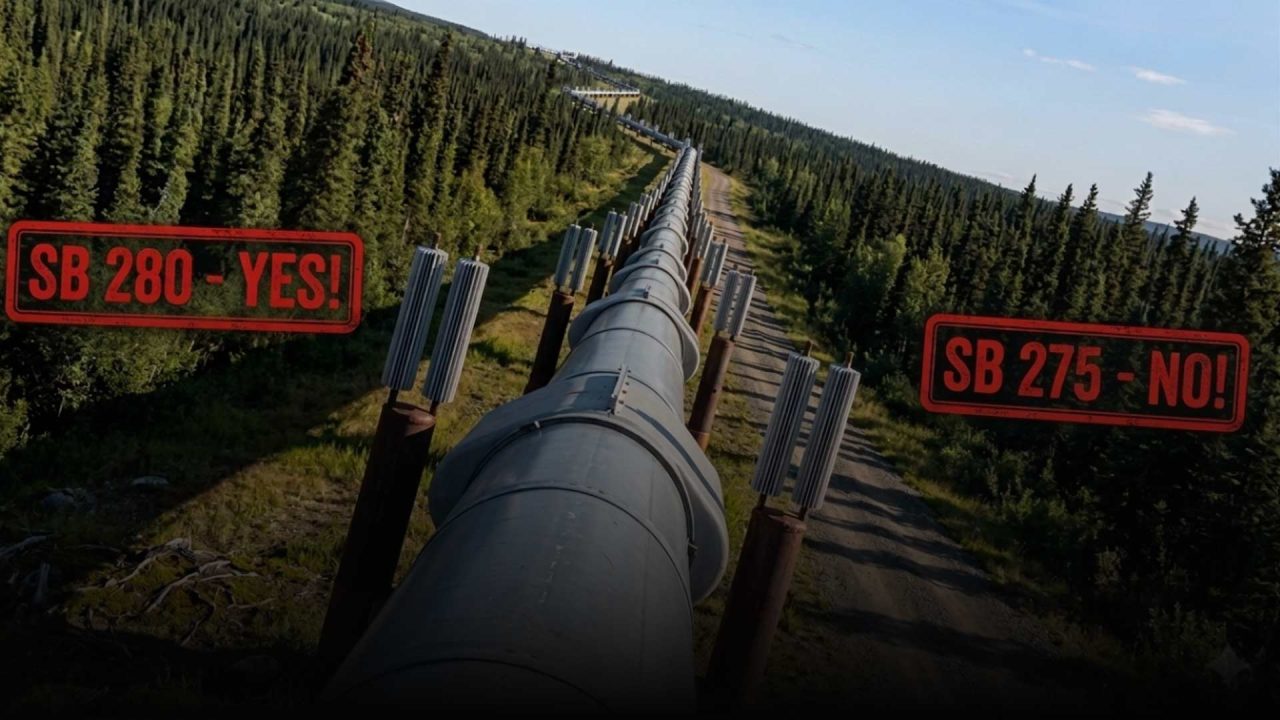

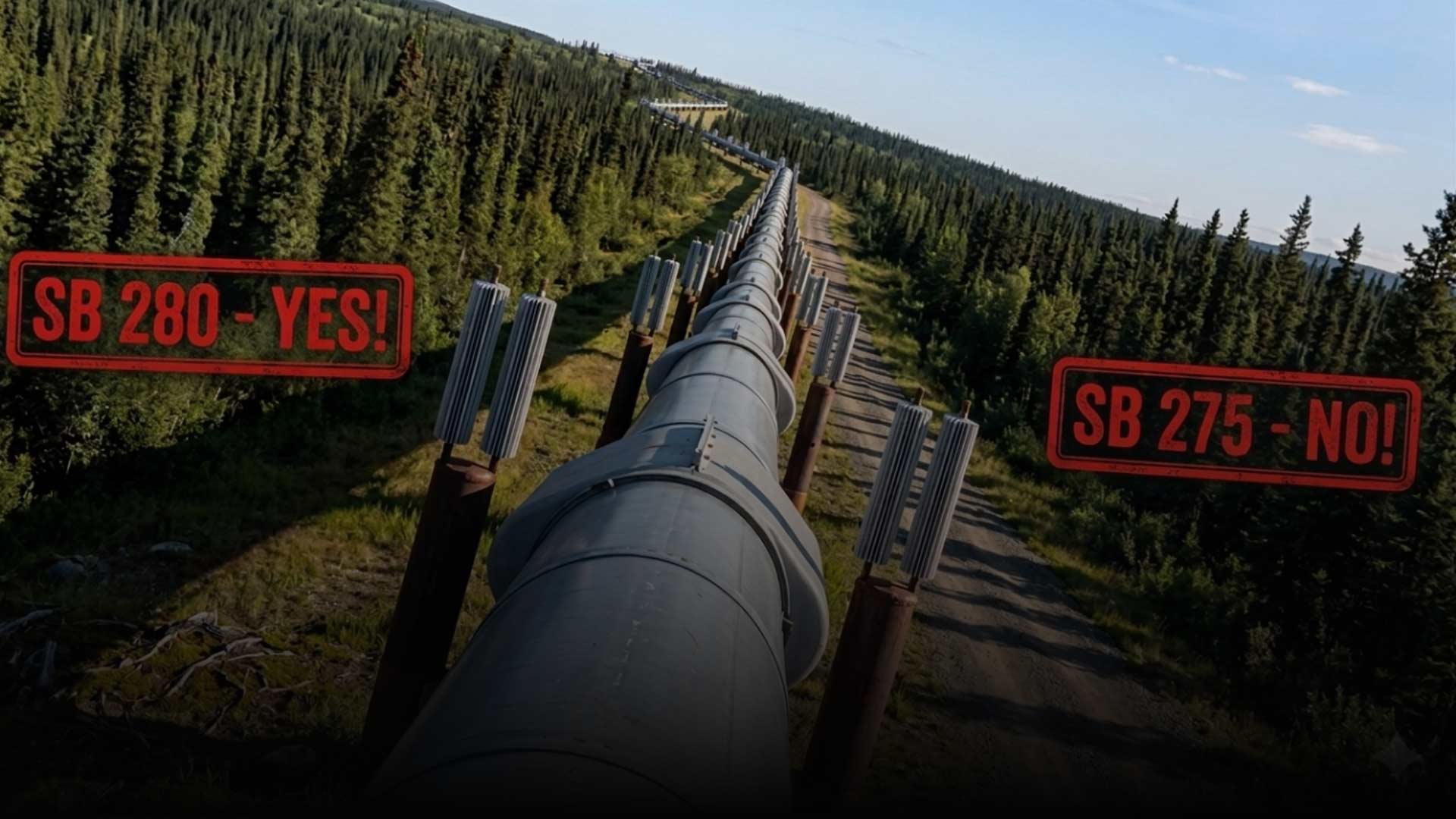
Alaskans are going to hear about Senate Bills 280 and 275 and assume they are basically the same thing. Both deal with the Alaska LNG natural gas pipeline project. Both touch taxes. Both come with thick binders and familiar promises.
They are not the same. The difference is not technical; it is philosophical. One bill is written to help a project get built. The other is written to maximize the state’s take, whether the project gets built or not.
SB 280 is the Gov. Dunleavy’s bill. It swaps out the current 20-mill property tax on the pipeline, gas treatment plant, and LNG terminal for a volumetric tax based on how much gas actually moves through the system.
Here is why that matters. Under current law, the moment construction starts, the project gets hit with a property tax on tens of billions of dollars of steel and concrete. No revenue. No gas moving. The tax bill still shows up. For a project expected to cost north of $40 billion, that front-end load is one of the reasons we have been stuck at the starting line for two decades.
SB 280 fixes that. No property tax during construction. Full abatement during a ramp-up period that ends when the pipeline hits one billion cubic feet per day or after ten years, whichever comes first. After that, six cents per thousand cubic feet of throughput, escalating one percent a year. That tax replaces state and municipal property, sales, use, and municipal income taxes on the pipeline assets. Revenue is split between the state and the municipalities through which the pipeline runs.
Short. Direct. Written to say, “Yes.”
SB 275 comes out of Senate Resources. Different animal. Forty sections doing three things.
One, it puts the Alaska Gasline Development Corporation (AGDC) on a shorter leash with annual audits by Alaska’s Legislative Budget & Audit. No divestment without a new law. New restrictions on confidentiality agreements. A requirement that any partnership with a foreign entity, directly or indirectly, gets legislative approval, by law.
Every major operating LNG export terminal in Texas and Louisiana has received a property tax abatement, often for 100% of the tax bill for ten years
Two, it lets the Division of Revenue and Division of Natural Resources impose a “prevailing value” standard on intra-company sales where the agencies believe the transaction price was too low. That is a legitimate anti-transfer-pricing tool and there is a case for it.
Three, and this is where the weight lands, it layers new taxes. A 9.4% corporate income tax applied more broadly to North Slope gas pipeline entities, including current S-corps and LLCs that currently sit outside the corporate tax (trying to close the HilCorp loop yet again). A fifteen-cents-per-thousand-cubic-feet surcharge on gas processed and liquefied in-state. And, after January 1, 2026, producers lose the ability to deduct North Slope gas development costs against oil production tax liability.
SB 280 takes the midstream tax and makes it predictable and modest. SB 275 keeps the existing tax, adds an income tax, adds a surcharge two and a half times the volumetric rate SB 280 proposes, closes a pass-through loophole, and eliminates a cross-commodity deduction producers have used for years to finance North Slope work.
These are not minor adjustments. They change the overall cost structure of the project. In short, this was written to say, “No.”
The Two Theories
SB 280 is built on a theory I have written about before. Alaska does not lack resources. Alaska lacks projects and vision. We have spent 40 years watching projects die at the finance stage because our tax structure makes the math impossible.
Look at the Gulf Coast. Every major operating LNG export terminal in Texas and Louisiana has received a property tax abatement, often for 100% of the tax bill for ten years, under programs like Texas Chapter 312 or Louisiana’s Industrial Tax Exemption Program. Freeport LNG, Sabine Pass, Cameron, Calcasieu Pass, all of them. You can argue whether that is the right policy. You cannot argue that it is not the policy. It is how those states have actually financed the projects that now dominate U.S. LNG export capacity. Alaska has the highest-cost project in the country, the longest supply chain, and the shortest construction season, and we are being asked to compete with jurisdictions that zero out front-end property taxes as a matter of course.
SB 275 is the control bill … Development becomes a threat to be managed rather than an opportunity to capture.
When DOR testifies, on the record, that “the Alaska LNG project will not proceed without property tax relief,” and when Glenfarne, the developer with actual capital on the line, says property tax relief is their primary ask, we should take that seriously. SB 280 answers that ask.
SB 275 starts from a different premise, that the state needs stronger controls, more review points, and a larger guaranteed share. Some of that is understandable. But taken together, the bill adds cost, uncertainty, and process. Capital is not sentimental. It goes where the math works.
One piece of SB 275 is being sold as a protection and is actually something else.
The provision says AGDC cannot enter into a legal relationship with a foreign entity, directly or indirectly, without legislative approval by law. Supporters will say this is about keeping China out. Read the language. It does not say China. It says, “foreign entity.” That includes the Korean utilities, Japanese trading houses, and Taiwanese off-takers that have been part of AKLNG partner discussions for years. These are allies. Several are already on the customer list.
A blanket foreign-entity gate does not improve oversight. It adds a veto point, and veto points are where large projects get killed. If we want an adversary carve-out, write an adversary carve-out. The bill, as drafted, gives any future legislature a kill switch on AKLNG’s customer base, and that is a different thing than oversight.
Capital goes where the numbers work and where the rules are clear. Alaska is not the only place in the world with gas to sell.
Where the Trump Memo Fits
Last week, the president issued a determination under Section 303 of the Defense Production Act declaring natural gas and LNG capacity essential to the national defense. He waived the usual procedural findings and authorized federal purchases, financial support, and permitting acceleration.
Washington just moved from relatively neutral to actively supportive. Federal financing pathways through the DPA, DOE, and EXIM can now be stacked. Permitting gets a national defense argument on top of the normal environmental review.
That is a direct tailwind for SB 280. Federal support plus state tax certainty equals final investment decision. SB 275 runs the other way. The administration is treating LNG as essential infrastructure. Senate Resources is proposing to treat the same infrastructure as a revenue-extraction opportunity and a geopolitical hazard. The president is pulling the project toward FID. SB 275 is pulling the other way.
SB 280 is the free-market bill. Trade tax certainty for project certainty. Take a smaller, more reliable slice of a much bigger pie. Let Alaskans heat their homes with Alaskan gas. Let Alaskan workers build an Alaskan project.
ALASKA WATCHMAN DIRECT TO YOUR INBOX
SB 275 is the control bill. Before anyone builds anything, they will pay more, clear more hurdles, sign more agreements, and submit to more approvals. Development becomes a threat to be managed rather than an opportunity to capture.
There are real reforms in SB 275 that deserve a home in a final bill. The transparency provisions. The prevailing-value rule. Stronger audit authority. Those pieces can be cleaned up and added to SB 280 without breaking the project.
But the core question is whether Alaska is a state that says yes when a project makes sense. The president just answered that. The developer has answered it. DOR has told us, on the record, what happens if we do not. The governor has put a bill on the table that actually solves the problem.
Capital goes where the numbers work and where the rules are clear. Alaska is not the only place in the world with gas to sell.
If we want this project, we need to act like it. We need a committee substitute out of the House Resources Committee that adds the few good parts from SB275 into the Governor’s SB280. We need to act like our constitutional mandate to develop our resource is important to us.
The views expressed here are those of the author.




3 Comments
Get it done and built. The dang left wants your money and to stop it because of the poor animals.
Plus if Trump supports it, then we have to stop it. Wait Natural Gas no windmills needed, that don’t work.
History is repeating itself and 26 years later, today, the same scenario of life, choices, people, positions, companies’ names and events have changed names but not the human element of money, pretend, greed, what if’s, countries in the world, projects, excitement, under the table money and acquisition agreements. It’s all there and coming round, full circle to the same events unfolding to a new generation of the same life’s choices. The best chapter is called, “When Pigs Could Fly” written by Bethany McLean and Peter Elkind in their famous book called, “The Smartest Guys In The Room” and it was about the famous company called Enron. It’s happening in Alaska today! The main body of actors is in full swing, attempting the same failures of the reporting in the book on Enron and its alliances. The questions today should be asked about how many of these new actors will end up in prison? Bet that is an answer on the horizon but moving fast in the same direction as that company of the past. Some committed suicide, some departed and went in other directions when the stench of bad decisions and bragging drove the best actors away, but the investigations and trials of companies and people documented in the report from court appearances and records were staggering in the telling of those events.
One thing we all know in Alaska, the LNG will be built when the people of Alaska want it done. The pretending of the companies and people and paper waving and shouting from the podium by CEO’s will not change what the people of Alaska want, when and where the pipe will go and be built. Remember, all who listen, Alaska will not be torn apart for your profit and gain. Unfortunately for Alaska, it’s path is being directed by the same sick standards of the Enron schemes and will not be tolerated by the Alaskans. Now the “players” want secrecy established in l.aw. “Shame” on the Dunleavy Administration and the legislative body that incorporates these underhanded standards to the character of state law. Its going to be good to have Dunleavy gone and a new governor to take on the work for the Alaskans. We are sick of Dunleavy’s lying, manipulation for Alaska’s resources.
Dunleavy and maccabe need to be gone