

For years, I have argued that Ranked Choice Voting, and especially the jungle primary that came with it, rewards political camouflage and punishes political clarity. It encourages candidates to blur distinctions, avoid firm positions, and present themselves as something they are not. What I did not expect was to see that camouflage become quite this literal.
As of this week, Alaska voters may see two Dan Sullivans on the ballot in the 2026 U.S. Senate race. One is our sitting United States Senator, a retired Marine, former Attorney General, and a public figure whose record is well known to Alaskans. The other is an unknown candidate from Petersburg who filed late and whose campaign materials have been linked to a progressive political consultant. The National Republican Senatorial Committee has raised concerns that the purpose is obvious: if you cannot defeat a candidate on the merits, create confusion around his name.
To be fair, facts matter. The Peltola campaign denies any involvement. The second Mr. Sullivan says he is running a legitimate campaign. I cannot tell you who encouraged who to run, nor can I prove anyone coordinated this effort. What I can say is that a healthy election system should never make a tactic like this attractive in the first place.
This is just the latest in a long list of why RCV needs to be repealed in Alaska.
But this race was never only about Alaska. Chuck Schumer personally recruited Mary Peltola into it, and his allied groups have already spent millions to soften up Senator Sullivan before the campaign has even begun in earnest. Senator Sullivan himself has said that Schumer is prepared to spend millions of dollars to defeat him.
They are not making that kind of investment because they care about Alaska.
They are doing it because control of the United States Senate may run straight through this seat. If Schumer flips Alaska, he and the same anti-Alaska Democrats who fight our resource development, our drilling, and our way of life move one step closer to control of the U.S. Senate. What happens on our ballot will be felt far beyond our borders. It will be felt in Alaska for decades.
This is what I would call the RCV Nuclear Option.
If political operatives believe they cannot beat an incumbent, they can recruit someone with the same name, place that person on the ballot, and hope enough voters become confused to alter the outcome. Whether that strategy succeeds is almost beside the point. The damage occurs the moment voters begin to question whether the ballot accurately reflects their choices.
This situation exists because of Ballot Measure 2, which passed in 2020 and created the jungle primary. I have said for years that the greatest weakness in Alaska’s current election system is not the ranking process itself, but the Jungle Primary. When every candidate appears together on a single ballot and only four advance, confusion becomes a political weapon. Two identical names can split votes, distort results, and affect who moves on to the general election. What was once an occasional accident of crowded races becomes a tactic available to anyone willing to exploit the system.
ALASKA WATCHMAN DIRECT TO YOUR INBOX
Under Alaska’s previous election structure, this problem was far less likely to occur. Parties chose their own nominees, and those nominees appeared on the general-election ballot with clear party labels. Voters could easily identify who was running, what they stood for, and which candidate represented their preferred party. The old system was not perfect, but it was understandable. Voters could read the ballot and know exactly what they were looking at.
Supporters of Ranked Choice Voting promised us a more civil politics and broader representation. Instead, Alaskans have spent the past several election cycles discovering new ways the system can be manipulated. We have seen exhausted ballots. We have seen candidates declared winners without receiving support from a majority of all ballots cast. Now we may see two candidates with the same name competing for votes in one of Alaska’s most important races.
Every election system should be judged by a simple standard: does it strengthen voter confidence or weaken it?
Two Dan Sullivans on the same ballot do not strengthen confidence. They raise questions that should never have to be asked. Elections are supposed to provide clarity. They are supposed to tell us who the candidates are, what each individual stands for, and what voters actually intended.
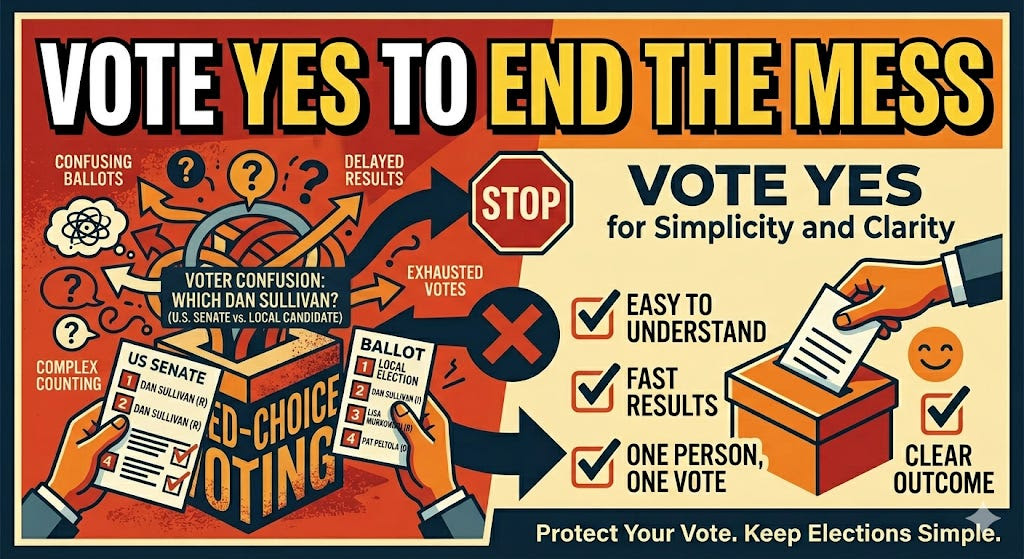
An election should not resemble a shell game. It should not depend on voters sorting through confusion created by consultants, strategists, and sneaky political tactics. Alaskans deserve a system that values transparency over gamesmanship and clarity over confusion.
For the sake of clarity, let me be precise about who I am talking about. The incumbent is Senator Daniel S. Sullivan, the Republican who has represented Alaska in the United States Senate since 2015. Under Alaska law, when two candidates share a name, the state resorts to printing their middle initials to tell them apart. That our elections may now hinge on whether a voter catches a single letter on the ballot is itself the clearest argument for repeal.
Most of all, they deserve a ballot that leaves no doubt about who they are voting for.
The views expressed here are those of the author.





14 Comments
I have yet to meet someone in Petersburg that knows the imposter Dan Sullivan who claims to have been a resident on the island for the last 50 years. Some of the inquirers have to residents who have been on the island for the past 90 years. So Not only does imposter cast a shadow on Alaska politics but also on the community of Petersburg. This guy is a fraud at many levels.
If the left can’t win, then yes they will cheat. RCV is so corrupt the candidate in last place becomes the winner, you ask yourself how can that be. You guessed it, it’s all about cheating.
It’s all about Lisa Murkowski staying in office. Vote YES on ballot measure 2
PA. Who is the all time winner of America’s Got Corruption? It’s not a democrat.
I wonder if Mary will rank her choices when she picks her next husband?
It’s like the Democrat Party, era 1847-1885. No sinister act is too low. They have no shame.
This just proves, or at least it should prove to all the Democrats party is completely corrupt to the soul! Any conceivable method they can conjure up to cheat, they move on it. The Democrats are going to push this country into civil unrest that we will never be able to repair. I only hope that President Trump brings the Dan Sullivan imposter to the attention of all American’s so they can see what soul less people the Democrat and Petersburg’s Dan Sullivan are.
The jungle primary is unconstitutional, because it violates our 1st Amendment right of free association: Congress shall make no law … or the right of the people peaceably to ASSEMBLE, and to petition the Government for a redress of grievances. Emphasis mine. That’s what political parties are, a method to assemble. A Justice Thomas or Alito might rule that way.
Linn is cooking cabbage again for dinner! Kevin is bloated! Sequestration at the maccabe house is needed to protect the climate!
The jungle primary is unconstitutional, because it violates our 1st Amendment right of free association: Congress shall make no law … or the right of the people peaceably to ASSEMBLE, and to petition the Government for a redress of grievances. Emphasis mine. That’s what political parties are, a method to assemble. A Justice Thomas or Alito might rule that way.
Let’s mark the real Dan Sullivan as “incumbent” on the ballot.
The danger is not that the State investigates fraud. The danger is when an incumbent’s campaign complaint appears to become State action.
Sen. Sullivan and national Republicans publicly accused the Petersburg Dan Sullivan of being a “sham” candidate and threatened legal action; then Lt. Gov. Dahlstrom opened an investigation into whether the challenger coordinated with “another candidate” to confuse voters. That sequence naturally raises a public-trust question: is the Division of Elections protecting voters, or protecting an incumbent?
The other Dan Sullivan says the candidacy was his own choice, denies being put up to it by Democrats or Peltola, and says he has every right to run. AP also reported that Peltola’s campaign, the Alaska Democratic Party, and the DSCC denied involvement. So until there is actual evidence of fraud, coercion, false filing, or paid coordination, the presumption should be: a qualified citizen may run for office under his own legal name.
An incumbent should not be able to turn ballot competition into an official investigation merely because he dislikes the political consequences. That chills citizen candidacy. It tells ordinary Alaskans, “Run against power and power may investigate you.”
A fair standard would be:
First, publish the complaint or referral that triggered the investigation.
Second, identify the specific statute or election rule allegedly violated.
Third, require real evidence — not campaign rhetoric, not name similarity, not past political donations.
Fourth, protect voters by clearer ballot identification: full name, middle initial, hometown, occupation, and “incumbent” if Alaska law allows that label equally and neutrally.
My bottom line: Dan S. Sullivan can warn voters. He can campaign hard. He can say, “Make sure you vote for Dan S. Sullivan.” But he should not get special government protection from lawful political competition. The ballot belongs to the people, not the incumbent. Liberty Ed
I agree with the Senator: the name similarity sows impermissible voter confusion. AND smells like a leftist dirty trick. But yes the solution may be to just ID the Senator as “incumbent.” Methinks the trickster will object to that, which would expose him.
Alaskan Republicans wanted RCV until it backfired on them.