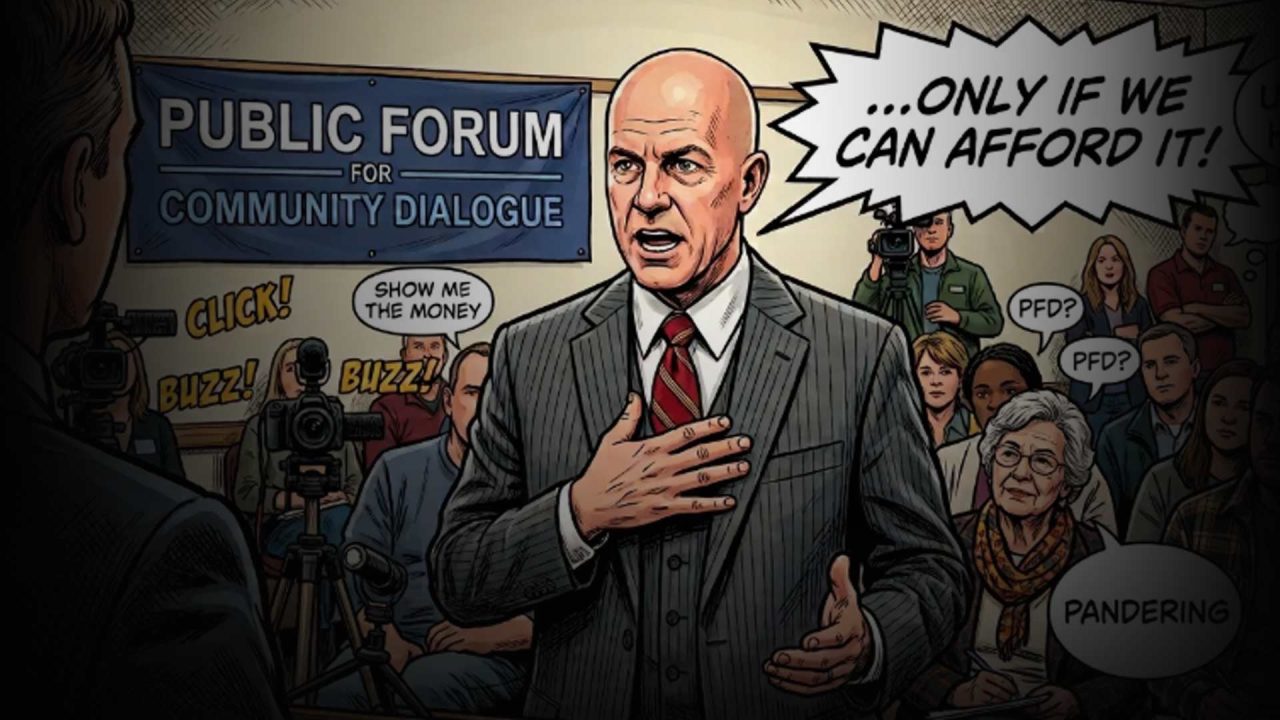

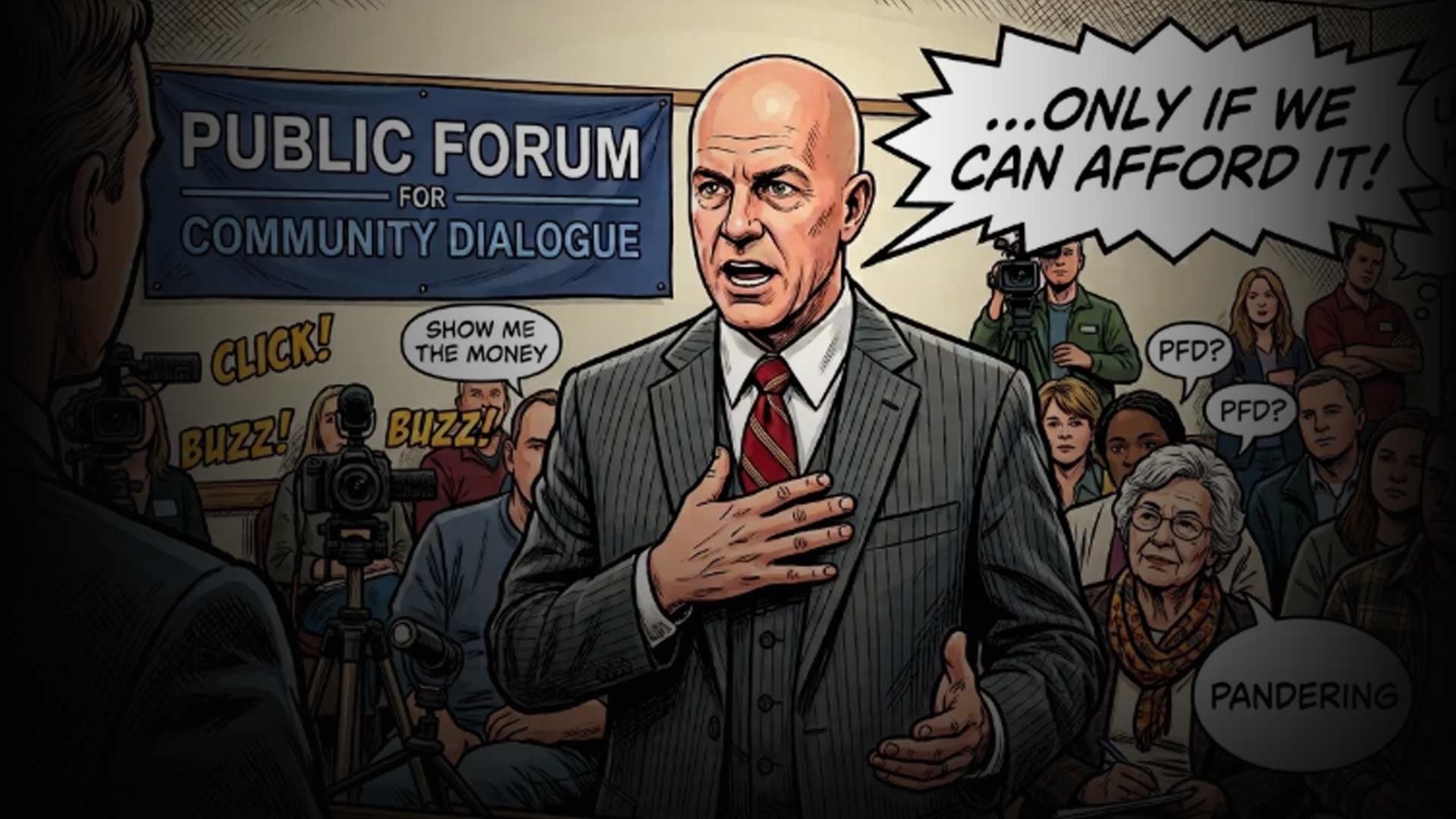
Before election day, you will hear a candidate say it. At a forum, in a mailer, or when a teacher or trooper asks where he stands on the old defined-benefit pension. He looks you in the eye and says: “I support defined benefits, but only if the state can afford it.”
It sounds responsible. It sounds like a man doing math. It is neither.
It is a trapdoor.
A defined-benefit pension is not something you buy at a sale on a Tuesday and check off your list. It is a constitutional promise that stretches 30, 40, 50 years out. A worker who signs on at 25 and retires at 65 collects that first pension check four decades later, across ten governors and twenty legislatures. “Can we afford it?” is not a question you answer once at the register. It gets re-asked every year for the rest of that worker’s life, and the person who has to answer it isn’t in the room today.
Ask him the follow-up, “Afford it when? On whose revenue forecast? At what rate of return?”
I can tell you exactly when Alaska could “afford” the last defined-benefit plan, the whole time it was quietly digging a hole now roughly $7 billion deep, about $46,000 for every Alaskan. Nobody in 1990 said, “We can’t afford this.” The light stayed green until the bill came due on somebody else’s watch. These plans feel affordable precisely when they are becoming unaffordable.
The whole case for reopening rests on one claim – that closing the plan in 2006 caused our teacher and trooper shortage. A new University of Alaska ISER paper, the cleanest natural experiment in the country, found it did not.
To the union member in the front row, the dodge says yes. To the fiscal conservative in the back row, it says, “Don’t worry, I’ll be careful.” It faces both ways and commits to nothing, because “afford” is never defined. That is not a principle. That is a man trying to win a room without telling it the truth.
Ask why the softest “yes,” but only if we can afford it, is suddenly this cycle’s fashionable line. No accident: it comes from the people who want these pensions most.
My opponent is a retired trooper and a former president of the troopers’ union, the Public Safety Employees Association, one of the loudest voices lobbying to bring these pensions back. A man who led that union is not going to be the Valley’s firewall against it. “Only if we can afford it” is just the polite way to hold the door open without scaring you off.
And he is not alone. House Bill 78, the pension bill, is carried by legislators who lean heavily on public-sector union support to win their seats. I do not say that to demonize anyone; some of them are people I work with and will keep working with. I say it because you deserve to know whose interests that line really serves. Too often, the people pushing these bills and the people who collect on them are the same.
The insiders learned that a flat “yes” scares the Valley, so the pitch got quieter: “Maybe, if we can afford it.” Same bill. Same $9 billion risk. Same hand reaching for your dividend. Just a softer voice.
So, when a candidate says he supports a full PFD and a reopened pension and it all pencils out if we’re careful, he is counting on you not doing the math.
Here is what the dodge is built to skip past: even in a year we could afford it, the old pension is still the wrong tool. The whole case for reopening rests on one claim – that closing the plan in 2006 caused our teacher and trooper shortage. A new University of Alaska ISER paper, the cleanest natural experiment in the country, found it did not.
The slogan does not survive contact with the evidence.
The structure is a bad deal on its own terms. The old pension pays off your final salary, the reason you hear “sorry, gotta grab the overtime, I’m in my high-three years,” not off what you actually put in. It handcuffs a mobile workforce to one employer and shortchanges anyone who leaves early. When markets fall short, the state must top up the plan, exactly when it can least afford to. Ask Detroit, which cut “guaranteed” pensions in bankruptcy. Ask Rhode Island, which clawed benefits back from retirees. “Defined” turned out to be a suggestion.
And every dollar comes out of the same pot. Each $1 billion in new pension liability is roughly $1,500 less per Alaskan in future dividends. Under the Reason Foundation’s realistic scenario, the version we already fought runs about $17,000 per Alaskan, on top of the $46,000 we still owe on the last one. The Legislature already pulled $1.66 billion out of the statutory PFD this year because there wasn’t room for everything. Billions in new promises won’t make room. They guarantee deeper cuts to your dividend and your kids for 30 years.
ALASKA WATCHMAN DIRECT TO YOUR INBOX
So, when a candidate says he supports a full PFD and a reopened pension and it all pencils out if we’re careful, he is counting on you not doing the math.
I won’t insult you with “only if we can afford it,” because it is a non-answer dressed up as prudence. My opponent answers to the public sector unions, the Juneau Democrat coalition, and the insiders who write these bills and cash these checks.
I answer to the Valley, to Talkeetna, and to Healy.
So here is where I stand, no trapdoor: I will never vote to reopen a system that already has $7 billion leftover unfunded from the last debacle, that the evidence says won’t fix retention, and that will get paid for out of your dividend. What I will build is a retirement Alaskans can count on, one where the benefit flexes with the market so the budget, and your PFD, never take the hit.
When you hear the dodge, you will know it for what it is. Make them give you a real answer.
I already have.
The views expressed here are those of the author.





7 Comments
Representative McCabe, Thank you for your information and insights as to “tricks” that are used. We appreciate you and pass along the information to our database!
Repubiconmen! Maccabe is one!
We are experiencing a manpower drain because people like McCabe can’t bear the thought of a smart and well-informed electorate. We could afford pensions just fine when fraudsters conned us into killing them, and we can afford them now. Perhaps McCabe should consider how much grift (legal or otherwise) he and his pals have tendered to extraction carpetbaggers?
Sure.. If you want to go down the same road as California did with their public employee pension plan. It must be awesome to make more money after retirement than working. /s
Thank you Representative McCabe for addressing the endless economic black hole that is defined benefit plans. Please stand firm against and please continue to illustrate the background of Mr Massie that would make him one of many that is beholden to the public sector unions.
It’s interesting to hear Representative McCabe lecture everyone else about why defined-benefit retirements are too risky—after spending a career earning retirement benefits he can count on.
A military retirement. An airline retirement. Now he wants to tell Alaska’s teachers and troopers that retirement security is a luxury the state simply can’t afford.
That’s easy to say when your retirement is already paid for.
No one is arguing Alaska should recreate the mistakes of the past. The real question is whether we can build a modern, sustainable retirement system that helps recruit and retain the people we ask to educate our children, protect our communities, and serve this state.
Apparently, retirement security is a great idea—as long as it’s his, not yours.
Military retirement is $1200/Mo after 20 years. Airline reirement is pretty good….but it was a 401K defined contribution that i manage(d). it has returned north of 15% and is totally transferrable to my heirs when i die. A DB plan is among the worst plan for our great retirees. Even the military no longer offers a full DB plan.
tm