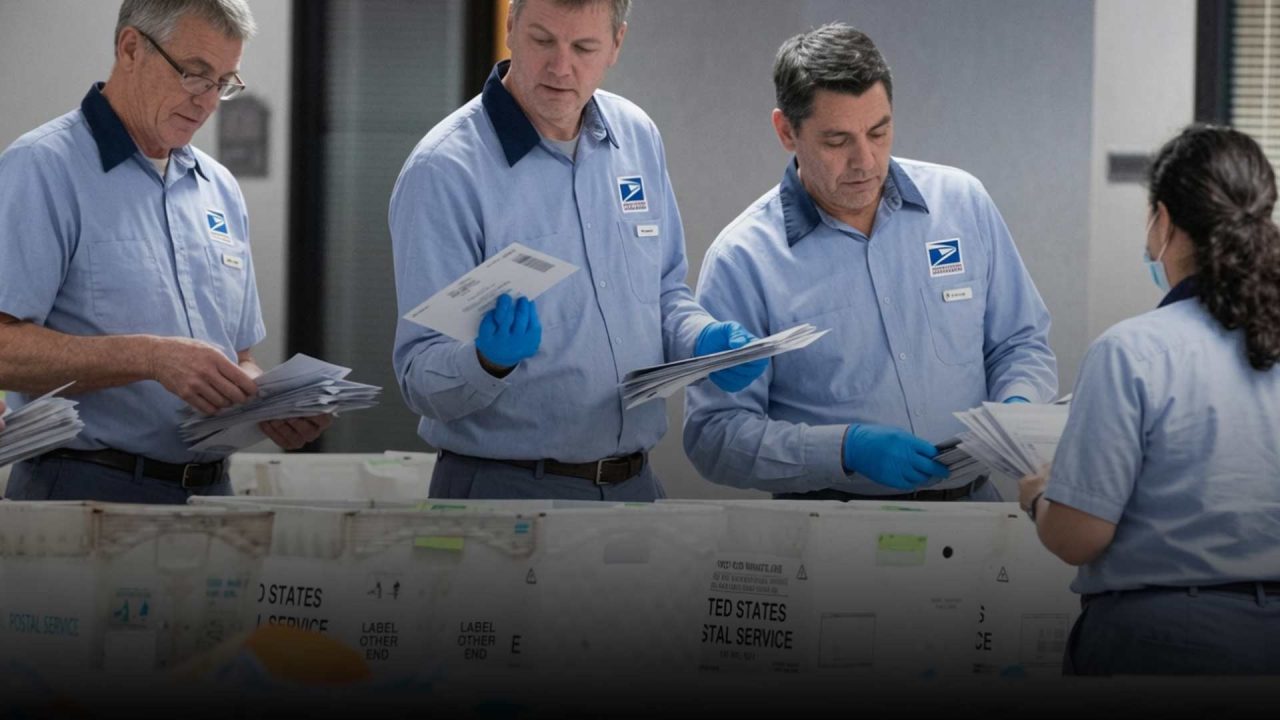

Juneau’s official tax bill notice has inadvertently raised questions about the city’s heavy reliance on the U.S. Postal Service to facilitate its mail-in-only ballot system.
A strange phrase appears across the top of the property tax bills that were recently sent to Juneau residents: “Stop playing USPS roulette and pay your CBJ Property Tax bill online!”
The warning spurred prominent local resident Angela Rodell to pen a column that recently ran in the Juneau Independent. Rodell notes that the tax-bill warning suggests the city “no longer trusts the mail to reliably get a check from a resident’s kitchen table to City Hall in time. It wants people to skip the postal system entirely.”
In a June 26 notice, the City and Borough of Juneau told property owners to expect their mailed 2026 annual property tax bills soon, but it added that those who don’t get a tax bill in the mail should contact local officials to find out what happened.
Rodell’s column questions why the city is confident when it comes to mail-in ballots, but leery when dealing with mail-in tax bills.
“[W]hen it comes to the single most important thing a local government asks its residents to do — vote — CBJ’s answer is the opposite,” she writes. “Voting here isn’t just mail-optional. It’s mail-only, mail-by-default, mail-as-the-whole-system.”
This begs a serious question for the former CEO of the Alaska Permanent Fund Corp and past Commissioner of the Alaska Dept. of Revenue.
“The city that warns you not to gamble on the post office for a tax payment asks you to trust that same post office with your ballot,” Rodell continues, adding that Juneau’s vote-by-mail system might deserve a second look.
ALASKA WATCHMAN DIRECT TO YOUR INBOX
In May of 2020, Juneau adopted a mail-in-only vote system for its municipal election, a move that drew some criticism because of the known fraudulent abuses and technical challenges associated with widespread mail-in voting. This includes sending multiple ballots to the same address, as occurred in 2024, residents not receiving their ballots in the mail, and difficulties ensuring the ballots are actually being filled out by the correct people.
As Rodell points out, the elections department prints more than 28,000 local ballots in Everett, Washington, before mailing them to individual voters’ homes in Alaska. Last year, just 10,263 of those ballots were returned, while nearly 18,000 were lost or thrown out.
In addition to the local government’s heavy reliance on the postal system, Juneau residents pay a heavy price for doing away with traditional in-person voting.
“Ongoing costs were expected to run roughly $200,000 more per year than a conventional election on top of nearly $1 million spent to launch the system in 2020,” Rodell observed.






12 Comments
One vote in person on Election Day, with ID. YES with ID.
If you’re dead, illegal or just don’t live in Alaska, then you can’t vote here. End of story.
As you know, Alaska is the biggest state, and a huge number of Alaskans live in wild, sometimes hundreds of miles from polling places. Should mail delivery of ballots be an option for them?
First of all, that is NOT a huge number, but there are some. Those people who live far from a polling place also live far from a post office. So traveling to cast your vote would be no more difficult than traveling to the post office to mail it. If you are too remote to even get to a post office or polling place, that is a trade-off that living remote creates. I know, I have had to charter a plane to get to a post office.
This is just the tip of the iceberg in Alaska’s election process. We have so much potential, or actual fraud in our elections system now. It’s a main point in the Democrat’s party platform. U.S. Sen. Elissa Slotkin, D-Mich., said “the SAVE America Act would make it difficult for Democrats to prevail in elections across the country”. Why? Because, in a secure election process the Democrats would not have a easy method of inserting fraud into our elections system. And let’s not forget Lisa Murkowski wants foreigners the opportunity to vote in our elections. With a free and fair election Lisa Murkowski would lose her (our) Senate seat. In a reply from Lisa she uses the same lame excuse that Paul Hart uses. And I fully agree with “daddio” if you chose to live in the bush it’s because you want isolation, with that comes a cost and the rest of us should not be responsible for changing our election day, nor system to suit your needs.
Daddio so Right, I’ve been to many of these remote villages also. Mail in voting is just plain cheating.
All of these villages have a polling place. Then after the election is over. The secured ballot box from everyone’s vote, that night. Would be shipped via a plane, under lock and key to be counted at the official office in Juneau. No extra ballots being found along the way.
If people wish to participate in “our democracy”, they will find a way to participate. If it is not that important to them, they won’t. No need to have such a vast and expensive (corruptible) outreach program. Refine it, make it simple, remove the bloat that leads to corruption.
Stop making excuses for People of Votes to be lazy.
You’re wrong there. They come into town to get their mail. Now whether they come into town in a timely manner to get their ballots, is on them. If they really want to vote, they’ll plan their trip to come into town on election day. There is no “huge number”. 90+% of Alaskans live on the road system. With your logic- send me the covid vaccination through the mail and a card stating I took it. You trust me, right…? /s
Pony Express or Balto, or perhaps Carrier Pigeon is cheaper and more reliabilie than USPS. Took two weeks to get a first class letter the 13 miles from Palmer to Wasilla. Two months after tracking a pkg from Seattle to Anchorage, UlSPS gave up in Arkansas.
I send anything official only by certified mail with also the return receipt card. I would never ever choose to vote by mail but if by some bizarre chance I had no choice I would send that also in same manner.
The problem with that certified mail process is that your ballot would probably not be received by election officials until after the deadline.
I have a friend who lives in Alabama. His absentee ballot was mailed on June 2 by the election office. He received his ballot on June 22. Guess what? The election was June 16. We should never trust any government agency to control the outcomes of our elections.
Once 100% vote by mail was passed in California as well as ballot harvesting being legalized , there has only been a handful of republicans elected to any offices here . The NGO’s handling all of the registration duties and harvests are totally dependent on on government handouts therefore continuing the fraud , remember , fraud only happens when “fraud ” is illegal . In California it is not , it’s just called something else