


By: Alaska State Representatives Kevin McCabe, Sarah Vance, and Jubilee Underwood.
There is a graphic going around social media made to look like a dollar bill with Jay Hammond’s face on it. It tells Alaskans that on April 19, 2026, the Legislature voted to cut the full Permanent Fund dividend out of the budget, and that the vote was unanimous, 40 to 0.
Before sharing it, go to akleg.gov, open the House Journal, and read page 2057.
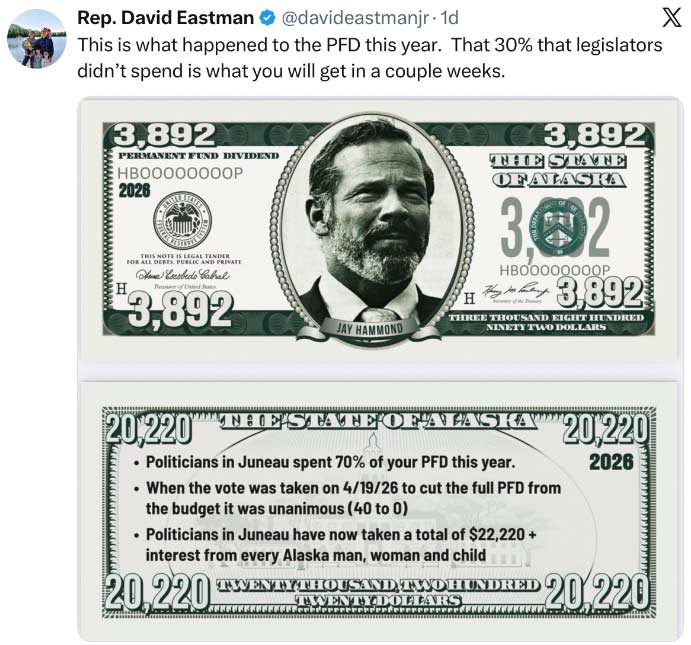
Here are the facts. On April 8, House Bill 263, the operating budget, was before the House. The Majority Leader moved that the House Finance Committee substitute be adopted as the working version of the bill and asked for unanimous consent. The journal records the result in four words:
“There being no objection.”
That was not a 40-to-0 vote. There was no roll call vote at all.
Committee substitutes are adopted this way, all the time, because we need a working version before we can debate and amend it. Nobody is voting on the PFD when that motion is made, or education, public safety, or any other line in the budget. We are deciding which draft we are going to work from, because debating and amending a bill everyone in the chamber knows is about to be replaced, burns days we do not have. Unless somebody objects, we move on.
You can see what an actual vote looks like two pages later. Amendment No. 5 went to a roll call and passed 21 to 19. The journal lists all 40 members by name, yeas and nays. Nothing like that appears for adoption of the committee substitute because nobody requested a vote.
So, the 40 to 0 tally is not a misreading of the record. It is not in the record at all. It is a number placed on a picture of a dollar bill and offered to Alaskans on faith, in an election year, by a former legislator describing a floor session he has not sat in since January of 2025.
And the date is wrong. The graphic says April 19 (A Sunday). This happened on April 8. On April 16, three days before the date he now claims the vote occurred, the same author commented on a column by Greg Sarber in the Alaska Watchman, claiming it happened April 8. He had the date right then.
But here is the part that matters most. Read three lines farther down page 2057: “The Speaker stated that, without objection, Amendment No. 1 would be moved to the bottom of the amendments.”
McCabe offered Amendment No. 1. It locked in the full statutory dividend of roughly $3,800 and functioned as a pseudo spending cap, forcing an honest debate about what state government actually costs. On April 8 it was set aside to be taken up last.
Alaskans have every reason to be angry about what has happened to the dividend. We are as well. But the PFD was not broken by a procedural motion in April 2026.
It came back two days later, on Friday, April 10. Representative Calvin Schrage offered an amendment that cut the dividend in that amendment to roughly $1,500. Two Republicans joined the majority to adopt that change. At that point, the amendment no longer did what it was written to do, so McCabe moved to withdraw it rather than let it become the vehicle for cutting the dividend. The House refused to let him withdraw it, with a single Republican joining the majority to keep it alive. The rewritten amendment then passed 23 to 17.
That is the vote. It has a date, a roll call, and forty names attached to it. It happened April 10, not April 19. It was not unanimous. And the graphic does not mention it.
He had the right page. He read the wrong line.
Wrong vote, wrong date, wrong direction. As usual, wrong on all counts.
By the time the budget gets to the floor, the chances of a full PFD amendment are almost nil. A vote for a budget is not a vote against the PFD. That is a nonsensical idea.
However, a real grievance underlies all of this, and that is why getting it right matters. Alaskans have every reason to be angry about what has happened to the dividend. We are as well. But the PFD was not broken by a procedural motion in April 2026. The real fight started years ago.
So, when somebody asks for your vote this fall, forget the imaginary 40 to 0 tally and ask about a vote that may actually happen…
Jay Hammond and Clem Tillion built the dividend around a simple idea. A share of Permanent Fund earnings would go to Alaskans under a formula instead of becoming another pot of money for government to spend. Hammond understood what happens when politicians see a pile of money. Eventually somebody finds a government program that desperately needs it.
That system collided with political reality in 2016 when Governor Bill Walker vetoed roughly half the dividend appropriation. Clem Tillion, Senator Bill Wielechowski and former Senate President Rick Halford went to court, arguing that the statutory transfer did not require an annual appropriation and therefore could not be reduced through the normal veto process.
They lost. In 2017, the Alaska Supreme Court ruled that Permanent Fund income is subject to the normal appropriation and veto process. Then, in 2018, SB 26 changed the statutory framework as well. Where the old dividend law had directed money to be “transferred” from the earnings reserve to the dividend fund, the new system expressly depended on money being “appropriated.”
That distinction matters. The court had already settled the constitutional question, but SB 26 brought the statute into the new reality. What Alaskans had understood for decades as a formula-driven transfer was now expressly tied to an annual appropriation.
That is the real problem. A statute can be changed. An appropriation can be reduced. A governor can veto it. We watched all three happen. Writing another promise into statute does not change that.
ALASKA WATCHMAN DIRECT TO YOUR INBOX
If Alaskans want the dividend protected from the annual political budget fight in Juneau, the real question is whether that protection belongs in the Alaska Constitution, where legislators and governors cannot change it by themselves.
So, when somebody asks for your vote this fall, forget the imaginary 40 to 0 tally and ask about a vote that may actually happen:
Will you vote to put a constitutional amendment before the people of Alaska so Alaskans themselves can decide whether the dividend should be protected from the annual appropriation process?
That answer is checkable.
And when that vote happens, it really will be in the journal.
Editor’s note: Rep. Kevin McCabe represents House District 30. Rep. Sarah Vance represents House District 6, and Jubilee Underwood currently represents District 27.
The views expressed here are those of the authors.




15 Comments
Hint:
Cut the budget FIRST, then give away the free money. Because every time I hear somebody talk about taxes (income, sales, or both) to maintain current spending, and talk about a “full dividend” out of the other side of their mouth, you lose me. Every time.
Don’t give me money, then tax it away, and then call yourselves patriots.
Dunleavy included a full PFD in this year’s budget. I give him credit for that. No committee can take it out without their recommendation being ratified by the full House of Representatives. In 2024, my last year in the legislature, the vote was 39-1 to keep the full PFD in the budget. This year it was 40-0 when the entire house ratified the committee’s recommendation to remove the full PFD from the governor’s budget. You didn’t have to go along with the Democrats in 2024, and you didn’t have to go along with the Democrats this year either. Please fight back when the Democrats are doing things like cutting the PFD. By voting with them you just become part of the problem.
Very well said!
No, if there is no objection then that means all were ok with that bill. It is sickening that these legislators don’t understand what their vote means.
No Lance you are 100% wrong. The vote to accept a committee substitue has zero to do with the PFD. The vote is merely to accept a certain document as a working document. And by the time it gets to that point the PFD is close to dead. An amendment like McCabe tried to put in is dangerous for exactly the way that happened. The place to fix the PFD is in the financne committee which Foster tried to do this year but was rejected because two republicans voted not to do it. THAT was the last place it could really be fixed. Eastman knows this. But he would rather crap all over everyone than provide factual information. This is the reason he is no longer in the legislature. He sounds good to certain people but in reality he has no idea what he is talking about. His skewed idea of how things actually work is troubling for someone who has been involved. Maybe he just refuses to be able to shift his thinking and try a different path? When things do not work for a decade, maybe it is time to redirect. This, among many things, could have been fixed years ago if not for his antics.
You sound an awful lot like Kevin McCabe. Are you one of his many online pseudonyms? He has too many for me to keep track of. I suspect you know that what you wrote is complete rubbish, but for the benefit of anyone who happens to read it, Kevin’s vote to replace Dunleavy’s budget with the Democrat’s budget killed Dunleavy’s budget (with the full PFD) forever. There was no going back to undo it later. If you can’t muster the 20 votes needed to defend the full PFD in Dunleavy’s budget, you certainly won’t be able to come up with 21 votes (a higher and much more difficult vote threshold) to add it back in after you’ve voted to take it out.
TTaL and E’von,, you democrats always promote shifty/compromise thinking. That’s fine when you’re the winner. News flash; real people you can trust have core principles that are non-negotiable. They don’t need to use legislative tactics to hide their real vote intentions. As rinos continue to spend more time at the surface the republican party shifts left. $50 million plus of campaign dinero sure can by a lot of favors.
“His skewed idea of how things actually work is troubling for someone who has been involved.”
If you’re willing to step out from behind your pseudonym, TTAL, and debate David on this I’m sure he would be willing to oblige. Pretty sure that goes for the OP-ed authors as well, whoever they actually are.
To McCabe, Vance, and Underwood:
Why didn’t you object to the motion to substitute the Finance Committee’s budget? Why not force a vote on the record? Your failure to object is a de-facto yes vote to cut the PFD as far as I’m concerned.
Dang. Get over this nonsense that the dividend belongs to individuals not the State. So tired of this disagreement. At least twice a year, wanks like me and wanks like you plow the same ground. Let’s end it. Let’s come up with some modest “buyout” and retire the thing. Then we can spar about other things.
Alaskans wake up, we need to vote out, ALL these Lame, Scared, Republicans who don’t have a backbone.
Once again, we are reminded of the reasons that they continue to keep their Legislation activities, and chamber “”down there in Juneau””.
Let’s keep beating this dead horse again. The politicians will never let their grip go on the permanent fund earnings for your share of the permanent fund dividend now that it is funding the governement since 2016. They don’t have to worry about it since voters won’t hold them accountable. There is no political downside to keep doing what they are doing with your money every year to fund the State budget. Be happy with your $1,200 Permanent Fund dividend/energy relief payment instead of the $3,650 it should have been in 2026.
can u go to ur neighbors house & install a camera on HIS property to watch him? no, u would get arrested. representatives r suppose to think this way. can I steal my neighbors money? no, arrest. that is y I hammer they have no authority. look up COLOR, COLOR of law, COLOR of office. color means pretense fraud color of office is the act of an officer who claims authority to do the act by reason of his office when the office does not confer on him ANY SUCH AUTHORITY. BLACKS LAW 6TH EDITION
Frauds and sociopaths. The Alaska uniparty.