
There is an old and simple idea at the heart of self-governance: citizens should be able to see their votes counted – not trust that a machine counted them correctly or rely on a vendor’s assurance that the software worked as advertised. Voters deserve to actually see it with their own eyes, in their own community, conducted by their neighbors.
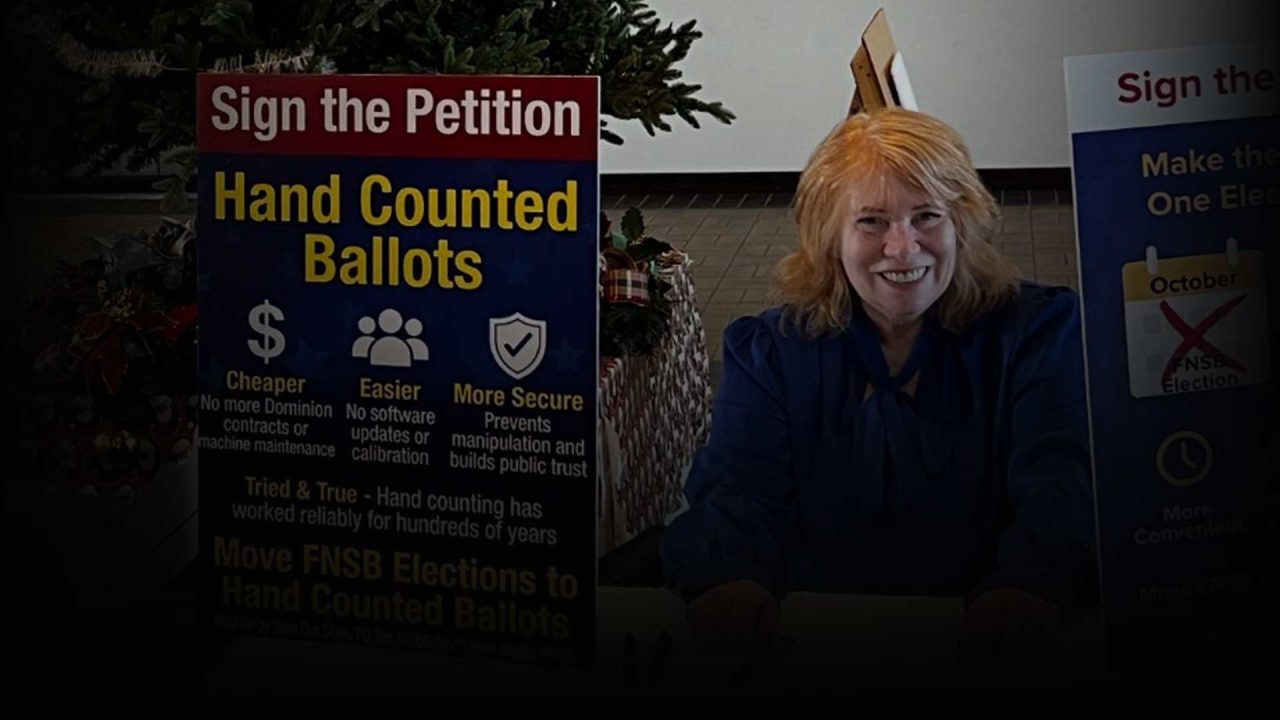
A citizen petition now circulating in the Fairbanks North Star Borough asks the Assembly to return to hand-counted paper ballots. The case for it is moral, practical and fiscal. Fairbanks residents who care about honest elections, responsible stewardship of public money, and local community over distant corporate interests should take notice.
Sending Borough Money Out of State
The FNSB owns its Dominion voting machines outright, yet the bills keep coming in, and that money keeps leaving Alaska.
Every year the borough sends $41,000 to $44,000 outside the community for software licensing, programming, warranties, and vendor support. Over five years that’s roughly $219,000. In 2022, when the state stopped lending equipment, FNSB spent another $217,000 on new tabulators and accessories. Earlier capital purchases in 2020 pushed total machine costs into the hundreds of thousands. A proposed Elections and Records Center to store and maintain the equipment has been estimated at several hundred thousand to $2.5 million.
Day-to-day costs add up too — hauling machines to every precinct, pre-election testing, training 200 to 250 workers, ballot stock, post-election audits — all of it drawn from the general fund, which means property taxpayers.
Hand counting changes where that money goes. There are no licensing fees, no vendor contracts, no out-of-state corporation drawing income from our elections. Workers are paid locally and the money stays in Fairbanks, where it belongs.
What Mat-Su Did
The Mat-Su Borough was paying $72,257 per year to lease Dominion machines. In 2022, they walked away from that contract. Beginning in 2023, they required full hand counting, conducted in public view.
The lease savings were immediate. Hand counting does require more workers. The Mat-Su clerk has been straightforward about that, but those workers are Alaskans, paid with money that circulates in their own communities. Mat-Su solved the logistics sensibly: one team works the polls; a second team counts ballots after closing. In borough elections, results came in within hours.
The full accounting is still being studied and we won’t overclaim. The basic trade is clear: a recurring payment to an out-of-state vendor, replaced by wages paid to your neighbors.
It’s Already the Law — and Already Working
This is not a novel idea. Alaska statute AS 15.15.350 explicitly recognizes hand-count precincts and requires that ballots in those precincts be counted in public, with watchers present to see every ballot opened and read. The legislature wrote this into law as a standard method, not a fallback.
More than a quarter of Alaska’s 402 voting precincts currently hand-count their Election Day results — over 100 precincts, functioning well, election after election. The Kenai Peninsula Borough is now considering the same switch Mat-Su made. This is a proven, lawful, and increasingly common practice across the state.
If Hand Counting Checks the Machines, Why Do We Need the Machines?
After the 2025 FNSB election, researcher Edward Solomon examined the official digital record of every ballot processed by the Dominion machines. Using the unopposed Assembly Seat B race as a neutral baseline, he studied how ballots from different partisan groups moved through the count across multiple races.
What he found was troubling. Voters on opposite sides of the partisan divide moved in near-perfect lockstep throughout the count — a pattern too precise to reflect the natural variation of thousands of individuals casting ballots at different times and locations. When he reshuffled the ballots while preserving their partisan makeup, the pattern vanished. It was tied to the sequence the machines used, not to the votes themselves.
This does not prove fraud. It raises a question every citizen has a right to ask: if something looks wrong in the machine data, can residents actually examine it? With proprietary software the public cannot access, the honest answer is no.
FNSB’s own post-election audit — conducted by hand counters checking early voting and two precincts — matched the machine totals exactly. The borough points to this as proof the machines are reliable. Consider what that argument concedes: the only check on the machines is a hand count. If hand counting is what verifies the machines, and hand counting works – what exactly are the machines for?
The Objections Don’t Hold
— It will cost more. More workers, yes — but those workers live here. Every dollar in wages stays in Fairbanks. Vendor fees and licensing payments do not. The question is whether we would rather pay our neighbors or pay Dominion.
— Results will be delayed: Mat-Su gets results the same night using two worker shifts. FNSB already employs hundreds of poll workers. This is a scheduling question, not a fundamental obstacle.
— It isn’t accurate enough: Alaska law requires hand counts to be conducted in public with party observers present for every ballot. FNSB’s own audit confirmed hand counts match machine totals. More than 100 Alaska precincts hand-count every election without incident.
Stewardship and Transparency
Good stewardship of public resources means spending wisely and spending locally. It means declining recurring contracts with outside vendors when a proven, cheaper alternative exists closer to home. It means being able to look your neighbors in the eye and show them exactly how their votes were counted — rather than asking them to trust a machine they cannot inspect, running software they cannot read, maintained by a company they have never met.
Every ballot counted by hand is counted in the open, by members of this community, with observers from both parties watching. We already use paper ballots. The only question is whether we need the machines, the contracts, and a potential multi-million-dollar storage facility to count them.
Alaska law permits the alternative. Over 100 Alaska precincts already practice it. Mat-Su proved it works. It is time Fairbanks chose its neighbors over its outside vendors.
Sign the petition and contact your Assembly members. Our ballots — and our budget — deserve better.
The views expressed here are those of the author.






2 Comments
It is better for Alaska to pay Alaskans to count ballots and for Alaskans from both parties to watch, This is the small business approach which keeps more money in Alaska, Keep as much $ at home as we can…
Plus, No more mail in voting either.
One vote in person on Election Day with ID YES with ID