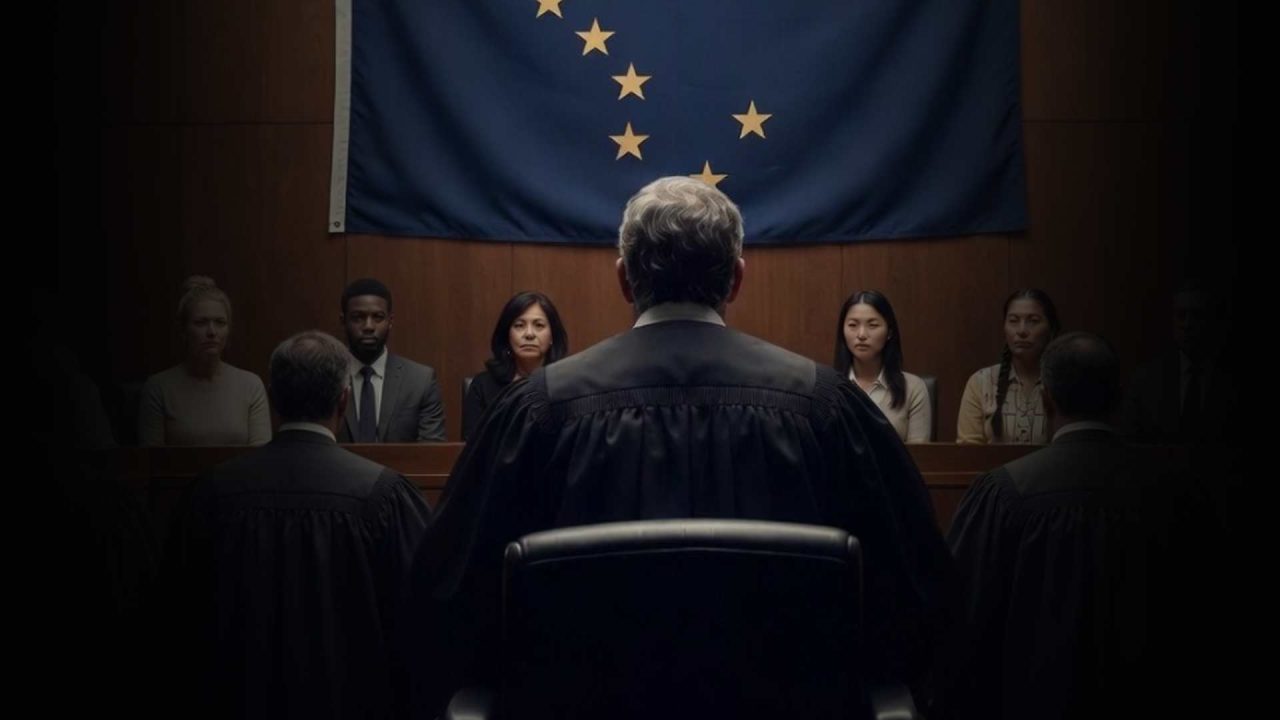

In a detailed new law review article published in the Harvard Journal of Law & Public Policy, authors Savannah Shoffner and Richard W. Garnett argue that Alaska’s Constitution explicitly protects the citizen grand jury’s historic “investigative” or “reporting” power as a vital check against government misconduct and inefficiency. The provision, found in Article I, Section 8, of the State Constitution declares: “The power of grand juries to investigate and make recommendations concerning the public welfare or safety shall never be suspended.”
This language, the authors contend, enshrines a robust right for grand juries far beyond simply approving or rejecting prosecutor-driven indictments. Instead, it positions grand juries as an independent intermediary between the people and their government – one empowered to expose neglect, corruption, or policy failures and issue public recommendations, even absent a formal criminal charge.
Shoffner and Garnett note that, unlike older Eastern states, Alaska’s founding occurred during the Warren Court era, when living constitutionalism influenced some framers. Yet the authors stress that the enacted text controls interpretation.
The authors highlight that Alaska courts and executives should not screen citizen petitions that are brought to grand juries or suppress reports on public welfare issues. Grand juries can initiate investigations or respond to citizen complaints, producing statements that inform policy without needing to result in charges, they maintain. This preserves their role as a “neighbor-intermediary.”
These influences reflected a deliberate choice to preserve the grand jury’s historic watchdog role amid national trends narrowing it.
The article draws on deep historical roots. Grand juries trace back to medieval England, where citizen panels sworn to tell the truth informed kings and later parliaments about local conditions. By Blackstone’s era in the 18th century, they served multiple functions: issuing indictments, but also issuing “presentments” or reports on broader public matters. These bodies, composed of respected local figures, acted as the “voice of the community” and an “official organ of public protest.” Colonial American grand juries continued this tradition, petitioning authorities about royal governors and general grievances.
As states formed after independence, many constitutions required grand jury indictments for serious crimes, but the reporting function faced pushback in the 19th and 20th centuries. Critics worried that reports criticizing officials without sufficient evidence for indictment could amount to unfair public defamation. Some states curtailed or banned such reports through statute or court rulings. Yet Alaska, drafting its constitution in 1955–56 ahead of statehood, chose to protect this power.
At Alaska’s constitutional convention, Delegate Barr proposed the language, emphasizing its importance. He viewed the investigative duty as one of the grand jury’s most critical roles in protecting citizens’ rights. Delegate Hellenthal supported a broad interpretation, noting that federal grand juries in territorial Alaska already issued wide-ranging reports on jail conditions, mental health policy, and government operations. Contemporary news accounts, such as a 1955 Fairbanks Daily News-Miner story on a federal grand jury blasting “deplorable” jail conditions and recommending policy changes, illustrated the practice in action.
ALASKA WATCHMAN DIRECT TO YOUR INBOX
The delegates drew inspiration from Missouri’s 1945 constitution, which similarly shielded grand juries’ power to inquire into official misconduct. New York’s provisions offered another model, protecting inquiries into public officers even without immediate indictments. These influences reflected a deliberate choice to preserve the grand jury’s historic watchdog role amid national trends narrowing it.
Critics at the convention, like Delegate Buckalew, raised concerns about reputational harm to officials from reports lacking full indictment-level evidence. The authors acknowledge this tension but argue the constitution resolves it in favor of transparency and accountability. History shows grand juries balanced deliberation with community representation, filtering raw public sentiment through sworn, local citizens.
In modern Alaska, where heated controversies over government efficiency, public safety, and resource management remain paramount, this constitutional protection could empower grand juries to address systemic problems without prosecutorial gatekeeping by government entities. The authors conclude that suspending or unduly restricting this power would violate the original understanding embedded in the state’s foundational document.






5 Comments
Awesome article, thanks Joel! It vindicates everything David Haeg and the Alaska Grand Jurors Association have been saying for years. Now we need a brave governor willing to restore our grand jury rights in Alaska.
We can change the last paragraph,: “would restrict” to “is restricting” . Timely article, so important to restore constitutional grand juries in AK. I have lived/voted here over forty years and only summoned twice for jury duty, once each state & fed. I know many who received six or more invites in less years. I’m not asking but am willing to serve. The question is who and how are jurors actually selected? It obviously places an unequal duty on some. Run the alphabet then start over to afford everyone an equal chance to serve while removing any suspicion of selectivity.
Would violate
Great article, now if we could just elect a governor that will return us to the intent of the State’s Constitution all will be good.
it only took one judge to steal our pfd